


In this article, I will overview the Top Web3 API and RPC Development service providers with reliable Blockchain Infrastructure, scalable RPC endpoints (HTTP/WebSocket), dev-centric APIs, and multi-chain connectivity.
These service providers help companies and Dev teams to build, deploy, and scale their appes and products that rely on blockchain based infrastructure with ease while maintaining extreme simplicity and complexity in managing distributed blockchain infrastructure and nodes across different networks.
Key Points & Best Web3 API and RPC Development Companies
| Provider | Explanation |
|---|---|
| QuickNode | Provides fast global endpoints, low latency, and reliable multi-chain infrastructure for applications. |
| Alchemy | Offers developer-focused infrastructure, powerful debugging tools, high limits, and enhanced reliability. |
| Infura | Provides stable infrastructure with comprehensive services and strong MetaMask ecosystem integration capabilities. |
| Chainstack | Delivers managed global nodes, dedicated infrastructure, and flexible subscription plans for developers. |
| Dwellir | Offers transparent one-to-one request pricing across 140+ networks without complex calculations. |
| dRPC | Uses decentralized infrastructure, flat-rate pricing, and built-in protection against MEV attacks. |
| Ankr | Connects applications through globally distributed decentralized nodes supporting multiple blockchain networks worldwide. |
| Moralis | Provides high-level Web3 APIs, clean indexing, and rapid decentralized application backend integration. |
| Blockdaemon | Delivers institutional-grade node management, strong security, and professional validator staking infrastructure. |
| GetBlock | Provides instant flexible JSON-RPC access to shared and dedicated nodes across protocols. |
10 Best Web3 API and RPC Development Companies
1. QuickNode
QuickNode builds fast Web3 infrastructure including RPC endpoints for blockchain connectivity to support Decentralized Applications (dApps). Developers no longer need to spin up individual nodes to connect to blockchains across the globe.
QuickNode’s capabilities are ideally suited for high traffic DeFi applications, NFT marketplaces and wallets, blockchain games, trading APIs, and other Web3 products.
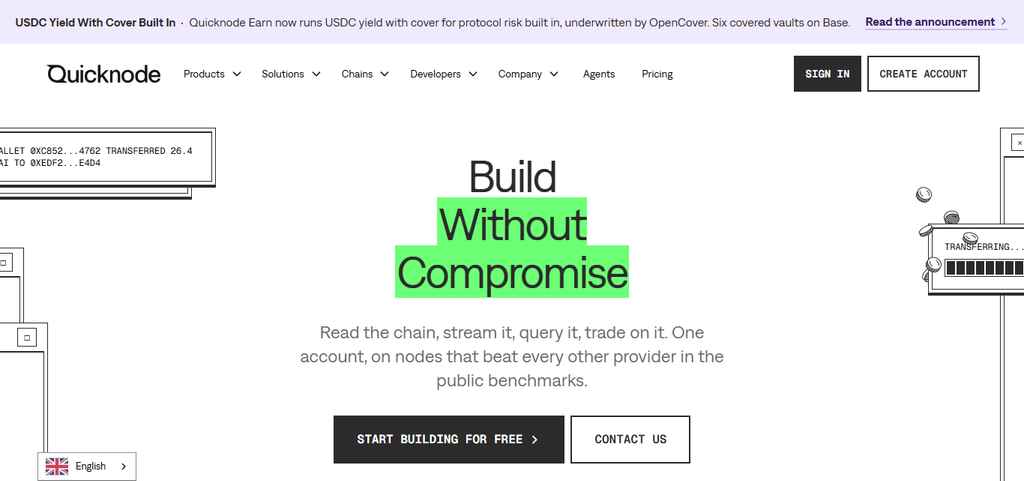
QuickNode’s infrastructure helps developers optimize performance of their applications with high availability and low latency connections. QuickNode’s infrastructure is built for the demands of the global economy across multiple blockchain networks.
QuickNode Features
- Global RPC Infrastructure: Offers fast, global RPC endpoints with low latency for dApps to connect with multiple blockchain networks.
- Low-Latency Performance: Develops high performance, low latency blockchain infrastructure designed for applications that need real-time data and transaction processing.
- Multi-Chain Support: Allows developers to build Apps within multiple blockchain ecosystems without the burden of managing individual nodes.
- High-Traffic Applications: Empowers you to build high performance, scalable DeFi, NFT marketplaces, wallets, games, trading applications and more.
2. Alchemy
Alchemy builds developer tools for the Web3 ecosystem to simplify the development and improve the performance of blockchain applications. Alchemy offers RPC, APIs, developer tools, monitoring and debugging services, all integrated to help developers build decentralized apps.
Alchemy’s tools are ideal for NFT applications, DeFi apps, wallets, blockchain games, marketplaces and enterprise applications.
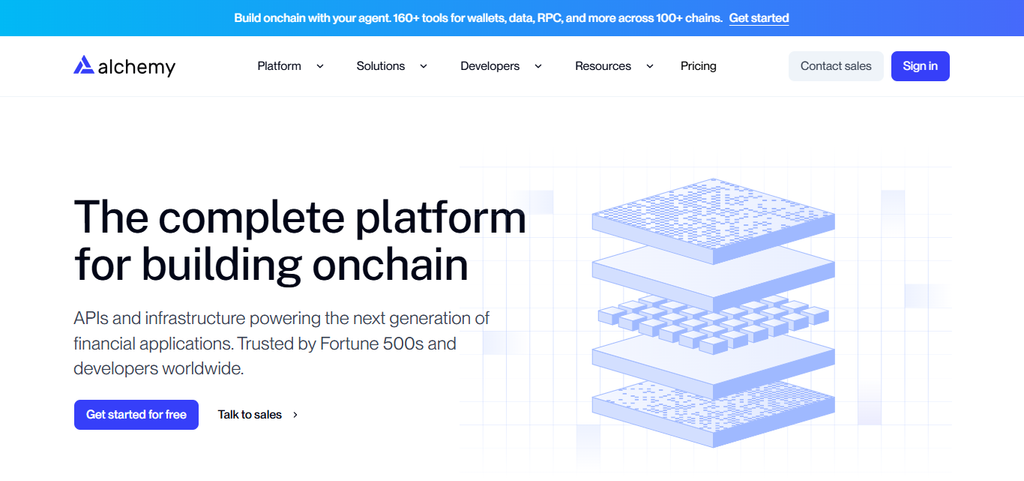
Alchemy is developer centric and therefore is preferred over simple RPC endpoint services. Developers are able to pull blockchain data, communicate with given networks and resolve application infrastructure challenges with Alchemy’s integrated development environment.
Alchemy Features
- Developer-Focused Tools: Delivers RPC Infrastructure, APIs, monitoring, debugging and development tools with a single offering.
- Blockchain Data Access: Empowers developers to retrieve data from all major public blockchains.
- Debugging and Monitoring: Helps development teams resolve issues, enhance Web2 performance and ultimately boost application performance.
- Broad Application Support: Serves an array of solutions including DeFi applications, wallets, marketplaces, gaming applications and enterprise blockchain solutions.
3. Infura
Infura is a Web3 infrastructure company. Infura offers managed RPC infrastructure and APIs for applications to communicate with blockchain networks. Infura has high regard in the Ethereum community and has a close-knit relationship with the wider MetaMask and Consensys community.
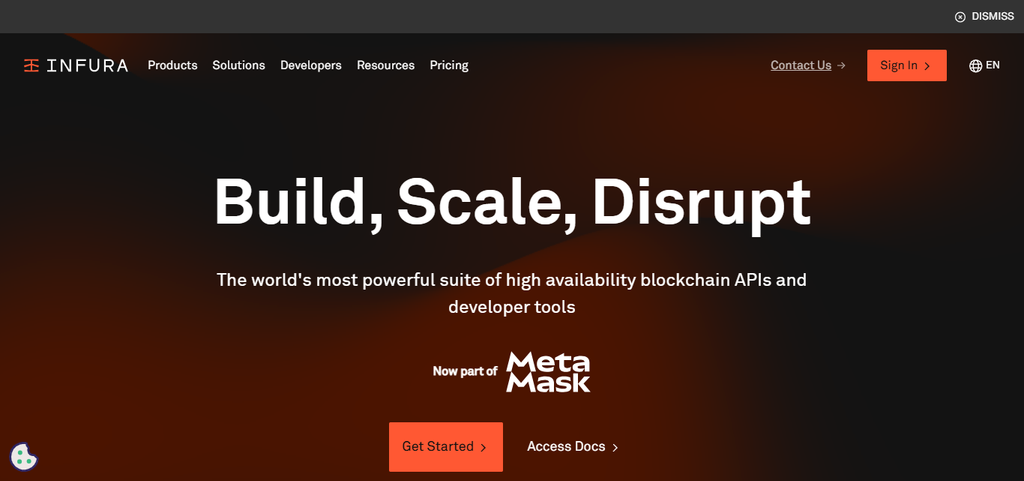
Infura facilitates the retrieval of blockchain data, interaction with smart contracts, the processing of transactions, and the association of apps with the supported networks.
Infura’s infrastructure allows teams to avoid running their blockchain nodes. This makes Infura quite useful for wallets, DeFi apps, and other decentralized services and products built on blockchain.
Infura Features
- Managed RPC Infrastructure: Reliable RPC endpoints and APIs for connecting applications to various blockchain networks.
- Strong Integrations: Strong relationships with MetaMask and ConsenSys ecosystems.
- Smart Contracts: Used by applications to interact with contracts and transact.
- No Node Management: Allows development teams to focus on building and less on blockchain operations.
4. Chainstack
Chainstack offers developers managed blockchain infrastructure with access to managed nodes and RPC endpoints and dedicated infrastructure. Chainstack’s services offer applications the flexibility to configure their infrastructure, all while assuring reliable connection to blockchain.
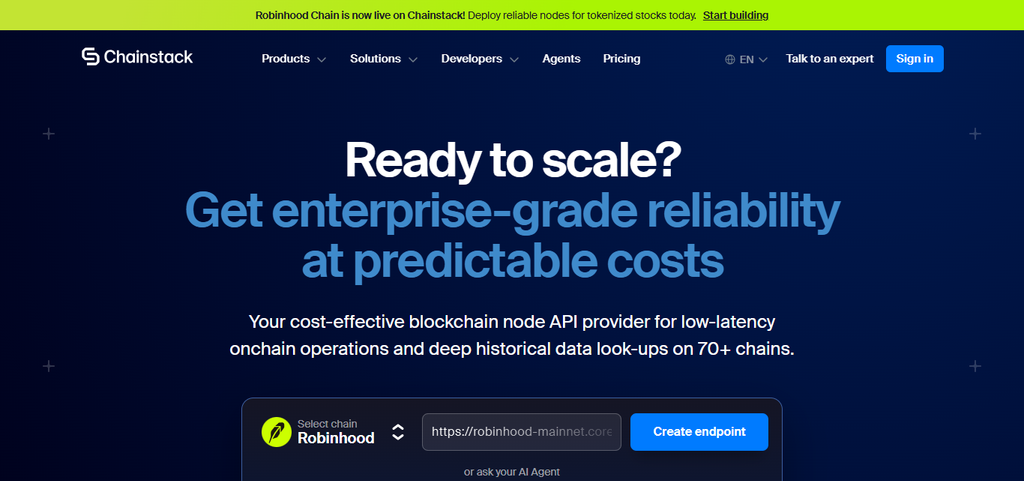
Chainstack’s services are useful for DeFi, Web3 gaming, NFT platforms, analytics, and other decentralized services. Chainstack’s managed infrastructure circumvents the hassle of deployment, configuration, maintenance, updates, and monitoring of blockchain nodes deployed across multiple networks.
Chainstack Features
- Managed Blockchain Nodes: Makes it easy to deploy and manage blockchain infrastructure with RPC endpoints and managed nodes.
- Dedicated Infrastructure: Dedicated infrastructure with greater control and performance.
- Multi-Chain Connectivity: Integrates with multiple blockchain networks, enabling developers to work across different ecosystems.
- Simplified Management: Minimizes hassle related to deploying nodes, configuring and maintaining nodes, and managing node updates and infrastructure.
5. Dwellir
Dwellir uses blockchain infrastructure and RPC services for multiple networks. Dwellir has a section of its website dedicated to explaining their pricing. Infrastructure costs can be hard to decipher to developers and business owners. Dwellir’s pricing is straightforward and request-based.
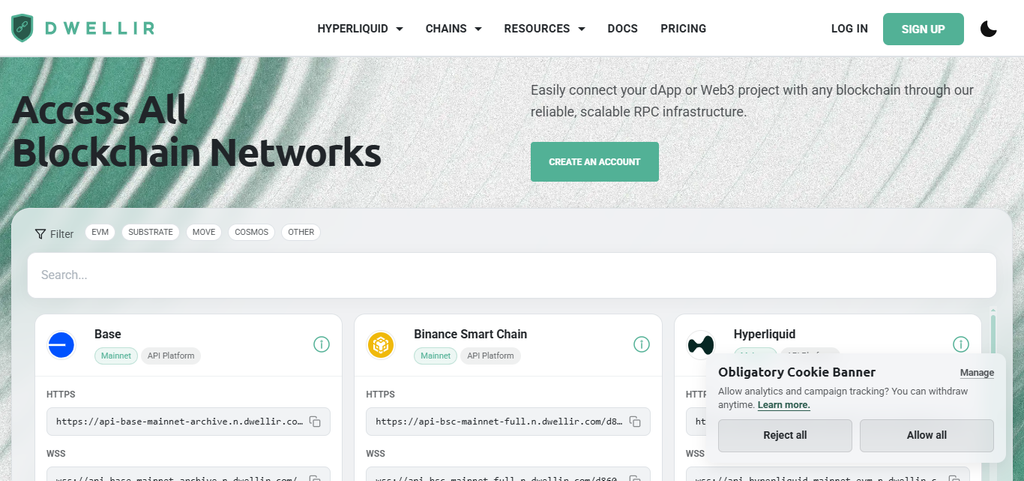
It further states that it has the “largest infrastructure offering of any multi-chain provider,” including access to more than 140 blockchain networks for developers. Developers can build with confidence knowing they will not need to adapt their infrastructure to access multiple blockchain networks.
Dwellir Features
- Transparent Pricing: With straightforward request-based pricing, blockchain infrastructure costs are now more developer and business-friendly.
- 140+ Blockchain Networks: Offering multi-chain infrastructure services, Dwellir gives its users access to over 140 blockchain networks.
- Multi-Chain Development: Using a single infrastructure, developers can now build applications on multiple networks.
- Simplified Infrastructure Planning: Developers can estimate costs for potential infrastructure, without the need for complex calculations.
6. dRPC
dRPC takes an entirely different approach to blockchain RPC infrastructure. Instead of relying on a centralized infrastructure provider, dRPC connects applications to a network of distributed RPC providers, offering infrastructure upgrades to blockchain connectivity.
dRPC pricing is also flat. dRPC offers its services to a variety of Web 3 applications, including DeFi, trading, and wallet applications, as well as blockchain tools and other web 3 gaming applications.
dRPC Features
- Decentralized RPC Network: Decentralized infrastructure gets applications connected with the RPC (Remote Procedure Call) infrastructure via distributed providers.
- Flat-Rate Pricing: Pricing simplified to make forecasting RPC (Remote Procedure Call) infrastructure easier.
- **Infrastructure Resilience:**distributed providers improve infrastructure and offer increased flexibility and redundancy for applications that require reliable blockchain connectivity.
- Web3 Application Support: Focuses on DeFi (Decentralized Finance), Trading, Wallets, Blockchain Games, and other Decentralized Applications.
7. Ankr
Ankr provides solutions for developers to access different blockchain networks without deploying and managing infrastructure for each individual network. Ankr’s solutions are widely used and compatible with many applications in the Web3 world including wallets, NFTs, decentralized applications, analytics, and blockchain games.
Ankr’s distributed node infrastructure spans geographic regions providing connectivity to blockchain networks. Ankr’s architecture ensures development teams need not worry about the many tasks needed to keep a node operational such as deployment, synchronization, maintenance, monitoring for updates, and ongoing management of the blockchain infrastructure.
Ankr Features
- Distributed Node Infrastructure: Geographic node distribution helps applications connect to blockchain networks.
- Multi-Chain Access: Using a single infrastructure, developers can connect to multiple blockchain networks.
- Reduced Infrastructure Management: Infrastructure responsibilities are reduced to deploying nodes, configuring nodes, keeping nodes synchronized, and monitoring the nodes.
8. Moralis
Moralis’ platform provides high level Web3 APIs and blockchain data infrastructure to make building decentralized applications more simple and efficient. Moralis’ APIs include structured access to data such as wallet activity, tokens, NFTs, transactions, as well as other data that fall under the Web3 data umbrella.
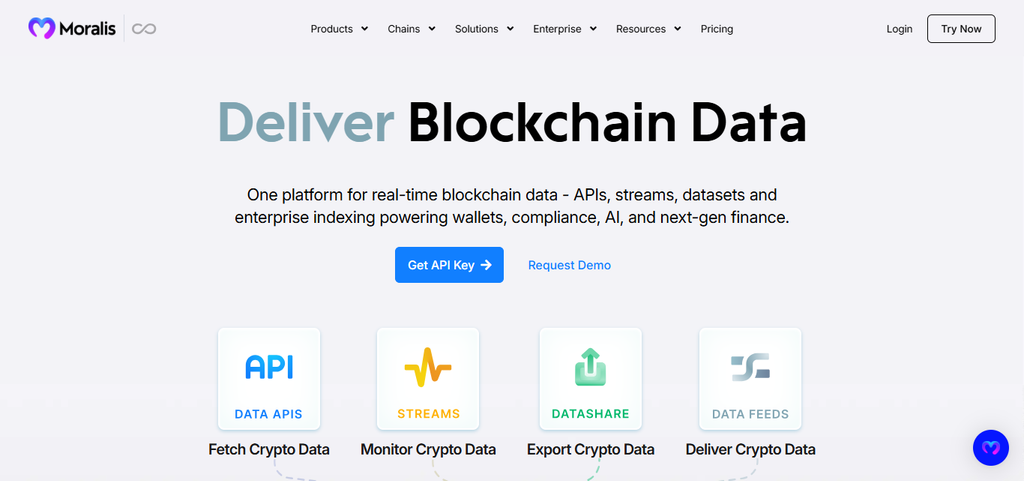
The complexity of collecting and processing blockchain data is heavily reduced through Moralis’ APIs. Analytical dashboards, portfolio applications, wallets, NFT platforms, and analytics applications, as well as other intensive data centric Web3 applications, are where Moralis APIs are most notably useful.
Developers use Moralis’ infrastructure and APIs to switch focus to better integration of blockchain technology to their backend in a more timely manner.
Moralis Features
- Web3 APIs: Provides easy to use APIs.
- Blockchain Data: Offers easy access to data including wallet engage proportion, transactions, token metadata, and NFTs.
- Data Simplification: Simplifies data from blockchains for developers and businesses.
- Back End Integrations: Helps developers and businesses integrate blockchain data, analytics, portfolio, dashboards, wallets and applications.
9. Blockdaemon
Blockdaemon serves professional clients, like banks, crypto businesses, exchanges, custodians, and enterprises, with their services to run blockchains at scale. These clients can use Blockdaemon’s node and staking services, as well as validator and connectivity offerings.
Security, reliability, and robust management of infrastructure and its institutional requirements are the strongest suits of Blockdaemon’s offering.
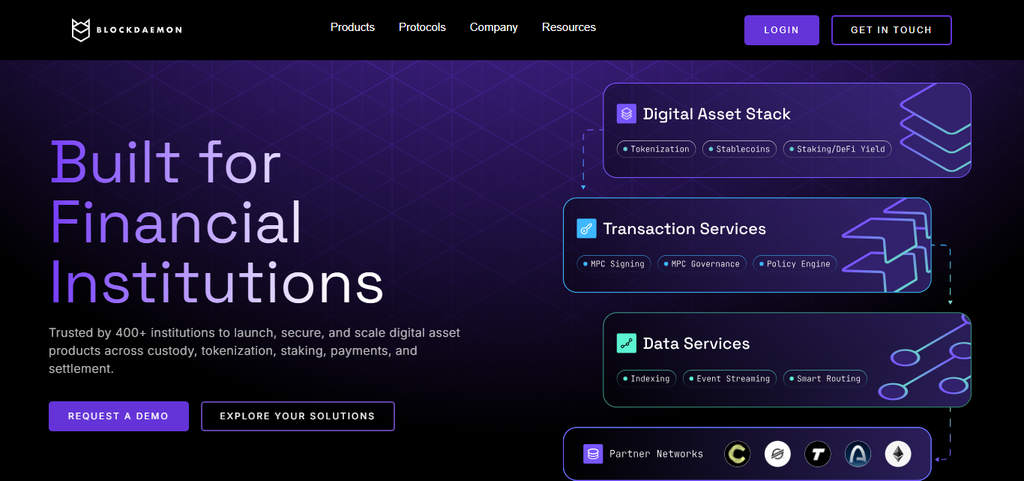
Organizations that are looking to offer their blockchain services at scale, either through validator-related services, staking services, or institutional-grade blockchain services, can use Blockdaemon. These businesses can use Blockdaemon’s blockchain-based framework, rather than develop everything in-house.
Blockdaemon Features
- Enterprise Blockchain Infrastructure: provides enterprise grade blockchain infrastructure for banks, firms, exchanges, custodians, and crypto businesses.
- Node and Validator Services: Managed node services for blockchain networks and validator services.
- Reliable Infrastructure: Focused on designing reliable blockchain services.
- Scalable Operations: Enables businesses to offer blockchain services without the need to build their commercial infrastructure.
10. GetBlock
GetBlock offers blockchain infrastructures, including JSON-RPC endpoints to connect to blockchain networks through shared and dedicated blockchain nodes. Shared JSON-RPC endpoints allow integration with blockchain networks without the need of running different blockchain nodes.
JSON RPC endpoints allow users to access and manipulate blockchain data, interact and control smart contracts, as well as build and control transactions to run decentralized applications. GetBlock empowers builders to develop wallets
DeFi applications, NFT marketplaces, gaming applications, analytics tools, and blockchain development applications. With its shared and dedicated options, developers can choose the appropriate level of performance and infrastructure based on various demands and traffic.
GetBlock Features
- JSON-RPC Endpoints: Provides JSON-RPC structure for interconnection with multiple blockchain networks
- Shared and Dedicated Nodes: Provides resources for developers to choose whether they require high performance or low performance resources
- Smart Contract Involvement: Allows applications to connect with blockchain networks, gather data, and sign transactions.
- Extensive Web3 Support: Supports Web3 services used in Defi, wallets, NFT marketplaces, and blockchain games.
Conclsuion
In Conclusion The best Web3 API and RPC development companies minimize the blockchain development learning curve with reliable connectivity to blockchain networks, optimized infrastructure, and automated tools for building decentralized applications.
QuickNode, Alchemy, Infura, Chainstack, Dwellir, dRPC, Ankr, Moralis, Blockdaemon, and GetBlock are some companies in this space. When considering which company to use, businesses need to analyze the lists of networks supported, reliability, speed, security, scalability, and pricing of the APIs.
FAQ
They simplify blockchain access without requiring developers to operate individual blockchain nodes.
QuickNode provides scalable infrastructure, low latency, and reliable multi-chain blockchain connectivity.
Alchemy combines RPC services, APIs, debugging tools, monitoring, and developer-focused infrastructure.
Infura offers established infrastructure with strong integration across the MetaMask ecosystem.
Chainstack provides managed nodes, RPC endpoints, and dedicated blockchain infrastructure options.