


The right setup advisor can help successful crypto OTC trading desk launches through secure, scalable, and compliant operations.
In this article, I will identify the Best Crypto OTC Trading Desk Setup Advisors and analyze their features, pros, and cons. I want businesses to be able to geographically compare the best solutions available in order to assist them with infrastructure, liquidity, technology, and institutional trading service offerings.
Key Points & Best Crypto OTC Trading Desk Setup Advisors
Finery Markets – Provides OTC infrastructure, institutional liquidity, and multi-blockchain settlement solutions.
B2Broker – Delivers turnkey brokerage, liquidity aggregation, and institutional OTC trading ecosystems.
FinchTrade – Offers non-custodial OTC architecture, liquidity feeds, and flexible execution channels.
PixelPlex – Builds customized crypto trading platforms with compliance, analytics, and scalable infrastructure.
Blockchain App Factory – Develops multi-asset trading engines and customized institutional OTC matching systems.
Hash Consultants – Creates institutional trading platforms with liquidity management and secure payment gateways.
Infinite Block Tech – Provides high-performance matching engines and multi-currency liquidity infrastructure solutions.
Coinsclone – Offers customizable white-label exchange and OTC solutions with layered security.
OSC Technologies – Designs enterprise liquidity routing solutions for centralized and decentralized crypto markets.
Zodia Markets – Provides institutional brokerage infrastructure, market access, and crypto trading advisory.
10 Best Crypto OTC Trading Desk Setup Advisors
1. Finery Markets
Finery Markets is an institutional-focused crypto electronic communication network (ECN) and trading infrastructure provider. They help businesses reach fragmented digital-asset liquidity through professional trading.
Finery Markets’ infrastructure provides firm order books, quote streams, RFQ trading, FIX, REST, and WebSocket connectivity as well as access to institutional liquidity providers.
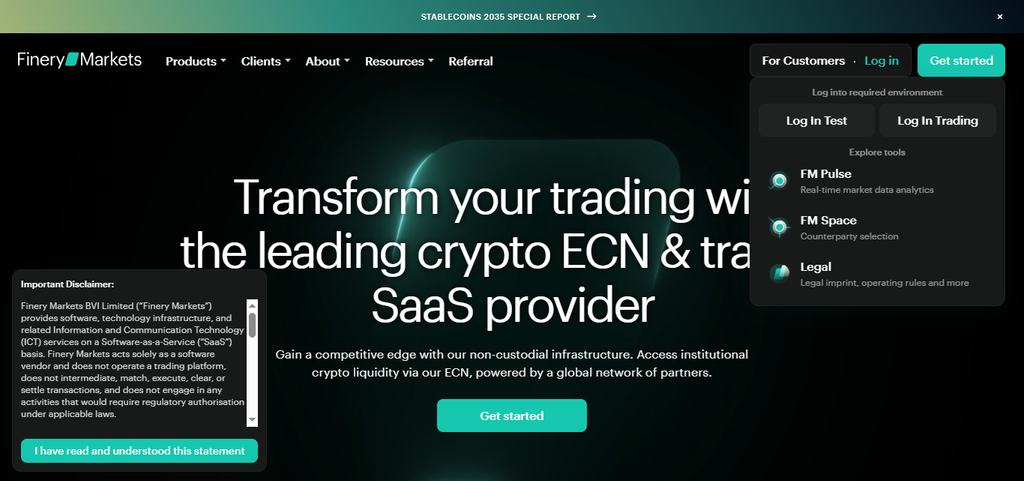
Post-trade settlement, reporting, and market and counterparty risk controls are automated on the Finery Markets platform. Founded in 2019, the first live trade was in Q4 2019.
The Finery Markets FM Whitelabel and ECN-as-a-Service launched in Q2 2023. Considering institutional connectivity, multi-dealer liquidity aggregation, and customizable technology infrastructure offered by Finery Markets, they are particularly relevant for companies building an OTC desk. Automated settlement and the trading stack are built internally by those companies.
Features Finery Markets
- Aggregation of prime-of-prime liquidity for digital assets.
- Modular brokerage and exchange infrastructure.
- Advanced trading technologies and connectivity for institutions.
- White-label technology for running trading businesses.
- CRM and back-office integrations available.
- Multiple choices for liquidity integrations and order execution.
Pros
- Innovative trading technology ecosystem.
- Well suited for businesses in need of a turnkey solution.
- Has a lot of experience with brokers and financial firms.
- Reduces the time and cost of development and infrastructure.
- Many services offered by one vendor that can be integrated.
Cons
- Comprehensive solutions cost a lot to implement.
- Possibly offers too much infrastructure for smaller OTC desks.
- More custom work may require further development.
- Infrastructure still remains third-party for businesses.
- Licenses and regulation still the client’s responsibility.
2. B2Broker
As a B2B financial technology and liquidity provider, B2Broker builds infrastructure for brokers, exchanges, banks, and other trading businesses. Its liquidity aggregation, prime-of-prime services, trading technology
CRM, and white-label solutions form an ecosystem that enables clients to provide brokerage services without developing individual solutions for every component. Launched/Founded: 2014; B2Broker states it was a fintech solutions provider in 2014. By 2016, B2Broker launched its Prime of Prime services.
B2Broker’s OTC desk service makes liquidity and technology integration a fully operational business with a trading offering. This aims to simplify infrastructure by consolidating trading platforms, liquidity, client management systems, and institutional execution.
Features B2Broker
- Builds a non-custodial OTC trading solution.
- Summarizes institutional cryptocurrency liquidity.
- Offers direct liquidity feeds and improved pricing.
- Provides GUI, API, and Telegram order execution.
- Offers a solution for trading and settlement for crypto to fiat.
- Features KYC/AML and transaction monitoring.
- Supports multi-currency and multi-asset settlement.
Pros
- May reduce counterparty exposure with a non-custodial model.
- Multiple channels for order execution offers flexibility.
- Designed for institutional trading of digital assets.
- May help OTC desks in need of liquidity aggregation.
- May help in ease of access to multiple liquidity sources.
Cons
- Depends on the jurisdiction, the availability of currencies may vary.
- May involve a lot of compliance documents for institutional onboarding.
- Clients must verify liquidity depth and spreads for themselves.
- May vary for different desks, the extent of integration.
- Operating in different jurisdictions may affect the permissive regime.
3. FinchTrade
FinchTrade is a SWISS liquidity provider that builds white label OTC trading and settlement infrastructure for institutional crypto-to-fiat trading.
Clients receive aggregate liquidity, institutional pricing, API and GUI access, trading via their Telegram, automated KYC/AML workflows, non-custodial wallets, and post-trade settlement.
FinchTrade is an ideal solution for crypto liquidity providers, payment service providers, exchanges and financial services firms with a strong focus on liquidity that do not wish to manage multiple relationships with crypto exchanges.
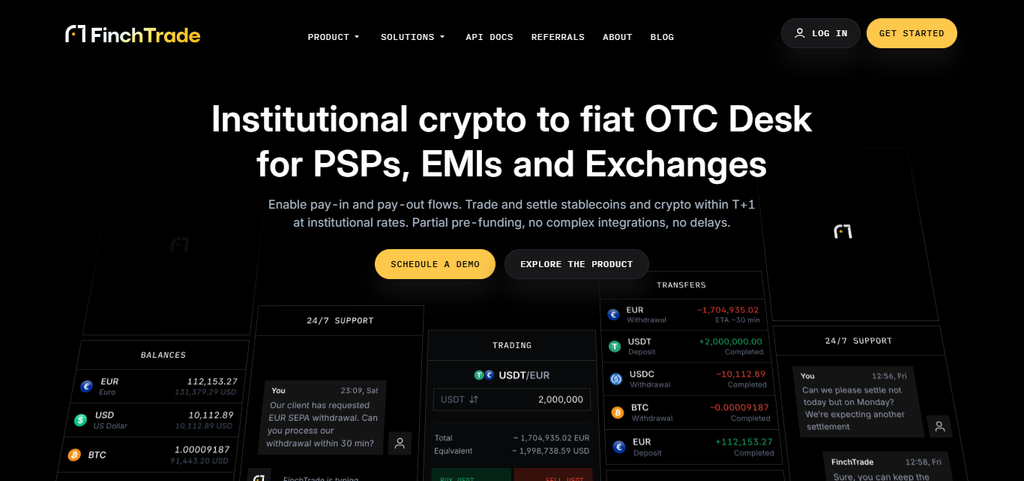
According to public sources, the business was founded in 2021 (although through LinkedIn it states 2018), and FinchTrade AG was established in 2021.
There is no hard evidence to support its founding date, so potential customers are encouraged to perform additional extensive due diligence. Its currently deployed infrastructure provides multiple Fiat and crypto Settlements.
Features FinchTrade
- Custom blockchain and crypto-platform development.
- Bespoke trading-platform architecture.
- API and blockchain integrations.
- Analytics and reporting functionality.
- Security-focused application development.
- Smart-contract and Web3 development capabilities.
- Scalable backend infrastructure.
Pros
- Highly customizable technology solutions.
- Suitable for unique OTC business models.
- Can integrate different blockchain technologies.
- Useful when off-the-shelf software is insufficient.
- Can build proprietary trading workflows.
Cons
- Custom development can take longer than white-label deployment.
- Costs may increase with complex requirements.
- Requires detailed technical project management.
- Liquidity may need separate third-party providers.
- Clients must verify current institutional OTC experience.
4. PixelPlex
PixelPlex builds custom software and blockchain solutions. They primarily do bespoke software development rather than operating as an Over-the-Counter (OTC) liquidity venue market maker. PixelPlex’s products and services can help firms create a bespoke OTC trading platform.
These services and products span blockchain, engineering, trading, analytics, and security infrastructure and technology. PixelPlex began its operations in 2007, and a web and mobile software development firm, and then entered the blockchain domain in 2013.
For an OTC desk that needs highly customized workflows, PixelPlex can design custom components of execution, compliance, analytics, settlement, and blockchain integration.
Clients must, however, verify for themselves which liquidity, custody, banking, and regulatory components are offered directly and which have to be obtained from third-party sources.
Features PixelPlex
- Cryptocurrency exchange development
- Multi-asset trading infrastructure
- Matching-engine development
- Wallet and blockchain integration
- Custom trading-platform development
- Smart-contract and Web3 capabilities
- White-label and bespoke blockchain solutions
Pros
- Extensive blockchain development services
- Flexible technology for specialized trading businesses
- Able to develop several components of digital assets
- Well suited for clients looking for custom-made solutions
- Supports blockchain and Web3 integrations
Cons
- More of a technology development firm than a liquidity provider
- Liquidity may need additional agreements
- Custom requests may require significant time and resources
- Participation in Institutional OTC may need to be verified on a case by case basis
- Compliance may be the responsibility of the client
5. Blockchain App Factory
Blockchain App Factory builds Web3 applications and infrastructure for businesses. The firm develops applications and exchanges, as well as wallets and tokenization tech. Their engineering skills can help firms build customized trading engines or add blockchain-based components to OTC operations.
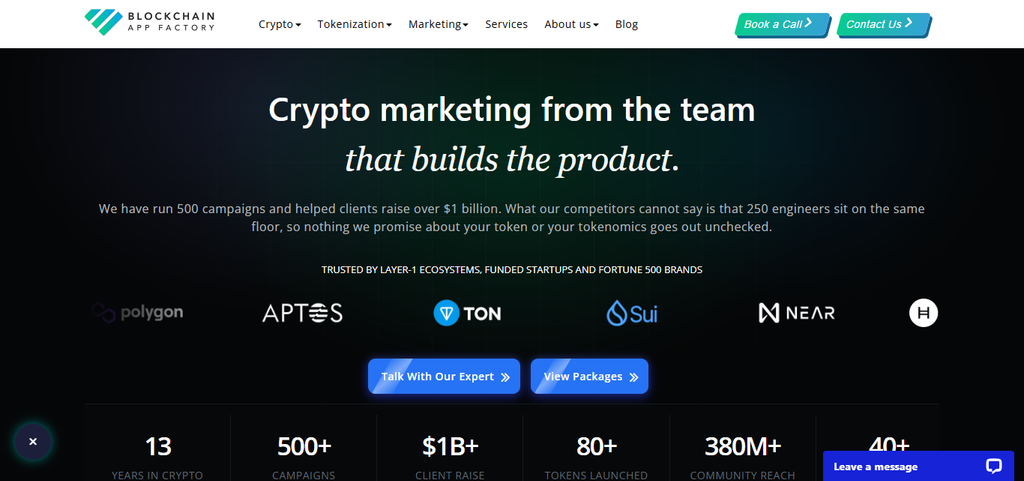
This is helpful to firms with trading desks that need more bespoke workflows. According to the firm, engineering started in 2013, however, the company was founded in 2010. Because of their broader engineering experience, they can build Web3 infrastructure wallets, and integrate
Web3 tech with exchange and trading platforms. Despite this, firms should also examine the firm’s track record of institutional software and infrastructure for trade execution and liquidity; compliance and post-trade settlement.
Features Blockchain App Factory
- Technology Consulting and Platform Development
- Trading Platform Architecture
- Integration of Liquidity Management Systems
- Payment Gateway Integration
- Blockchain Technology Consulting
- Custom Software Development
- Technology and Project Management of Business Activities
Pros
- The projects can be customized based on the consulting approach.
- Useful for complex challenges that involve technology.
- Consulting and software implementation can occur concurrently.
- Flexible approach to infrastructure development.
- Ideal for clients seeking project-specific solutions.
Cons
- Public documentation is lacking for dedicated institutional OTC offerings.
- Crypto liquidity depth should be verified.
- May use multiple third-party infrastructure providers.
- Less focused on OTC trading than other providers.
- Clients should ask for recent case studies focused on institutions.
6. Hash Consultants
Hash Consultants claims to be a tech and management firm with expertise spanning strategic planning and tech PM. For a crypto OTC desk, a firm like Hash could provide support with planning, architecture, coordination, security processes, and frameworks related to implementation.
According to its LinkedIn page, the firm was founded in 2010. However, from its public profile, its primary lines of business are telecoms and management consulting. This does not define Hash Consultants as a dedicated institutional crypto OTC infrastructure provider.
So, firms thinking of hiring Hash Consultants to build an OTC desk, should do box on additional due diligence on the firm’s crypto-related work. This include the firm’s work in the area of crypto projects, liquidity integration, custody, and regulatory work with institutional trading.
Features Hash Consultants
- Custom development of cryptocurrency exchanges
- Built to handle high volume trading
- Custom developed matching engines
- Integration with multiple blockchains and multiple currencies
- Developing cryptocurrency wallets
- Building infrastructure for DeFi projects and Web3
- Custom development of blockchain applications
Pros
- Extensive experience with cryptocurrency technology
- Builds custom developed trading infrastructures
- Works with multiple blockchain ecosystems
- Best for companies that need custom built software
- Can build combinations of exchange, wallet, blockchain services
Cons
- Existing liquidity providers may be required
- Custom development may take longer
- OTC capabilities may need to be validated
- Technical services may be required
- Banking and regulatory services will need to be arranged separately
7. Infinite Block Tech
Infinite Block Tech offers custom blockchain applications, cryptocurrency exchange software, wallets, DeFi platforms, and smart contracts. They also offer other digital-asset technologies.
These services offer capabilities that an OTC desk may need when a customized backend or blockchain integrations are required. An OTC desk may need wallet infrastructure or a Web3 trading ecosystem.
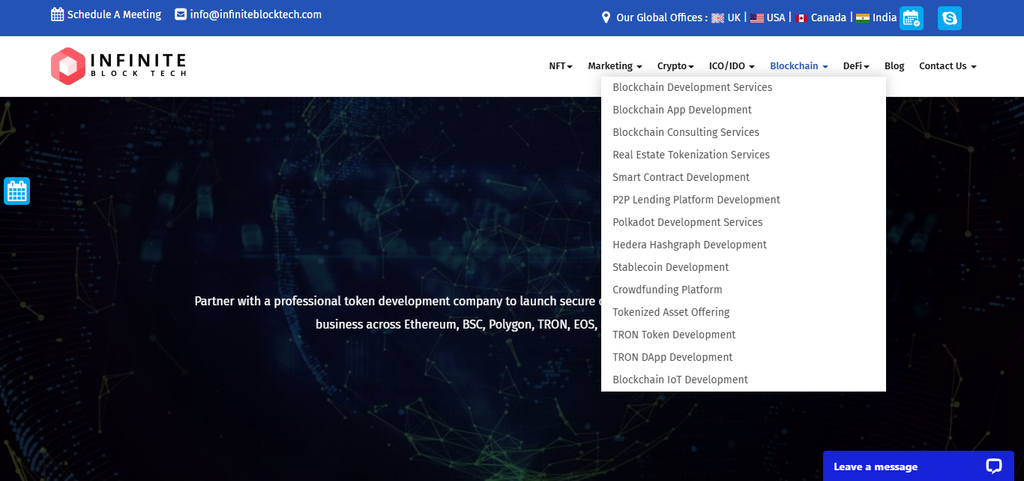
Infinite Block Tech launched in 2005 according to their LinkedIn company profile and now has over a decade of blockchain experience. They claim on their site that they create secure and scalable blockchain solutions and have exchange software and cryptocurrency infrastructure experience.
While they may have experience in the space, it is important for potential clients to investigate actual experience with high volume execution, institutional liquidity, risk management, compliance, settlement, and production-grade OTC environments.
Features Infinite Block Tech
- Customizable white-label cryptocurrency exchange solutions
- OTC trading and cryptocurrency exchange software
- Multiple trading asset support
- Integrated wallets
- Integrated payment gateway
- Multiple security and administrative mechanisms
- Flexible trading platform design
Pros
- High speed design reduces time to market
- Varied crypto software supports different business needs
- Potential for lower development cost compared to building from scratch
- Well suited for new market trading businesses
Cons
- Providing institutional liquidity may require using third-party software
- Sophisticated OTC operations may need customizations
- Higher enterprise requirements add to cost
- Buyers need to confirm security and audit compliance
- Regulatory licensing is the operator’s responsibility
8. Coinsclone
Coinsclone is a developer of Web3 and cryptocurrency software. Their offerings include white-label solutions for crypto exchanges, wallets, payment systems, and DEXs.
They also offer blockchain-based APIs and custom software development. They can help businesses build an OTC desk or exchange without the need to build everything from scratch.
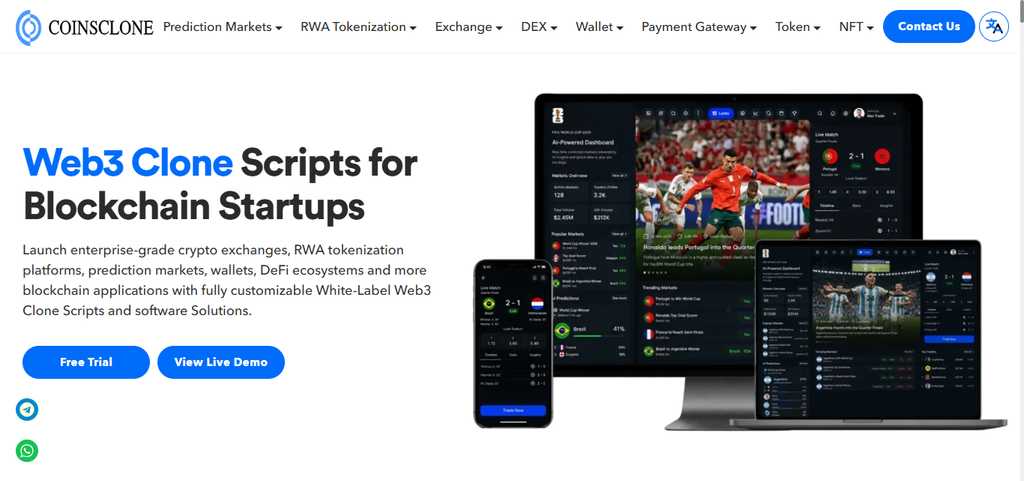
Coinsclone was established in 2016 to help startups and enterprises build blockchain applications. The company helps customers build safe and scalable products. They specialize in developing software across multiple countries in all regions.
When evaluating OTC solutions, buyers should examine if the proposed solution offers RFQ, trading limits, compliance integrations, custody solutions, settlement workflows, and audit trails, and if the solution offers institutional-grade security.
Features Coinsclone
- Digital-asset Liquidity Infrastructure:
- Liquidity Routing Technology:
- Centralized Exchange Connectivity Technology:
- Decentralized Exchange Connectivity Technology:
- Infrastructure for Order Routing and Execution:
- Enterprise Trading Technology:
- Ability to integrate custom APIs and services:
Pros:
- Liquidity routing and connectivity servicing is a primary concern:
- May be useful to liquidity service customers in fragmented crypto markets
- May connect multiple liquidity services:
- May be used in complex trading systems:
- Flexibility of centralized and decentralized connectivity may be an advantage
Cons:
- Limited public information with regard to company functionality
- Coverage of liquidity providers needs to be confirmed
- Integration may be extensive
- Regulatory and custody services may require additional vendors
- Institutional OTC coverage and history may warrant caution.
9. OSC Technologies
OSC Technologies puts itself in the category of a technology provider geared toward digital asset and liquidity infrastructure. This places them in the scope of companies that need customized trading and liquidity-routing solutions.
In regards to an OTC model, OSC Technologies would generally connect liquidity sources, set up execution infrastructure, and develop order routing technology for orders that can be sent to either centralized or decentralized markets.

There does not seem to be a reliable, public source for launch/founded dates. As such, the founding date should be confirmed directly with OSC Technologies, and not estimated. This is relevant for an OTC desk given that it needs much more than trading interfaces, namely, connected liquidity
Prices, risk management, compliance, control, wallet and settlement infrastructures, monitoring, and operational support. Prior to any commitment, potential clients should ask for published case studies and confirm what resources and services OSC Technologies will provide.
Features OSC Technologies
- Digital-asset liquidity infrastructure.
- Liquidity routing technology.
- Centralized-exchange connectivity.
- Decentralized-exchange connectivity.
- Order-routing and execution infrastructure.
- Enterprise trading technology.
- Customized integration capabilities.
Pros
- Focus on liquidity connectivity and routing.
- Potentially useful for fragmented crypto markets.
- Can connect multiple liquidity sources.
- Suitable for sophisticated trading architectures.
- Centralized and decentralized connectivity can improve flexibility.
Cons
- Public information about company capabilities may be limited.
- Exact liquidity-provider coverage should be verified.
- Integration complexity depends on the desired architecture.
- Regulatory and custody services may require other providers.
- Institutional OTC track record should be assessed carefully.
10. Zodia Markets
Zodia Markets was built with brokerage services for financial institutions and launched with support from Standard Chartered through SC Ventures. OSL Group became a partner.
Zodia Markets has an edge over development firms that only build software, as Zodia Markets actively engages in institutional markets for digital assets. Zodia Markets was launched in June 2021.
However, Zodia Markets’ official launch of its institutional crypto exchange and brokerage business was in July 2022. This was after Zodia Markets received UK FCA cryptoasset registration in June 2021.

Since then, it has grown its institutional client base by providing middle and back office services including settlement and liquidity services. It now operates in the UK, Abu Dhabi, and Jersey.
Overall, the firm offers services more applicable and relevant to institutions that want regulated market infrastructure, institutional execution, banking relationships, and OTC trading services, as opposed to firms that sell white-label software.
Features Zodia Markets
- Institutional digital-asset brokerage.
- OTC crypto trading.
- Institutional market access.
- Digital-asset liquidity.
- Professional trading infrastructure.
- Settlement and custody-related integrations.
- Regulatory-focused institutional operating model.
Pros
- Strong institutional-market orientation.
- Backed by established financial-sector organizations.
- Focused on professional digital-asset clients.
- Suitable for institutions seeking regulated-market infrastructure.
- Provides direct institutional trading and brokerage capabilities.
Cons
- Primarily designed for institutional clients rather than small startups.
- Geographic availability depends on regulatory permissions.
- Onboarding can involve stringent institutional requirements.
- Less suitable if you want completely customized software.
- Product availability can vary by jurisdiction.
Conclusion
In Closing Considering the Top Advisors for the Best Crypto OTC Trading Desk Setup balances your business needs with your budget and meets your compliance needs, liquidity needs, and tech needs. Some of them include FinchTrade, B2Broker, PixelPlex, Coinsclone, and Zodia Markets.
Each of these has its own strengths. Before making a decision, evaluate their infrastructure and security, as well as how customizable their solution is, the liquidity they can provide, the compliance and institutional trading services they offer, etc.
FAQ
An advisor can help with technology selection, liquidity integration, compliance planning, risk management, banking connections, and overall OTC desk infrastructure.
Providers include B2Broker, FinchTrade, PixelPlex, Blockchain App Factory, Hash Consultants, Infinite Block Tech, Coinsclone, OSC Technologies, and Zodia Markets.
An OTC desk typically requires trading interfaces, liquidity aggregation, RFQ systems, APIs, wallets, settlement infrastructure, transaction monitoring, reporting, and security controls.
Liquidity is essential because it helps desks execute large orders efficiently while maintaining competitive pricing and minimizing market impact.