


In this post, I will examine Apps That Simplify Crypto Data, aiding novice and seasoned investors in navigating the intricacies of the crypto market. These applications ease the complexity of market trends, prices, portfolio management, and analytics.
They help investors make decisions based on data without the frustration of intricate charts and complicated language. Let’s review the leading crypto data apps.
Key Points & Apps That Explain Crypto Data In a Simple Way
CoinMarketCap – Tracks crypto prices, market caps, and trends with easy charts for beginners.
CryptoCompare – Offers clear comparisons, portfolio tracking, and educational insights for understanding crypto markets.
Blockfolio – Simplifies portfolio management, price alerts, and news updates for everyday crypto investors.
Delta – Provides intuitive portfolio tracking, price charts, and market analysis in a user-friendly interface.
Glassnode – Explains blockchain data with simple visuals, helping users understand on-chain activity and trends.
Messari – Delivers crypto research, charts, and news in digestible formats for informed decision-making.
CoinGecko – Tracks thousands of coins, exchanges, and trends with beginner-friendly charts and community ratings.
TradingView – Offers simplified crypto charts, technical indicators, and social insights for traders and learners.
Santiment – Breaks down crypto sentiment, on-chain data, and market behavior into easy-to-read dashboards.
Nomics – Presents transparent crypto market data, charts, and analytics in a clean, simple design.
10 Apps That Explain Crypto Data In a Simple Way
1. CoinMarketCap
CoinMarketCap is one of the largest and most popular platforms for crypto data. Since its inception in 2013, it has aimed to simplify crypto data for the general public.
The platform features thousands of coins and tokens and aggregates real-time pricing, market cap, trading volume, price charts, and historical data.
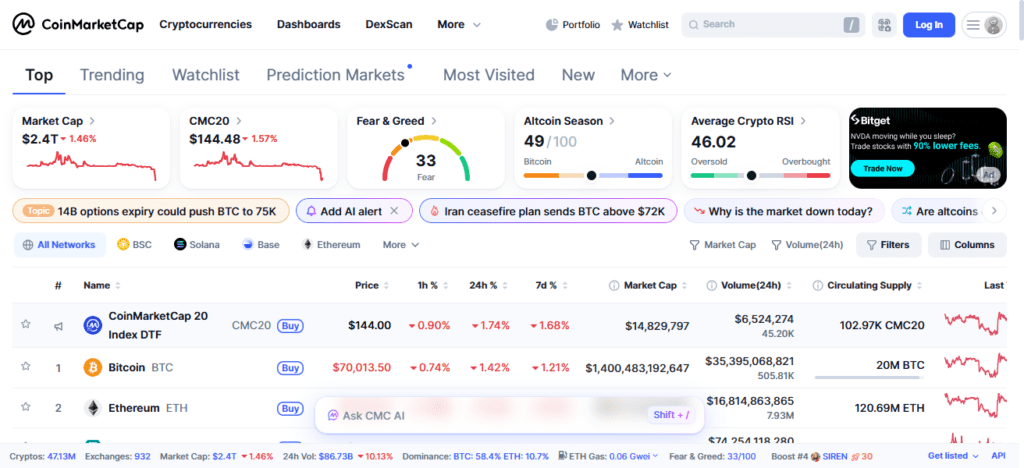
Users can compare different assets. CoinMarketCap is beginner-friendly with features like price alerts and simple watchlists, in addition to more advanced features like depth of metrics and research news.
These qualities make CoinMarketCap more beginner-friendly than other, more specialized competitors like Santiment or Glassnode, which cater to more advanced market data.
| Pros | Cons |
|---|---|
| Extremely beginner‑friendly layout with quick price snapshots. | Lacks deep on‑chain metrics that advanced traders want. |
| Covers thousands of coins with global rankings. | Can feel overwhelming due to extensive lists. |
| Easy watchlists and price alerts. | Limited social or sentiment insights. |
| Clear market cap and real‑time volume info. | Doesn’t analyze wallet behavior or blockchain activity. |
2. CryptoCompare
CryptoCompare provides more than 5,300 digital currencies and 240,000+ currency pairings by consolidating market prices and volume data from hundreds of exchanges.
They simplify complex data by consolidating prices, order books, historical charts, and social metrics.
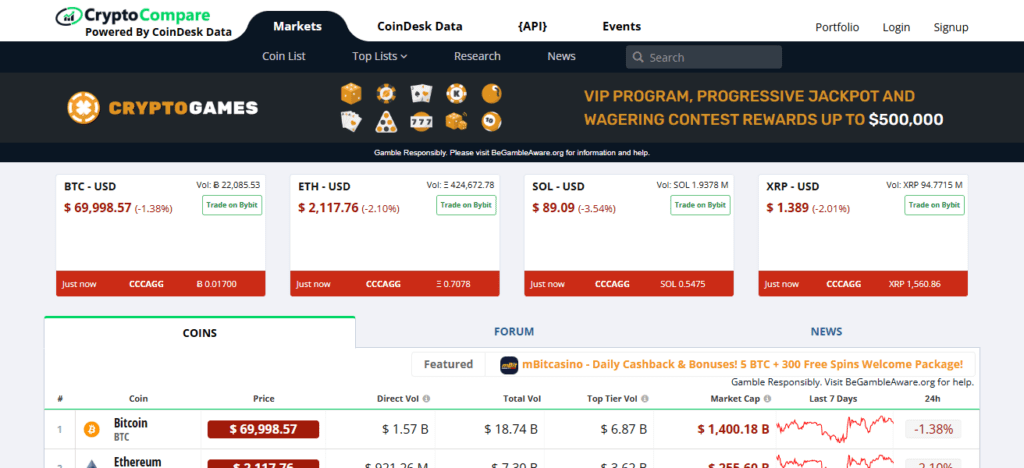
Unlike CoinMarketCap and CoinGecko, CryptoCompare focuses on data depth and breadth, providing professional and casual consumers with cleaner aggregated feeds and superior filtration.
While novice-focused applications reduce complexity by restricting functionality, CryptoCompare strives to connect unrefined exchange data and usable summaries to all experience levels.
| Pros | Cons |
|---|---|
| Aggregates data from many exchanges for broad market coverage. | User interface is less polished than some alternatives. |
| Offers both price and order book summaries. | Can be confusing for complete beginners due to advanced data sets. |
| Historical market snapshots simplify trend tracking. | Social and sentiment data are not the platform’s focus. |
| Offers portfolio and API access for deeper use. | Not as visually engaging as some mobile apps. |
3. Blockfolio
Blockfolio was built as a portfolio tracker specifically for mobile use. Users can manage all their crypto holdings and price movements alongside them, as well as create custom alerts and lists.
They differ from apps like CoinMarketCap and CoinGecko that give broad market-level data and focus on individual portfolios at a more granular level.
They give users real-time updates on their investments as well as updates from project teams through their Signal feature, which gives developers more control over communication.
The design on Blockfolio is good for investors who want a simplified experience so they can view their assets.
| Pros | Cons |
|---|---|
| Excellent personal portfolio tracking. | Mainly focused on portfolio, not broad market research. |
| Custom price alerts per asset. | Deeper analytics (like on‑chain stats) missing. |
| Great mobile interface designed for investors. | Projects may update info inconsistently. |
| Simple view of holdings and profit/loss. | Limited global exchange comparison tools. |
4. Delta
Delta has similar features to BlockFolio, but with greater wallet linking, wallet exchange account linking for automated portfolio tracking, and analysis capabilities.
Delta provides trade history analysis, charts, multiple portfolios, and profit/loss summaries. Delta is better than BlockFolio for personal portfolio tracking.
Delta abstracts the intricacies out of the analysis of individual trades, and focuses more of the analysis on the portfolio as a whole, and the individual components (holdings, trades, etc.) of the portfolio, to make more of an analysis of trade effect over time easier.
Delta is the more data-centric app than the broad market apps (like CoinMarketCap) and focuses more on tracking user-specific data than market/broad market data.
| Pros | Cons |
|---|---|
| Multiple portfolio support for diverse tracking. | More complex setup than basic trackers. |
| Connects wallets and exchanges directly. | Some advanced features are behind a paid tier. |
| Detailed profit/loss and timeframe analytics. | Not ideal for quick coin browsing. |
| Good for long‑term investment reviews. | Less social sentiment data than competitors. |
5. Glassnode
Glassnode translates raw blockchain data (transactions, wallet activity, supply flows) into effective statistics regarding market conditions and investor behavior, and specializes in on-chain analytics.
This translates into translating blockchain data meaningfully. This offers the customers data and analysis that other apps don’t provide, like network fundamentals, activity, large holder movement, etc.
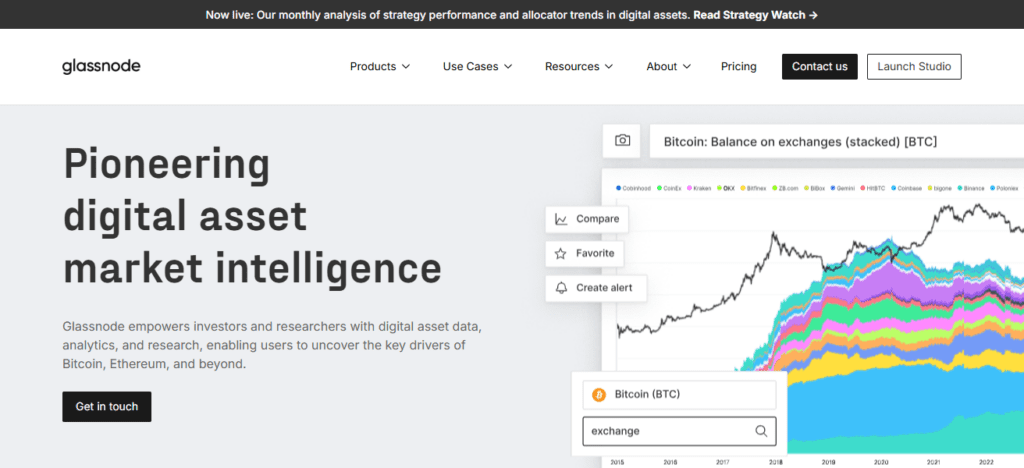
Customers can analyze visual analytics and charts to know the reason of the price movement and not solely the specific price.
Glassnode supplements context and depth to price aggregator analytics compared to other data market analytics.
| Pros | Cons |
|---|---|
| Strong on‑chain data revealing real blockchain activity. | Steeper learning curve for new users. |
| Network fundamentals help explain price moves. | Less emphasis on simple price lists. |
| Alerts on whale movements and supply flows. | Not designed primarily as a portfolio tracker. |
| Excellent for deeper market context. | Some data terms require prior knowledge. |
6. Messari
Messari blends market data, analysis, and tools, so streamlined market research is available to users at all levels of expertise.
Messari helps users understand market data vis-à- vis market narratives. Messari’s dashboard provides price data, research, social sentiment, structural token data, and articles that assess trends and potential risks.
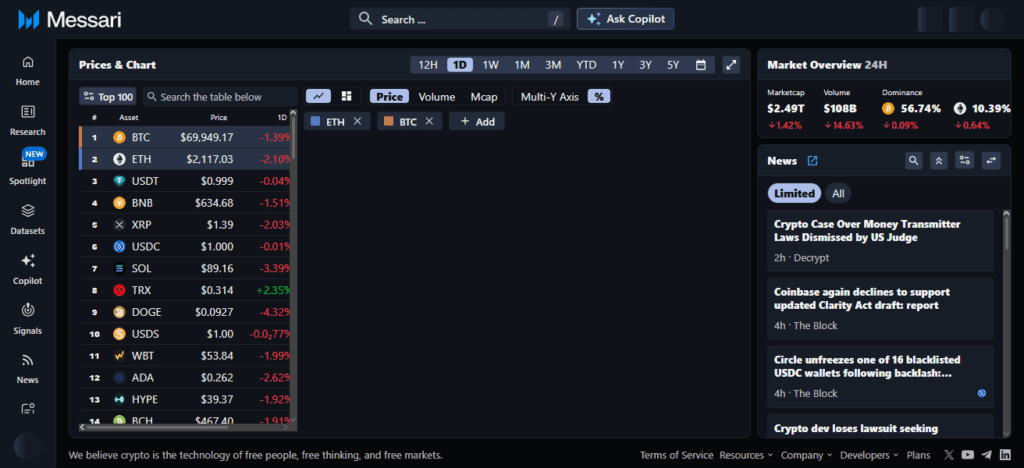
Unlike Messari, CoinMarketCap provides less market insight, leading to less qualitative data vis-à- vis market understanding. Messari’s qualitative metrics are fundamental for users to understand data reliability.
| Pros | Cons |
|---|---|
| Combines market data with research insights. | Advanced reports can be dense for beginners. |
| Narrative context adds understanding to raw prices. | Paid features have richer content — free tier limited. |
| Fundamental metrics highlight value beyond price. | Not as instantaneous as basic price trackers. |
| Excellent for learning project fundamentals. | Less intuitive for casual checking. |
7. CoinGecko
CoinGecko, similar to CoinMarketCap, offers live pricing, market caps, fluctuations, rankings, and other metrics on over 10,000 cryptocurrencies, but offers the extra metadata of social engagement and developer statistics.
It assesses exchange liquidity and the quality of the data provided with its ‘Trust Score’ system, giving users an extra degree of transparency about the data’s origins.
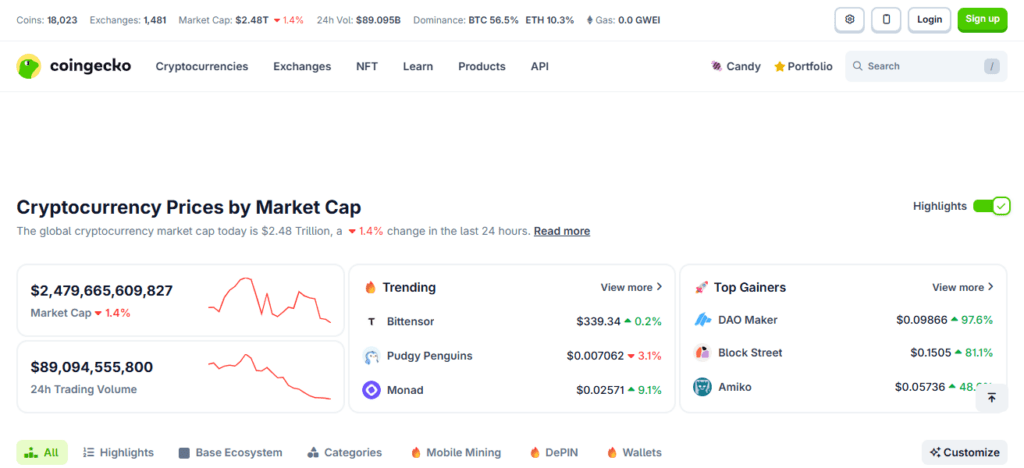
In contrast to other, more basic platforms, CoinGecko includes developing areas such as NFTs and DeFi. It offers a more user-friendly experience than CoinMarketCap, especially
for users seeking more than just pricing and trading volume data, because of its more comprehensive data and more streamlined interface.
| Pros | Cons |
|---|---|
| Extensive coverage — thousands of tokens and categories. | UI has a lot of information packed in one screen. |
| Adds community & developer activity metrics. | Can be overwhelming without filters. |
| Simple price and market cap overview. | Social sentiment not as deep as dedicated tools. |
| Customizable watchlists available. | Some data fields may feel redundant to casual users. |
8. TradingView
TradingView is not exclusive to crypto investors. Furthermore, it’s an all-in-one platform for charting, technical analysis, and other features for multiple financial asset classes.
For example, cryptocurrencies it integrates real-time pricing from various exchanges, and provide a variety of charts, advanced visualization tools, and hundreds of indicators to analyze and chart trends.

Moreover, educational resources and community-created tools simplify complex charting and technical analysis.
It’s superior to other price tracking tools since it displays price data and technical signals and patterns used in trading decisions.
| Pros | Cons |
|---|---|
| Best charting with advanced technical tools. | Too many features for users just wanting simple prices. |
| Custom indicators and community scripts. | Charts can be intimidating if new to trading. |
| Real‑time multi‑exchange feeds. | Less focus on fundamental metrics. |
| Excellent for pattern analysis. | Mobile view sometimes feels crowded. |
9. Santiment
Santiment enhances traditional data with emotional and network context through on-chain activity, social sentiment, and behavioral analytics.
Santiment goes beyond traditional data visualization methods, integrating whale behavior, social mention analytics, and developer activity tracking as market psychology proxies.
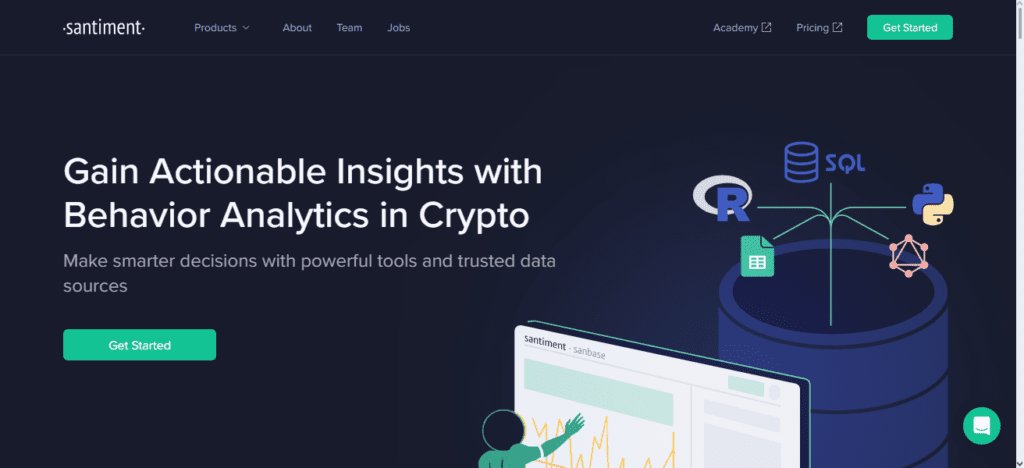
This approach offers market behavioral interpretations as opposed to traditional data visualizations.
Unlike traditional data visualization, Santiment’s data focuses on emotional and network context, potentially identifying crowd behavior, such as fear and hype, in anticipation of price movements.
| Pros | Cons |
|---|---|
| Sentiment and behavioral analytics built‑in. | Very different from basic price trackers — learning required. |
| Tracks social buzz and large investor activity. | Not ideal for quick price checks. |
| On‑chain metrics combined with sentiment. | Limited portfolio tools. |
| Good for spotting crowd behavior trends. | Visualizations can feel busy. |
10. Nomics
Nomics focuses on dirty free gaps in historical pricing, as well as clear methodologies behind all gaps.
Their real-time pricing and metrics stream aggregation focuses on clarity and accuracy, providing users the ability to analyze historical data compared to other gaps in the data.

It provides a better user experience compared to the apps that offer plain pricing and market cap data.
It provides transparent historical pricing data compared to analytics and trading apps and is valuable for backtesting, developing trading strategies, and historical analytics. (General understanding of Nomics’ positioning; well-known in industry for cleaner data.)
| Pros | Cons |
|---|---|
| Emphasizes clean, gap‑free historical data. | Fewer social signals than competitor platforms. |
| Transparent methodology builds trust. | Interface feels more analytical than casual. |
| Easy to compare long‑term price history. | Not many on‑chain analytics. |
| Clean market cap and volume stats. | Less intuitive for beginners than basic coaches. |
How To Choose Top Apps That Make Crypto Data Easy to Understand
- Ease of Use: Look for an app that features an easy-to-use interface with clear visuals and dashboards.
- Access to Information: Look for an app which provides live updates for prices, market caps, and volume.
- Tracking: The app should have easy tracking features for holdings and profits.
- Advanced Analytics: The app you choose should provide on-chain data, data trends, and positive and negative data sentiment assessments in order to help with data-driven decision-making.
- Crypto Selection: The app should have a large variety of supported cryptocurrencies.
- Up-to-date information: The app should provide timely updated information through the use of push notifications and alerts for ongoing prices and market changes.
- Cost: Choose an app that features the basic tracking and analysis tools you need for free, and pays for the premium features for analysis and information.
Conclsuion
To summarize, Apps That Explain Crypto Data In a Simple Way help simplify complex processes in the cryptocurrency market.
They assist users in making decisions by tracking portfolios, pricing fluctuations, on-chain analytic tools, and sentiment analytics.
Apps help crypto investors, regardless of their level of expertise, save time, understand processes better, and improve their crypto strategies.
FAQ
Crypto data apps track prices, market caps, volume, and trends to help users understand the cryptocurrency market.
Beginners, traders, investors, and analysts can use these apps to simplify crypto tracking and decision-making.
Yes, most apps provide live prices and updates from multiple exchanges.
Apps like Blockfolio and Delta allow users to monitor personal holdings and profits.