


Here, I will cover the top platforms centered around Web3 identity with a focus on managing secure digital identities in a decentralized manner. I will highlight key functionalities, advantages the platforms offer, security features, and appropriate scenarios for best use.
As a crypto user, developer, or business professional, this guide will assist your selection of a Web3 identity platform for privacy and authentication, and will ease your connected experience with blockchains.
What Are Web3 Identity Platforms?
Web3 identity platforms combine decentralization and ownership of one’s identity. They stem from a desire to eliminate centralized authorities that oversee and, often, control one’s digital identity.
Using blockchain and other technologies associated with it, users are empowered to take back the control of their personal information, which can be authenticated across the many dApps and services.
Web3 identity platforms are designed to eliminate identity fraud and improve security while allowing individuals to seamlessly and independently control their authentication across a multitude of platforms.
Key Points & Best Web3 Identity Platforms
| Web3 Identity Platform | Explanation |
|---|---|
| ENS (Ethereum Name Service) | Simplifies blockchain addresses using human-readable names for seamless decentralized identity management across applications. |
| Polygon ID | Enables privacy-focused digital identity verification using zero-knowledge proofs without exposing personal information publicly. |
| World ID | Verifies unique human identities while preserving privacy through secure biometric authentication and decentralized technology. |
| Spruce ID | Provides self-sovereign identity solutions allowing users complete ownership over digital credentials and authentication. |
| Civic | Delivers secure identity verification services reducing fraud while protecting user privacy across platforms. |
| Ontology ONT ID | Supports decentralized identity management with trusted credentials for secure cross-platform digital interactions globally. |
| Gitcoin Passport | Combines verifiable credentials helping users prove authenticity and improve trust in decentralized ecosystems. |
| Veramo | Open-source framework enabling developers to create interoperable decentralized identity applications with flexible credential management. |
| SelfKey | Empowers users to securely store, control, and share verified digital identities independently online. |
| Lit Protocol | Enables programmable identity access using decentralized encryption and secure blockchain-based authorization for applications. |
10 Best Web3 Identity Platforms
1. ENS (Ethereum Name Service)
ENS is a prominent Web3 identity solution. By replacing long, complex cryptocurrency wallet addresses with ENS names, members can utilize Web3 Identity to simplify payments. An added benefit is that an ENS name is a universal digital identity.
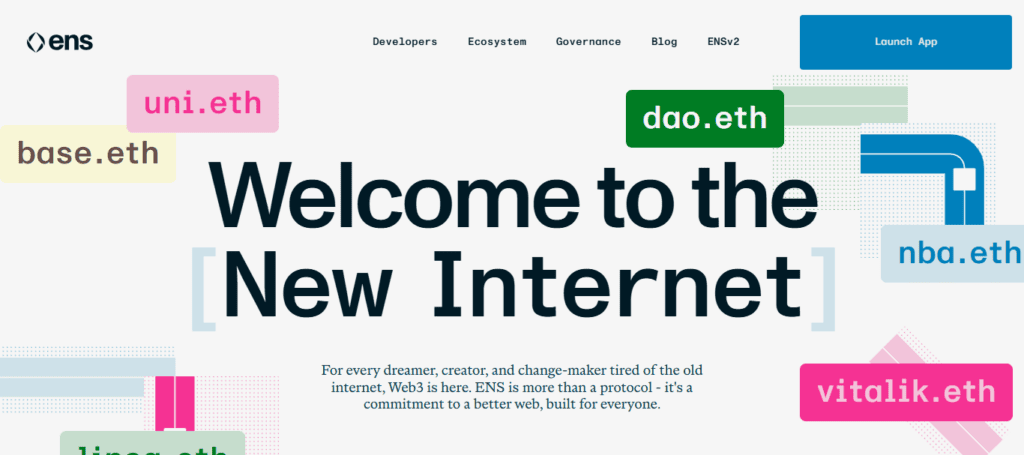
This means that the ENS name can be used across the various decentralized applications, NFT marketplaces, DAO memberships, and wallets across the blockchain. ENS names are stored on Ethereum as smart contracts, so the registrar no longer is central.
Continuous improvements in the ENS ecosystem are increasing interoperability, allowing holders to incorporate their ENS names into other blockchains.
Moreover, decentralized web hosting can be used to publish profiles. ENS is actively being integrated by developers in Web3 to simplify log in, indicating that the ENS is an identity layer that can be incorporated into the decentralized web.
ENS (Ethereum Name Service) Features
- Consolidating an elaborate wallet into a human-readable .eth makes wallets easy to share.
- Supports decentralized identities across wallets, NFTs, DAOs, and Web3 applications.
- Smart contracts permanently register users’ names on the blockchain for users to secure and own completely.
- Provides developers an infrastructure for censorship-resistant, blockchain-based, decentralized domains to host websites.
- Eases access with growing cross-chain compatibility and integrations across multiple wallets.
| Pros | Cons |
|---|---|
| Easy-to-remember .eth wallet names | Registration and renewal require blockchain transaction fees |
| Widely supported across Web3 applications | Primarily centered around the Ethereum ecosystem |
| Full user ownership through smart contracts | Popular names may already be unavailable |
| Improves payment accuracy and convenience | Beginners may find setup slightly confusing |
2. Polygon ID
Privacy-first digital identity is a growing vertical for Polygon ID, and especially with the innovative use of zero-knowledge proofs (ZKPs). Instead of revealing personal information, users can prove specific facts—such as age, citizenship, or other sensitive data.
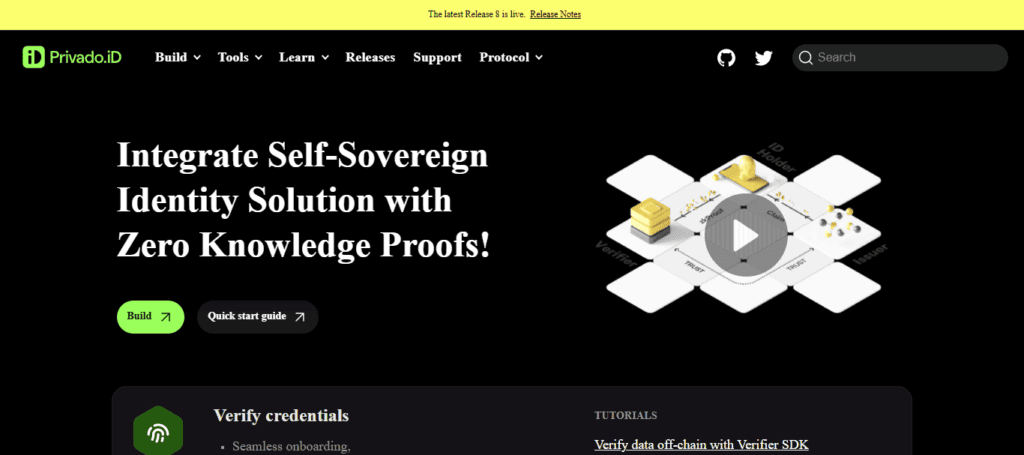
This helps Polygon ID mitigate privacy concerns all while being compliant with regulations. In addition, Polygon ID easily integrates into DeFi, gaming, education, and enterprise solutions.
Polygon ID continues to be implemented in a variety of sectors and will be an important player in the digital identity space, especially with the growing regulations on privacy in the coming years.
Polygon ID Features
- Facilitates identity verification by employing zero-knowledge proofs to sustain privacy.
- Allows secure, reusable verifiable credentials in multiple dApps and in enterprise ecosystems.
- Supports selective disclosure, giving users control over the amount personal data shared during verification.
- Easily integrates with Polygon for an affordable and scalable identity management framework.
- Uses cryptographic verification to sustain privacy while satisfying compliance for different contexts.
| Pros | Cons |
|---|---|
| Privacy protected with zero-knowledge proofs | Advanced technology can be difficult to understand |
| Users control their identity credentials | Adoption is still expanding across platforms |
| Supports selective information disclosure | Some applications lack Polygon ID integration |
| Scalable and low-cost verification system | Enterprise implementation may require technical expertise |
3. World ID
World ID aims to identify authentic individuals and differentiate them from bots while keeping their privacy intact. It uses biometric data alongside cryptographic technology to construct an identity that is digital and unique without putting any of your private data at risk.
Verification helps decentralized apps to block fake user accounts, Sybil attacks, and the abuse of automation. The verified ID can be used to log into any app or service of your choice that is supported without the need to overshare private data.
Automated bots and AI generated content is becoming more widely used. World ID and other similar projects will be essential in proving that users are indeed real and are not bots within decentralized apps and other online platforms.
World ID Features
- Allows authentication while securely validating identity with minimal data exposure.
- Demonstrates verified human participation to negate Sybil attacks on decentralized frameworks.
- Supports advanced privacy-guarding biometric authentication globally, employing cryptographic identity protection.
- Supports online services that require the secure authentication of sensitive identification documents.
- Designed for an internet dominated by AI wherein verified proof of genuine human identities is a necessity.
| Pros | Cons |
|---|---|
| Helps verify genuine human users | Biometric verification raises privacy concerns for some users |
| Reduces bots and Sybil attacks | Availability differs by country and region |
| Preserves privacy using cryptographic verification | Requires ecosystem adoption for maximum usefulness |
| Useful for AI-resistant authentication | Some users dislike biometric enrollment requirements |
4. Spruce ID
Spruce Systems Spruce ID is self-sovereign identity system that is open to everyone. Just like the other self-sovereign identity systems, no third-party identity is required to validate the identity of an individual. Spruce ID is an open identity system that is also a flexible self-sovereign identity, authentication, and verification system.
It enables the issuance of digital certificates that can be selectively disclosed. Because of its emphasis on privacy, security, and data minimization, Spruce ID is widely used across the decentralized ecosystems. Moreover, it is developer-friendly and clearly provides a system that is in line with rapidly evolving global digital identity frameworks.
Spruce ID Features
- Fully self-sovereign identities securely support self-ownership of digital credentials.
- Employs decentralized identifiers (DIDs) and open standards for secure, global, identity interoperability.
- Supports wallet-based authentication for decentralized applications across the web.
- Backed by verifiable credentials issued and validated by a worldwide trusted decentralized identity infrastructure.
- Supports privacy-centric verification by empowering users to share data selectively and give consent when desired.
| Pros | Cons |
|---|---|
| Supports self-sovereign digital identity ownership | Mainly targeted toward developers and organizations |
| Built using open identity standards | Smaller ecosystem than leading identity platforms |
| Strong privacy and consent management | Enterprise deployment may require technical resources |
| Flexible wallet-based authentication | Limited mainstream consumer awareness currently |
5. Civic
Civic Technologies Civic provides decentralized identity verification services that decrease fraud and simplify verification for users. Rather than having to send identity documents to various platforms multiple times, verified credentials can be reused with the document holder’s permission.
Civic combines blockchain technology and identity verification services to assist in the creation of businesses that target cryptocurrencies and decentralized finance. Civic also provides age verification, KYC verification, and secure access management.
By decreasing the number of verification checks that are repeated, Civic offers a better experience for end users. Civic also helps clients offer improved regulatory compliance and decreases the operational costs tied to the verification process.
Civic Features
- Enables identity verification by eliminating the need to repeatedly submit the same documents across multiple digital services.
- Allows flexible, verified reusable credentials that assist businesses and users in crossing the threshold to optimal digital operations.
- Unites KYC verified, compliant, and secure blockchain infrastructure.
- Lowers identity fraud with trusted, decentralized, cross-sector verification technologies.
- Provides secure verification solutions to blockchain infrastructure, cryptocurrency exchange, and DeFi services.
| Pros | Cons |
|---|---|
| Simplifies KYC verification processes | Some features depend on partner integrations |
| Reduces repeated identity submissions | Availability varies across supported services |
| Helps prevent identity fraud effectively | Certain services may require additional verification |
| Suitable for regulated financial platforms | Enterprise pricing may not suit smaller businesses |
6. Ontology ONT ID
Ontology ONT ID is a decentralized identity system that offers blockchain technology to verify and construct a reliable digital identity to individuals and businesses. Users take ownership of their credentials and can decide what information they would like to disclose to third-parties.
ONT ID is designed to be flexible and can adapt to needs of various organizations, from financial services to healthcare and education, as it supports verifiable claims, decentralized identifiers, and cross-domain authentication.
The system is also aligned with decentralized data management frameworks and supports secure identity verification without revealing unnecessary data. Its extensibility makes it a great fit for organizations looking for scalable, digital identity solutions that both manage privacy securely and focus on placing the user in control of their identity.
Ontology ONT ID Features
- Backed by decentralized identifiers empowering users to own trusted digital identities across multiple blockchains.
- Allows selective disclosure of information to maintain privacy of personal data.
- Merges secure, verified credentials to decentralized identity solutions in education, healthcare, and finance.
- Integrates multiple blockchains to provide efficient global digital services.
- Merges secure verified KYC compliant blockchains with flexible organizational identity solutions.
| Pros | Cons |
|---|---|
| Supports decentralized identity ownership | Smaller adoption than Ethereum-based identity solutions |
| Cross-platform interoperability available | Learning curve for new blockchain users |
| Strong enterprise identity capabilities | Limited consumer-focused applications currently |
| Protects user privacy through selective sharing | Ecosystem growth remains gradual |
7. Gitcoin Passport
Gitcoin Passport bolsters trust in decentralized systems by allowing users to encapsulate their credentials as a single identity profile. Users extract credentials using different signals from their blockchain history, verified accounts, and participation in various online communities.
These credentials are critical for identifying authenticity to decentralized applications and for minimizing Sybil attacks and fraudulent behavior.
Gitcoin Passport is commonly found in the many aspects of DAO operations (grant, governance, community, and voting), among others. As reputation identity systems grow in utility in Web3, so does Gitcoin Passport in terms of its ecosystem and credential integrations.
Gitcoin Passport Features
- Collects multiple credentials to build a trusted decentralized reputation profile for users.
- Effectively prevents Sybil attacks with verified, blockchain-based decentralized trust scoring systems.
- Supports DAO voting by verified participation, enhancing trust of voters.
- Integrates verified identity and reputation credentials to improve grant distribution in a decentralized Web3 ecosystem.
| Pros | Cons |
|---|---|
| Builds decentralized reputation using multiple credentials | Reputation score depends on available credentials |
| Helps reduce Sybil attacks effectively | Not accepted by every Web3 platform |
| Valuable for DAO governance participation | Requires linking multiple identity sources |
| Supports fair community reward distribution | Privacy preferences may limit credential collection |
8. Veramo
Veramo is a development framework for modular decentralized identity applications. Its open-source identity applications are based on a number of standards that provide many resources (e.g., decentralized identifiers, wallets with verifiable credentials, and identity management systems).
Veramo is not a ready-made solution for end users, on the contrary, it offers many easily usable tools for developers to create interoperable systems.
Veramo is highly adaptable and offers many, if not all, options for customizing different blocks of authentication and workflows for the issuance and verification of credentials. Veramo is an easily scalable decentralized identity infrastructure that developers will appreciate.
Veramo Features
- A seamless multi-blockchain decentralized identity application development framework.
- Implements decentralized identifiers and verifiable credentials at global interoperability standards.
- A modular framework for customization of authentication, credential issuance, and verification.
- A customizable identity infrastructure that is enterprise-ready and scalable.
- A multi-blockchain ecosystem framework for decentralized identities.
| Pros | Cons |
|---|---|
| Open-source and highly customizable framework | Designed primarily for developers |
| Supports decentralized identity standards | Requires programming knowledge for implementation |
| Compatible with multiple blockchain networks | Not intended for everyday end users |
| Flexible modular architecture | Documentation may challenge beginners |
9. SelfKey
With SelfKey, users are empowered to have total ownership of their digital identity through the implementation of Self Sovereign Identity.
This means that users have the option of safely storing their passports, governmental documents, licensing, certifications, and any other relevant documentation locally and personally as opposed to trusting and relying upon third-party, centralized storage and databases.
In the scenario that an individual needs to submit their credentials for verification, users of SelfKey are able to share only the relevant information for the verification process and retain ownership and control of the remaining information.
SelfKey also streamlines the verification process for banking, financial services, starting a company, and all forms of cryptocurrency. Because of the self-sovereign design of the platform, privacy and security are inherently improved and the risk of identity theft are also reduced.
SelfKey Features
- Provides ownership of digital identity credentials without intermediaries.
- Self-sovereign identity wallets store passports and documents permanently and locally.
- Digital verification and authentication can be done without sharing credentials.
- Fast identity verification for banking and business activities, even for cryptocurrency.
- Decentralized storage and blockchain authentication eliminates identity theft.
| Pros | Cons |
|---|---|
| Users fully control personal identity data | Limited acceptance outside supported ecosystems |
| Secure local credential storage | Lost wallet access may complicate recovery |
| Reusable identity verification saves time | Initial setup requires careful security management |
| Supports banking and crypto services | Adoption remains lower than larger competitors |
10. Lit Protocol
Programmable access control via decentralized encryption and distributed key management is the core offering of Lit Protocol. Programmable access control is the ability to define who is able to access specific content or digital assets or applications.
This access control of authenticated identities is then governed by the ownership of specific assets on the blockchain, credentials, or additional custom authentication rules defined by the developer or organization.
This offering of Lit Protocol empowers the administrator or governing body of token gated communities to implement decentralized subscriptions, encrypted messaging, secure AI apps, and private data sharing.
With the growing focus on user data and programmable access of Web3, Lit Protocol offers a sophisticated identity and access control solution within the user data paradigm, unlike typical authentication frameworks.
Lit Protocol Features
- Decentralized encryption allows web-based applications to have programmable access control.
- Token gating for exclusive digital experiences is supplemented with blockchain authorization.
- Distributed key management makes a significant improvement to security of applications that have no reliance on centralized authentication.
- Programmable access control and encrypted messaging ensures security of data sharing.
- Integration of programmable permissions is simplified for NFTs, subscriptions, and other blockchain applications.
| Pros | Cons |
|---|---|
| Advanced programmable access control features | More complex than traditional identity platforms |
| Strong decentralized encryption capabilities | Primarily suited for developers |
| Supports token-gated applications securely | Requires technical integration expertise |
| Flexible authorization for Web3 services | Still expanding ecosystem adoption worldwide |
How We Choose The Best Web3 Identity Platforms
- Security – The security mechanisms of a platform are critical when determining if the platform is a good candidate. Strong encryption and architecture, audits, and secure Smart Contracts are needed.
- Validating Identity and Privacy – If a platform allows for user data privacy and user data is more controllable, it is a preferred candidate. If it is privacy-preserving verification, that is also preferred.
- Self-Sovereign Identity – Eliminating identity centralization is imperative, and the preferred candidates are those that support and provide Self-Sovereign Identity.
- User Experience – Platforms that enable easy user management, onboarding and integrating identity to a wallet are preferred.
- Cross-Platform Compatibility – If a Web3 Identity solution is compatible across many blockchains, wallets, and dApps, it’s a preferred candidate.
- Supporting Credential Verification – Platforms that support DIDs and digital credentials are preferred.
- Community and Developer Support – If a platform has a strong developer community, good APIs, and good documentation and SDKs, it’s preferred.
- Market and Ecosystem Acceptance – The community and Web3 trust the platform and the partnerships it has in the ecosystem are needed.
- Trust and Performance – If a solution validates user identity promptly and does so in a scalable manner is preferred.
- Dynamic Evolution – Platforms that actively evolve to enhance the user experience are preferred.
Conclsuion
In conclsuion Each Web3 identity platform can be used in different ways depending on individual needs, including privacy and use requirements, as well as the blockchain ecosystem. For example, the clear blockchain identity system Ethereum Name Service (ENS) may be preferred.
Alternatively, Polygon ID may be preferred for privacy. Lit Protocol may be preferred for programmable access. Each does identity solutions and provides user-controlled authentication to decentralized services across the growing spectrum that decentralized technology enables. The evolution of Web3 identity technology will be significant.
FAQ
ENS, Polygon ID, and World ID are among the most popular and trusted options.
Yes, most use blockchain, encryption, and cryptographic verification for enhanced security.
DIDs are blockchain-based identifiers that users fully control without centralized authorities.
Yes, many platforms support reusable identities across compatible Web3 applications and services.