


In this article, I am going to talk about the Top Corporate Crypto Expense Cards for Teams to help businesses manage digital assets in order to streamline employee spending and simplify expense tracking.
These cards are a solid choice and offer benefits like spending limits, transaction monitoring and easy crypto payments. Whether you’re running a startup or an established company, investigating these options can help you find the right solution for your business needs.
Key Points & Top Corporate Crypto Expense Cards for Teams
| Card Name and Explanation |
|---|
| Oobit Corporate Cards: Enables businesses to spend cryptocurrency conveniently through supported payment cards and services. |
| Digitap Corporate Crypto Cards: Offers crypto-linked financial tools for managing digital assets and everyday business payments. |
| Slash Card: Helps businesses manage spending, payments, and expenses through streamlined financial management tools. |
| Meow Card: Supports business expense management with crypto-friendly financial infrastructure and payment solutions. |
| MPCVault Card: Combines digital asset custody solutions with secure management for business cryptocurrency operations. |
| MetaMask Card: Lets eligible users spend supported cryptocurrency assets through compatible everyday payment systems. |
| Solayer Emerald Card: Provides Solana ecosystem payment access for eligible users seeking convenient cryptocurrency spending options. |
| XPlace Card: Offers cryptocurrency payment capabilities for users seeking flexible digital asset spending options. |
| BitPay Corporate: Supports business cryptocurrency payments, helping companies manage digital currency transactions with merchants. |
| Coinbase Business: Provides cryptocurrency financial services that help businesses manage digital assets and payments. |
10 Top Corporate Crypto Expense Cards for Teams
1. Oobit Corporate Cards
Businesses looking at cryptocurrency payments for everyday expenses may want to consider Oobit Corporate Cards. Oobit wants to make digital currencies more usable for real world purchases through supported payment services. Depending on the product and region, crypto-based spending can make certain transactions easier and offer an alternative to traditional payment methods for teams.

Companies should check to see if Oobit offers corporate cards, employee cards, expense controls and centralized reporting in their country. Companies should also look at supported cryptocurrencies, transaction fees, merchant acceptance, funding methods and compliance requirements before adopting the service. These checks help determine if Oobit is a good fit for business spending needs.
Oobit Corporate Cards Pros & Cons
| Pros | Cons |
|---|---|
| Supports corporate cards funded through a stablecoin treasury. | Currently lists USDT as its supported business treasury stablecoin. |
| Offers employee, contractor, travel, and expense cards. | Business features depend on regional availability and licensed partners. |
| Provides customizable employee and card spending limits. | Companies must complete business verification and onboarding. |
| Supports Apple Pay, Google Pay, and Visa payments. | Not every business or jurisdiction will qualify. |
| Offers real-time transaction tracking and accounting exports. | Companies should confirm integration and settlement fees before onboarding. |
2. Digitap Corporate Crypto Cards
Digitap Corporate Crypto Cards are designed for businesses to combine cryptocurrency spending, traditional payments, and team expense management in a single platform. Businesses can issue virtual and physical cards, set spending limits, control departmental budgets and track transactions through a central dashboard, according to the company.
The platform also boasts features such as transaction alerts, expense reporting, and crypto-to-fiat conversion on qualifying payments. These features are useful for startups, remote teams and companies that deal with international expenses. However, companies should consult the list of supported countries, the availability of card issuance, fees, and the provider’s licensing agreements before opening an account.
Digitap Corporate Crypto Cards Pros & Cons
| Pros | Cons |
|---|---|
| Offers virtual and physical corporate cards for teams. | Business plan pricing is available on request. |
| Supports crypto and fiat spending through one platform. | Availability and features depend on eligibility and partner arrangements. |
| Provides employee spending limits and departmental budgets. | Companies should confirm conversion rates and deposit fees. |
| Includes transaction tracking, expense reports, and accounting exports. | Some advertised features may depend on plan or rollout status. |
| Advertises multi-user access and automated expense management. | Businesses should independently assess provider security and regulatory coverage. |
3. Slash Card
Slash Card is a corporate charge card and financial management solution that helps businesses manage employee spending and simplify financial operations. Teams can create virtual and physical cards, set spending limits, restrict purchases by merchant, and allocate costs to different departments or projects. Slash also provides expense insights, accounting automation and business financial services, which can be helpful for companies who want more insight into their spending.

Its platform includes stablecoin on and off ramps that could help eligible businesses connect virtual assets to conventional financial operations. But Slash is not just a crypto card, so businesses would need to check eligibility, funding requirement and product terms.
Slash Card Pros & Cons
| Pros | Cons |
|---|---|
| Offers corporate charge cards for business purchases. | Daily repayment requires sufficient funds in the account. |
| Provides spending management and business financial tools. | Not every business qualifies for onboarding. |
| Supports virtual and physical cards through its card programs. | Global Card eligibility differs from standard US business products. |
| Offers stablecoin-linked funding options through its Global Cards product. | Stablecoin conversion and funding terms require careful review. |
| Supports international payments through Visa acceptance. | It is a charge card, not a conventional revolving credit card. |
4. Meow Card
Meow builds the infrastructure for corporate cards and financial services for companies, including crypto companies. The platform provides virtual and physical corporate cards, with the option to set personalized spending limits, merchant restrictions and category-based controls. The tools allow companies to give budgets to employees, vendors and specific operational expenses, all under one roof of oversight.
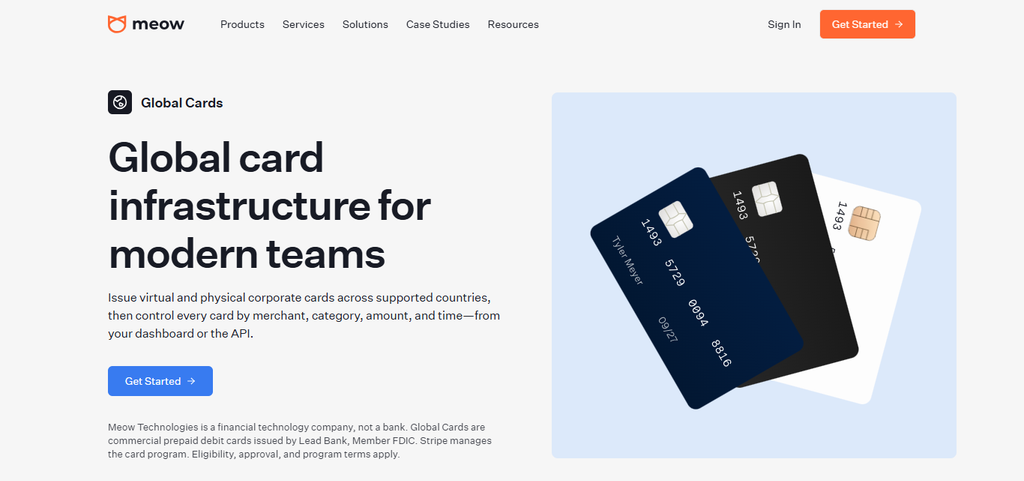
Meow also has business financial accounts that support cash and selected cryptocurrencies or stablecoins, and integrations with accounting software such as QuickBooks and Xero. This combination can help finance teams manage different types of business funds better. Companies need to check card eligibility, supported regions and terms of the applicable banking partner before onboarding.
Meow Card Pros & Cons
| Pros | Cons |
|---|---|
| Supports virtual and physical corporate cards. | The card program is subject to approval and eligibility requirements. |
| Allows merchant-specific and category-based spending restrictions. | Availability depends on the applicable card program and supported country. |
| Offers adjustable transaction and time-based spending limits. | Businesses should verify which banking and card services apply to them. |
| Provides card management through a dashboard and API. | Some advanced controls may require technical integration. |
| Offers business financial tools beyond card payments. | Meow is a financial technology company, not a bank. |
5. Mpcvault Card
MPCVault is related to digital asset security and wallet infrastructure, thus relevant to businesses exploring the security of cryptocurrency management. However, a corporate expense card product named exactly “MPCVault Card” could not be independently confirmed from the available sources.
Companies considering MPCVault need to understand that cryptocurrency custody or wallet-management services are not the same as a physical payment card with corporate expense controls. Before you integrate it into a business spending strategy, check whether the provider has employee cards, supported payment networks, spending limits, transaction monitoring, and accounting integrations.
In addition, businesses should review key-management arrangements, transaction approval processes and recovery procedures to evaluate whether the solution meets their security needs.
MPCVault Card Pros & Cons
| Pros | Cons |
|---|---|
| Provides team-oriented cryptocurrency wallet infrastructure. | Businesses should verify current card availability and eligibility. |
| Focuses on multi-party computation and transaction security. | Wallet security tools may require additional technical setup. |
| Supports institutional workflows and access management. | Not primarily a conventional expense-management platform. |
| Offers enterprise-oriented plans and customizable operational workflows. | Enterprise services may involve custom pricing and onboarding. |
| Can be relevant for businesses managing digital assets. | Card rewards and expense features should not be assumed. |
6. MetaMask Card
The MetaMask Card lets qualified users pay with supported crypto assets through a payment card connected to their MetaMask wallet. It can be useful for people and crypto-focused professionals who want to make everyday purchases without relying solely on traditional bank-funded cards.
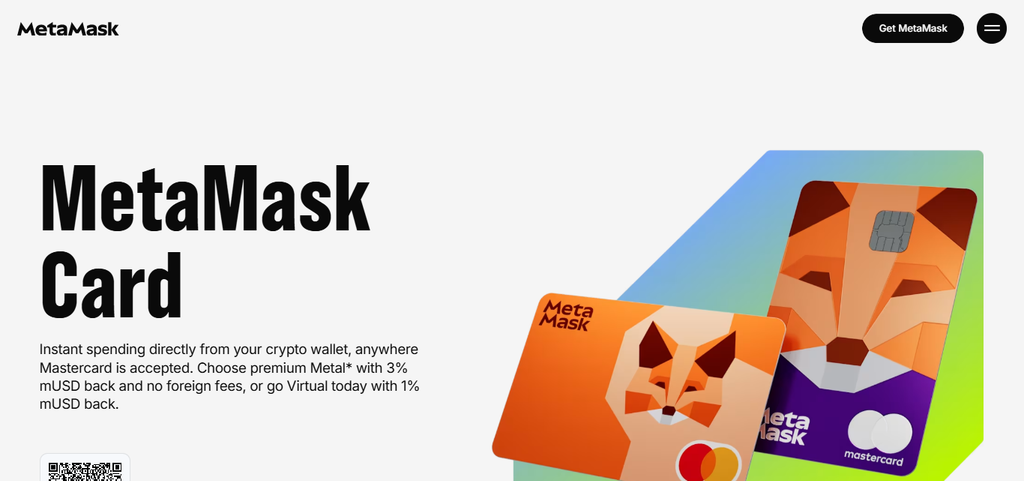
MetaMask says its card works with supported networks like Linea, Solana, Monad and Base, but availability depends on the product and region. The company also outlines a self-custodial model where the user retains control of their funds until payment.
While this feature can help business owners control some costs, teams should verify if corporate accounts, employee cards, expense reporting, and admin controls fit their needs.
MetaMask Card Pros & Cons
| Pros | Cons |
|---|---|
| Lets eligible users spend supported crypto directly from their wallet. | Sign-up is restricted to supported countries and territories. |
| Offers a free virtual card option in supported regions. | It is not designed specifically for corporate expense administration. |
| Supports Apple Pay and Google Pay where available. | Team-wide card issuance and centralized employee reporting are limited. |
| Provides self-custody until payment is made. | Spending crypto can create tax-reporting obligations. |
| Offers cashback on eligible purchases under applicable terms. | Some assets, transactions, and regions may involve additional fees. |
7. Solayer Emerald Card
Solayer Emerald Card is a name to look into for businesses who are exploring payment products connected with the Solayer and Solana ecosystems. A platform that links blockchain assets with everyday payments may be attractive to crypto-centric teams — especially around digital asset holdings and online business purchases.
But the sources we found don’t provide details of current specs for a Solayer Emerald corporate expense card and don’t independently verify its employee management features.
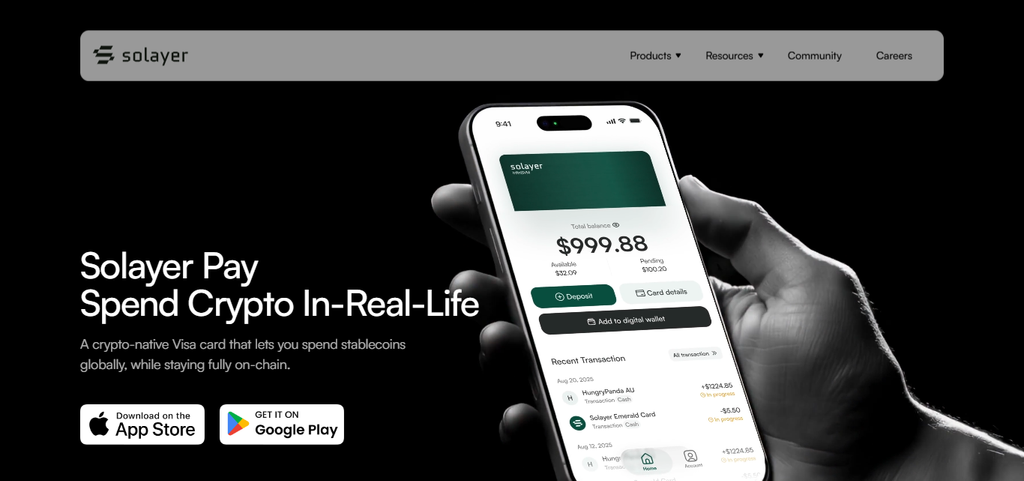
Hence, companies must refer to the official documentation of the product before using it for company expenses. You’ll want to take into account things like supported assets, card network acceptance, custody, spending limits, transaction fees, supported countries, and whether or not the card offers business administration and accounting tools.
Solayer Emerald Card Pros & Cons
| Pros | Cons |
|---|---|
| May interest users exploring Solayer ecosystem payment products. | Current corporate card specifications require independent verification. |
| Could appeal to teams operating within Solana-related ecosystems. | Corporate card issuance and employee management are unconfirmed. |
| May align with businesses holding blockchain-based assets. | Supported currencies and payment networks need confirmation. |
| Could offer an alternative to traditional payment methods if available. | Fees, spending limits, and regional availability are unclear. |
| Provides a potential avenue for researching crypto payment innovation. | Business expense reporting and accounting integrations are unverified. |
8. XPlace Card
XPlace Card is a cryptocurrency payment product that aims to bridge the gap between holding digital currencies and every day spending by card. Its website says users can choose between Cash Mode, which uses available funds, or Credit Mode, which borrows against eligible holdings without having to sell those assets.
XPlace talks about the non-custodial approach, supported crypto assets on Solana, mobile wallet compatibility and Visa acceptance in supported markets. These features might attract founders and crypto pros with digital wealth who want flexible ways to spend.
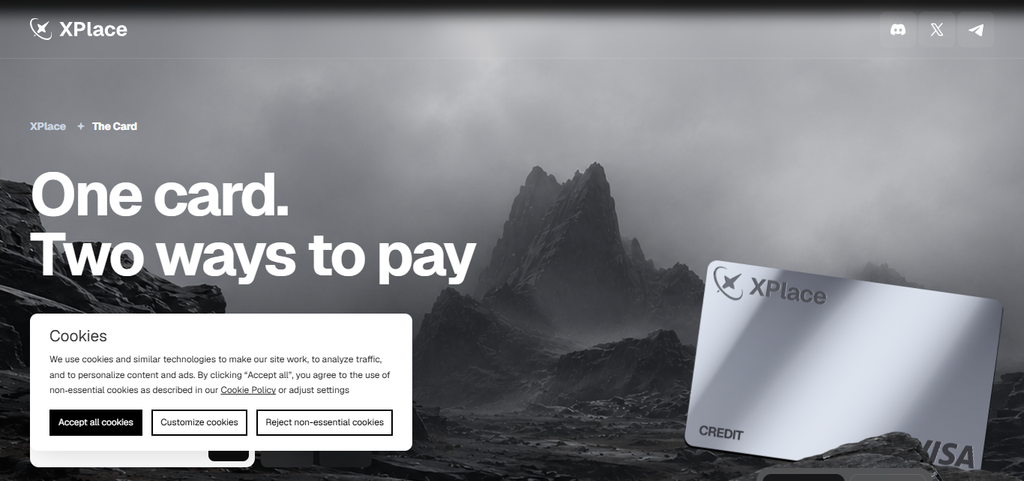
XPlace is primarily positioned as a consumer product rather than a dedicated corporate expense platform. Businesses should check employee card issuance, company expense reporting, borrowing risks and regional eligibility before adoption.
XPlace Card Pros & Cons
| Pros | Cons |
|---|---|
| Offers Cash Mode and Credit Mode for spending. | Credit Mode introduces borrowing and collateral-related risks. |
| Supports self-custodial digital asset management. | Cryptocurrency and collateral values can fluctuate significantly. |
| Supports Visa payments and mobile wallet compatibility. | It is primarily a consumer-focused product, not a dedicated team expense platform. |
| Advertises USDC cashback on eligible purchases. | Rewards and fees vary by membership tier. |
| Provides card freezing and transaction history tools. | Regional eligibility and borrowing terms should be reviewed carefully |
9. BitPay Corporate
BitPay is recognized for its cryptocurrency payment solutions that enable companies to accept digital currencies and handle crypto-related transactions. Its business solutions are pertinent for companies that want to integrate cryptocurrency payments into customer checkout, invoicing, or payment operations. Businesses can evaluate BitPay to accept supported digital resources and look at payment settlement options that align with their accounting processes.
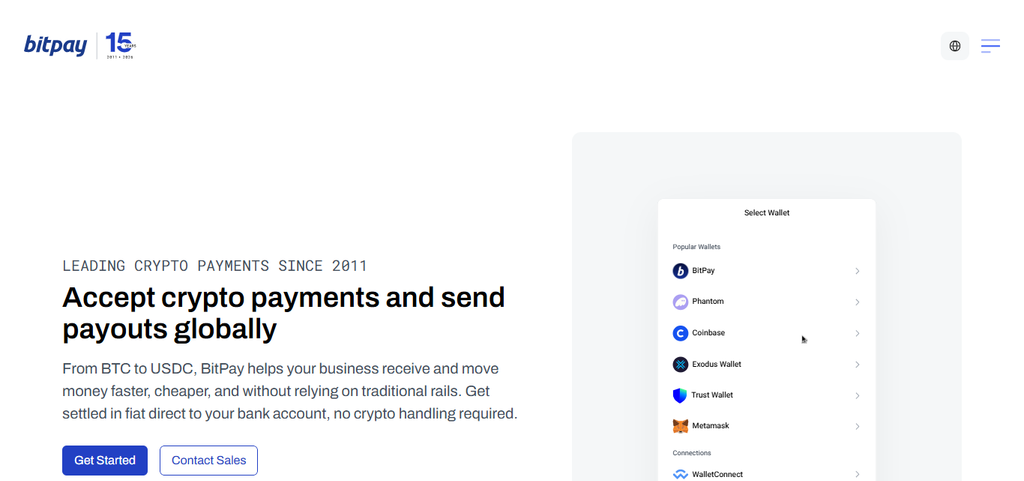
However, BitPay’s business payment services aren’t to be mistaken for a dedicated corporate expense card offering. If you’re a company looking for employee cards, see if BitPay offers a corporate card that fits your needs and is available in your jurisdiction. When choosing a solution, consider the supported cryptocurrencies, settlement currencies, transaction fees, compliance requirements, and accounting integration capabilities.
BitPay Corporate Pros & Cons
| Pros | Cons |
|---|---|
| Provides established cryptocurrency payment-processing services. | A dedicated corporate expense card under this exact name is unverified. |
| Supports businesses accepting cryptocurrency payments. | Merchant payment processing differs from employee card management. |
| Can help businesses integrate digital currency transactions. | Supported assets and settlement options depend on the service. |
| Offers payment-related tools for eligible businesses. | Transaction fees and settlement conditions require review. |
| May suit companies building crypto payment workflows. | It may not meet centralized employee spending and budgeting needs. |
10. Coinbase Business
Coinbase Business is a crypto-focused financial platform that enables qualified businesses to handle digital currencies and business payments. Its published features include buying, selling and exchanging cryptocurrency, sending and receiving global payments, creating invoices and payment links, and automating selected transactions via APIs. Businesses that are eligible can also get USDC-related rewards and supported staking services, subject to applicable terms.

These capabilities can help startups and crypto-native companies to manage treasury activities and integrate digital currencies into financial workflows. But don’t confuse Coinbase Business with a dedicated corporate expense card: its main offering is business accounts, crypto management and payments. Companies should check regional eligibility, fees and accounting requirements before signing up.
Coinbase Business Pros & Cons
| Pros | Cons |
|---|---|
| Supports buying, selling, and exchanging cryptocurrencies and stablecoins. | Business account availability is limited to eligible jurisdictions and entities. |
| Provides international payment tools, invoices, and payment links. | It is not itself a dedicated corporate expense card offering. |
| Offers APIs for automating selected financial operations. | API integrations may require development resources. |
| Supports eligible USDC rewards and staking services. | Rewards and staking depend on asset and account eligibility. |
| Helps businesses manage crypto treasury activities in one platform. | Trading, custody, and transaction fees may affect overall costs. |
Conclusion
In conclusion, the best corporate crypto expense cards for teams are convenient solutions for businesses to manage digital assets as well as monitor employee spending and simplify expense reconciliation. Oobit, Digitap, Slash and Meow are some of the platforms with different business-focused features.
When choosing a card, compare transaction fees, supported cryptocurrencies, security, regional availability and accounting integrations to find the most suitable solution for your company’s financial needs.
FAQ
They help businesses spend cryptocurrency and manage employee expenses efficiently.
Oobit, Digitap, Slash, and Meow offer business-focused spending solutions.
Yes, where supported by card networks, providers, and regional regulations.
Many providers offer customizable spending limits and transaction monitoring tools.
Security depends on provider safeguards, custody arrangements, authentication, and compliance.