
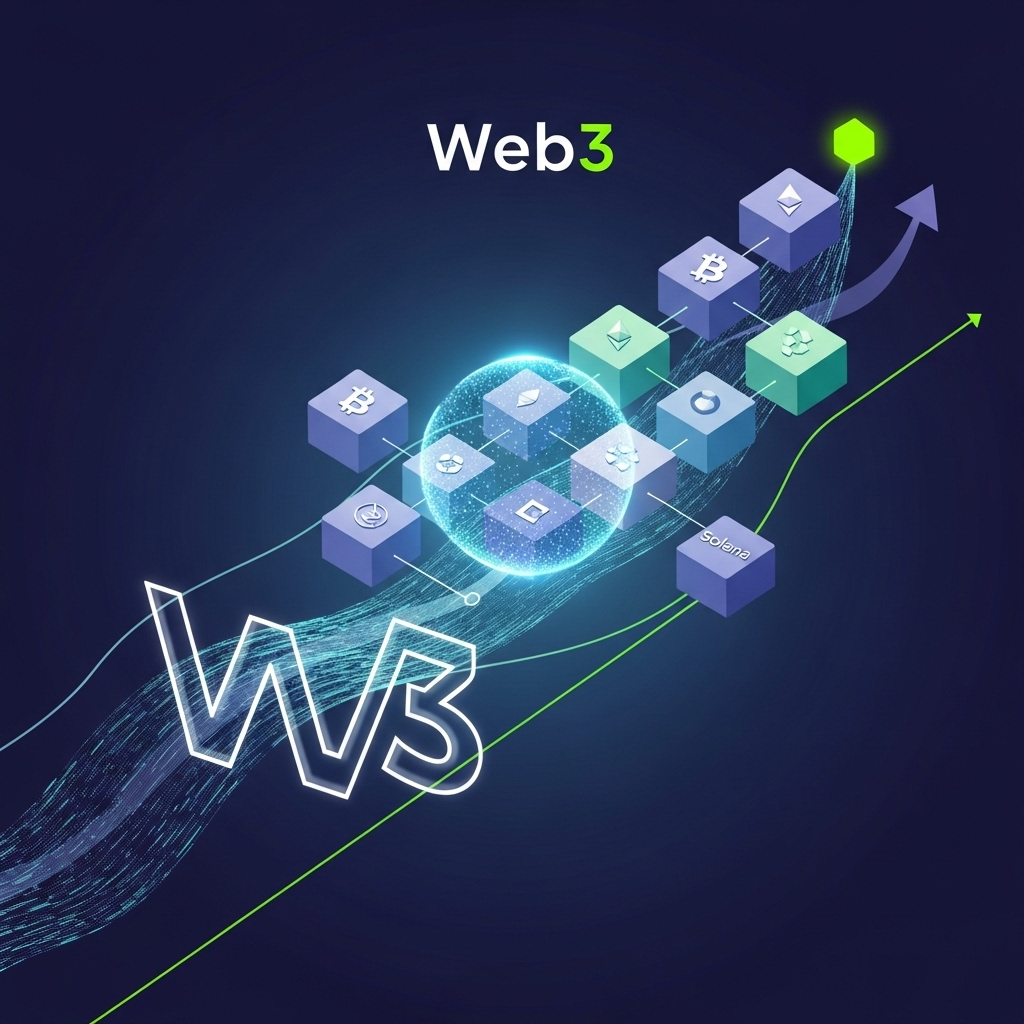

In this article, I examine some of the Best Web3 API and RPC Development Companies developing essential building blocks for modern blockchain infrastructure.
Performance-driven providers offer RPC endpoints and multi-chain APIs, and decentralized connectivity and enterprise-grade reliability to support developers building advanced applications on blockchain networks.
Analyzing their capabilities helps developers select a partner that provides secure, swift and future proof Web3 development.
Key Points & Best Web3 API and RPC Development Companies
- Alchemy — Comprehensive Web3 platform delivering reliable multi‑chain APIs, strong tooling, and consistent performance.
- QuickNode — High‑speed global edge RPC delivering fast responses and broad multi‑chain network coverage.
- Ankr — Decentralized multi‑chain network offering rapid RPC endpoints, advanced APIs, and extensive coverage.
- Chainstack — Enterprise node management providing dedicated infrastructure, hybrid‑cloud scalability, and secure deployments.
- Dwellir — Transparent pricing model using one RPC response per credit across vast networks.
- dRPC — Decentralized RPC aggregator offering flat‑rate pricing eliminating compute‑unit complexity entirely.
- Infura — Secure MetaMask‑integrated infrastructure enabling scalable Ethereum and multi‑chain API access.
- GetBlock — Flexible compute models with stable JSON‑RPC connectivity across numerous mainstream blockchains.
- OnFinality — Subquery‑powered platform offering private endpoints and seamless upgrades to dedicated clusters.
- Pocket Network — Relay‑based decentralized node network supplying censorship‑resistant public and private RPC endpoints.
10 Best Web3 API and RPC Development Companies
1. Alchemy
Alchemy is the leading multi-chain development platform in Web3. It offers powerful multi-chain APIs, first-class node services, and dedicated developer tools for debugging. A mid-paragraph mention is Alchemy’s enhanced monitoring suite where developers get real-time insights on performance, latency, and the behavior of requests across the networks.
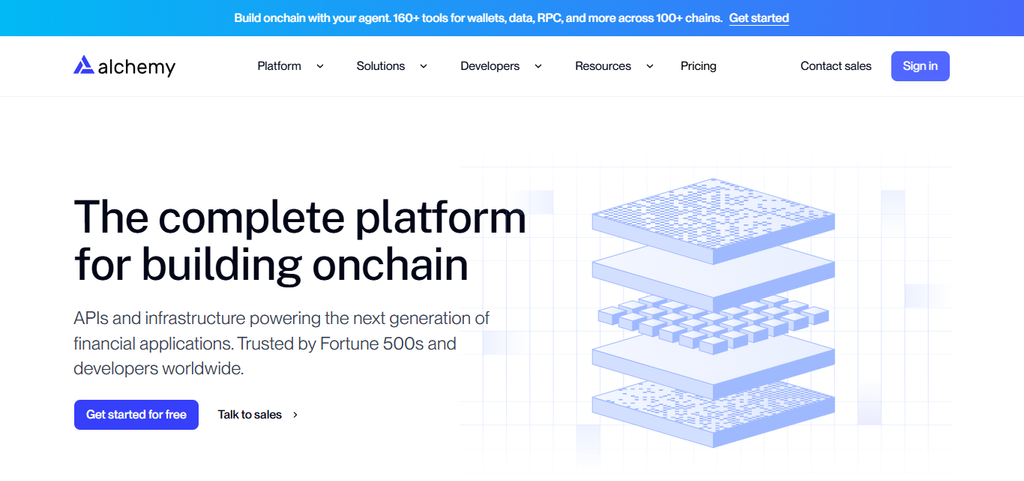
Alchemy’s architecture is optimized to support enterprise-level multi-chain applications across Ethereum, Polygon, Arbitrum, and Optimism. Among other things, Alchemy’s dashboards and documentation have been built to be intuitive in order to help teams build at maximum speed and deploy with confidence for maintenance of production continuously at scale across various blockchain ecosystems.
Pros
- Serves multiple blockchain networks with single endpoints.
- Good documentation and user tools.
- Flexible and quick to implement infrastructure.
- Useful APIs for blockchain data.
- Low latency and reliable connections.
Cons
- More powerful features increase overall cost.
- More advanced features complex and difficult to implement.
- Variable pricing.
- Coverage and reliability depending on the service.
- Limited plan options.
Alchemy — Features
| Feature | Details |
|---|---|
| Multi‑chain APIs | Reliable endpoints supporting major EVM and L2 networks. |
| Developer tooling | Debuggers, monitors, and dashboards for production‑grade workflows. |
| High uptime | Consistent performance with enterprise‑level reliability guarantees. |
| Scalable infrastructure | Handles heavy dApp traffic without latency spikes. |
2. QuickNode
QuickNode offers multi-chain scalability, speed, and reliability with its RPC infrastructure spanning the globe. QuickNode’s edge network reduces response times for users navigating wallets, as well as decentralized exchanges and applications with high volumes.
Mid-paragraph, QuickNode’s analytics offers detailed logging, performance, and error tracking to optimize a developing workload.
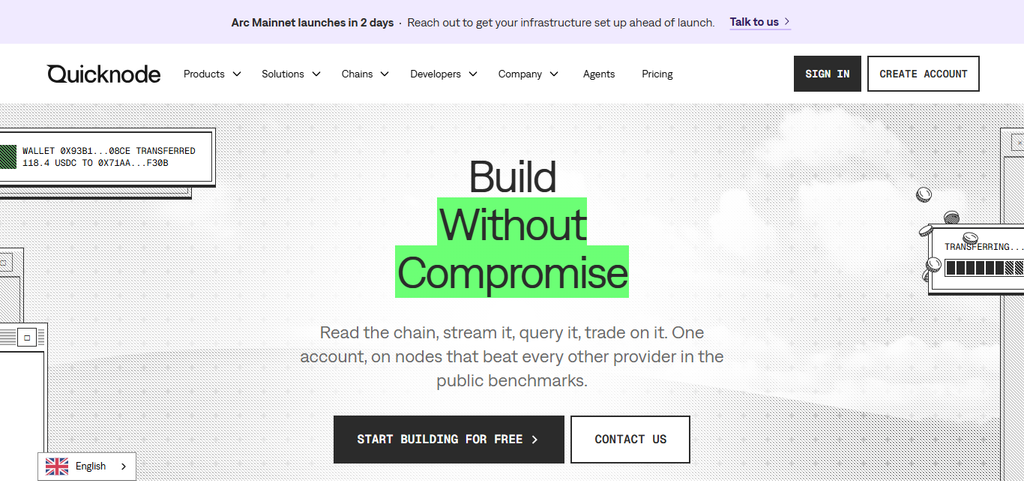
Scalable to more than 70 networks, including Ethereum, Solana, Base, and Avalanche, QuickNode offers optimized plans, dedicated nodes and advanced APIs. QuickNode is great for teams that need blockchain connectivity that is production-ready around the world.
Pros
- Low latency Web3 RPC nodes.
- Connects to numerous blockchains.
- International data centers.
- Toolkit and add-ons for developers.
- Ideal for applications requiring a lot of scalable RPC connections.
Cons
- More features increase cost.
- Variable and unmanned pricing.
- Configuration of more advanced features.
- Option overload.
- Differences in performance of supported networks.
QuickNode — Features
| Feature | Details |
|---|---|
| Global edge network | Ultra‑fast RPC routing across worldwide nodes. |
| 70+ chains | Broad multi‑chain coverage for modern Web3 apps. |
| Advanced analytics | Logs, metrics, and error tracking for developers. |
| Dedicated nodes | High‑performance private infrastructure for scaling. |
3. Ankr
Ankr’s multi-chain RPC network spans over 70 blockchains and focuses on speed and connectivity. It has a distributed node system that decreases the likelihood of failure and improves the reliability of Web3 applications.
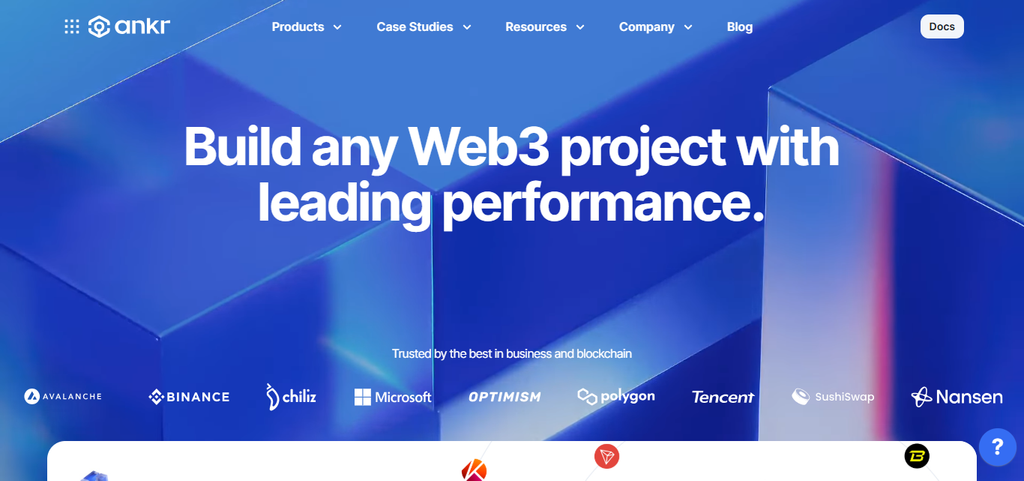
Ankr’s sophisticated API suite allows developers to access and integrate staking data and token metrics as well as blockchain indexing through unified endpoints. Ankr also ensures stellar performance for large‑scale deployments with dedicated enterprise‑grade nodes.
Combining a global presence and decentralization principles, Ankr provides developers the ability to create robust, effective, and efficient blockchain applications without the hassle of managing complex nodes.
Pros
- Connects to multiple blockchains via RPC.
- Coverage of a lot of blockchains and chains.
- Provides blockchain development APIs and data.
- Decentralized and distributed architecture.
- Multi-chain applications.
Cons
- Steep learning curve.
- Pricing is based on usage of different services.
- Differences in performance between blockchains.
- Decentralized and distributed infrastructure.
- Technical knowledge of distributed systems is required.
Ankr — Features
| Feature | Details |
|---|---|
| Decentralized RPC | Distributed node network reducing single‑point failures. |
| 70+ networks | Extensive chain coverage for global Web3 builders. |
| Advanced APIs | Unified endpoints for staking, analytics, and indexing. |
| Enterprise nodes | Dedicated infrastructure for predictable performance. |
4. Chainstack
Chainstack’s expertise is in enterprise‑grade node orchestration. It provides dedicated, isolated nodes and offers scalability across public and private blockchains. This makes it a great choice for regulated fields and deployment with high security.
Mid‑paragraph, Chainstack addresses the issue of increased workload performance by using its stateful automated scaling technology that eliminates performance upgrades.
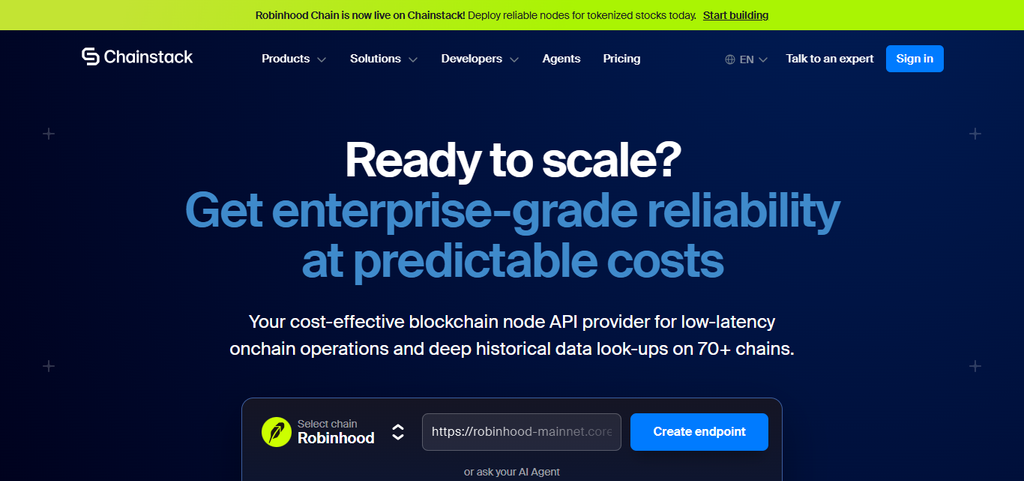
The platform offers solid performance monitoring, multi‑chain support spanning Ethereum, Polygon, and BNB Chain, and a competitive pricing model.
Combining infrastructure reliability and customization, Chainstack is a great choice for those looking for secure, production-ready connectivity for blockchain.
Chainstack — Features
| Feature | Details |
|---|---|
| Dedicated nodes | Isolated infrastructure for secure enterprise workloads. |
| Hybrid‑cloud | Flexible deployment across cloud and private environments. |
| Automated scaling | Smooth performance upgrades during traffic surges. |
| Multi‑chain support | Supports Ethereum, Polygon, BNB Chain, and more. |
5. Dwellir
Dwellir’s pricing is simple and transparent because the cost for one API call is the cost of one API response. Since Dwellir operates on approximately 140 networks, users of multi-chain applications can take advantage of Dwellir’s broad coverage.
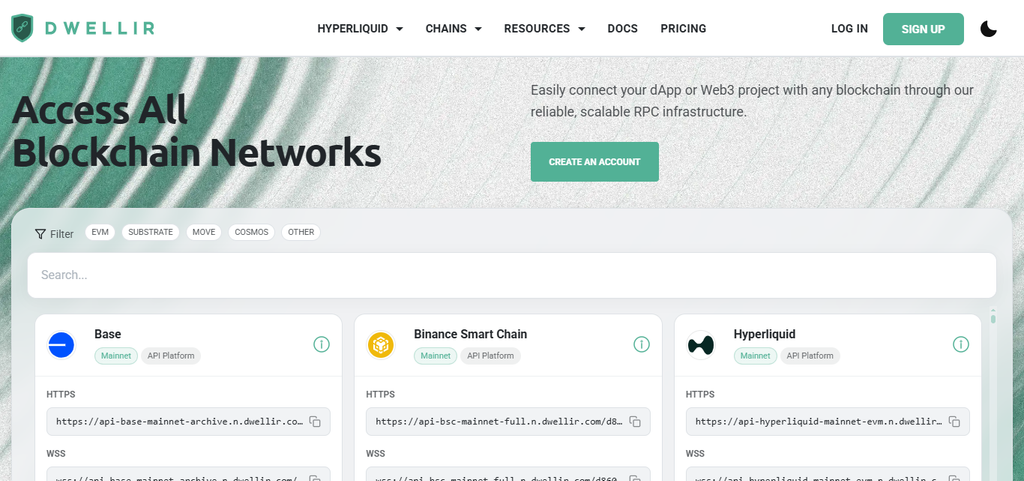
High performance nodes are used by Dwellir, so API requests have very low response time with a high throughput, even when a network is congested. Dwellir’s platform is intended for teams who have previously worked with compute-unit complex systems, as the platform is built around simplistic and predictable billing.
With useful and approachable documentation, support, and an expanding ecosystem, Dwellir makes RPC usage simple and accessible for developers across different blockchain ecosystems.
Pros
- Uses a straightforward RPC response-based credit approach.
- Provides access to many blockchain networks.
- Transparent usage can simplify infrastructure budgeting.
- Supports developers requiring predictable RPC access.
- Suitable for applications with diverse network requirements.
Cons
- Credit consumption depends on application activity.
- Developers must monitor usage carefully.
- Available features vary across supported networks.
- Advanced requirements may need additional configuration.
- Large applications may require higher-capacity plans.
Dwellir — Features
| Feature | Details |
|---|---|
| Transparent pricing | One RPC response equals one API credit. |
| 140+ networks | Massive chain coverage for global applications. |
| High‑performance nodes | Stable throughput even during network congestion. |
| Predictable billing | No compute‑unit confusion or hidden charges. |
6. dRPC
dRPC has designed its model to be a decentralized flat-rate RPC aggregator with the intent to provide simplicity with its pricing. dRPC’s request routing is designed across multiple node providers, so DEXs and wallets will remain stable and resistant to censorship.
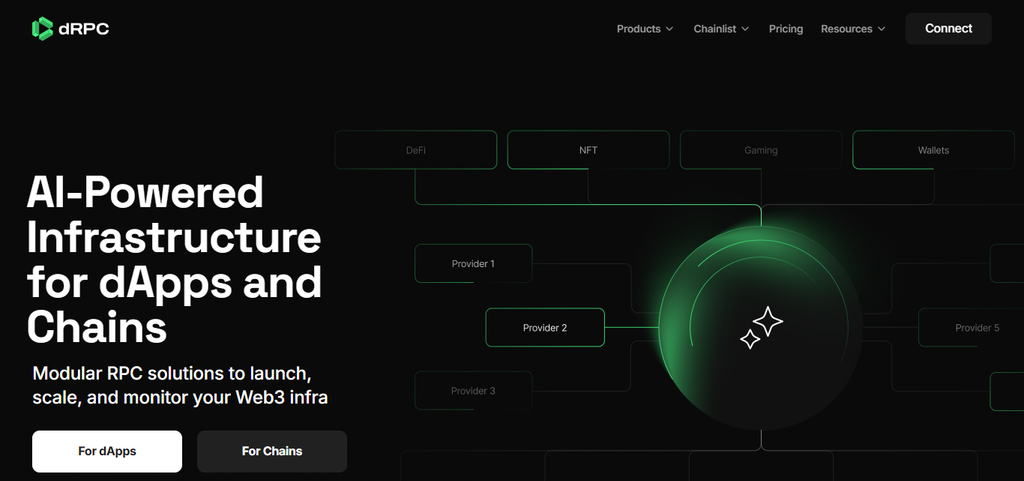
One of dRPC’s user-facing features is an intelligent routing system which automatically selects the fastest endpoint to further improve performance. dRPC supports numerous blockchains that make it incredibly simple for users to track and monitor their usage of the platform.
The combination of simplicity through pricing and ensuring a decentralized service makes dRPC a great choice for teams looking for easy to use high performance RPC access.
Pros
- Uses flat-rate pricing to simplify RPC costs.
- Removes traditional compute-unit complexity.
- Provides decentralized RPC infrastructure.
- Supports multiple blockchain networks.
- Can make infrastructure budgeting easier for developers.
Cons
- Decentralized architecture may require additional understanding.
- Network availability can vary across supported chains.
- Flat-rate plans may not suit every usage pattern.
- Advanced users may need custom configuration.
- Feature availability differs between blockchain networks
dRPC — Features
| Feature | Details |
|---|---|
| RPC aggregation | Routes requests across multiple providers for reliability. |
| Flat‑rate pricing | Simple billing without compute‑unit complexity. |
| Fast routing | Intelligent engine selects fastest available endpoint. |
| Decentralized design | Eliminates dependency on single RPC providers. |
7. Infura
Infura offers API access for Ethereum and some other leading multi-chain protocols, and can now handle millions of daily blockchain requests. It has integrated with MetaMask and has thus become a major part of many Web3 applications and a significant infrastructure provider.
Mid-paragraph, Infura’s high-availability style architecture means they can maintain service for their customers even if one of the networks begins to get heavier than normal.
Their dedicated Ethereum archive data and hosting services for IPFS and a range of endpoints for infrastructure across multiple chains means users can build all the applications they need without dealing with any hosts.
With enterprise-level security, a solid track record, and a great deal of trust among users in Web3, Infura is among the most trusted RPC providers.
Pros
- Provides established Ethereum infrastructure and APIs.
- Integrates closely with the broader MetaMask ecosystem.
- Supports scalable blockchain application development.
- Offers reliable RPC connectivity for developers.
- Provides tools designed for Web3 infrastructure needs.
Cons
- Some advanced capabilities require paid plans.
- Ethereum-focused users may find it more suitable.
- Pricing can increase with substantial usage.
- Developers need to understand API limits.
- Multi-chain support varies by individual network.
Infura — Features
| Feature | Details |
|---|---|
| MetaMask integration | Native support powering millions of wallet requests. |
| Ethereum scalability | Handles high‑volume traffic for major dApps. |
| IPFS hosting | Decentralized storage support for Web3 apps. |
| Multi‑chain APIs | Endpoints for L2s and emerging blockchain ecosystems. |
8. GetBlock
GetBlock has stable and fast JSON-RPC connections across multiple blockchains. Their offering has options for either shared or dedicated nodes so developers can choose their performance/cost tradeoff.
Mid-paragraph, GetBlock has tools for analyzing requests that will help developers understand how their applications are being used and how they perform.
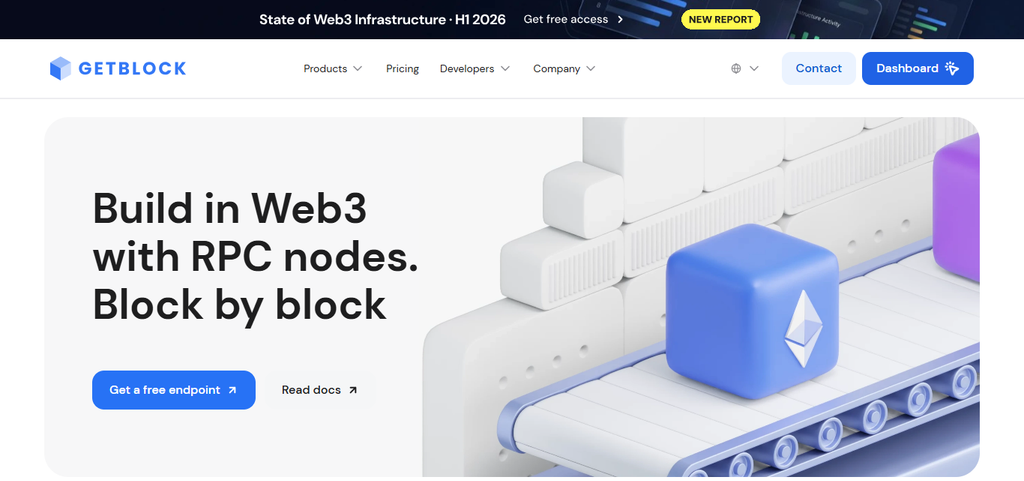
They support dozens of blockchains, including Ethereum and BNB Chain and multi-chain connectivity. Their offerings seem to be the best choice for devs looking for stable RPC access that are scalable.
Pros
- Provides RPC access across many popular blockchains.
- Offers flexible infrastructure and compute options.
- Supports standard JSON-RPC connectivity.
- Useful for developers building multi-chain applications.
- Provides different plans for varying workloads.
Cons
- Pricing depends heavily on selected usage levels.
- Plan comparisons may require careful evaluation.
- Network performance can differ by blockchain.
- Some advanced requirements may need technical setup.
- High-volume applications should monitor resource consumption.
GetBlock — Features
| Feature | Details |
|---|---|
| Flexible compute | Shared and dedicated node options for all workloads. |
| JSON‑RPC stability | Reliable connections across major blockchains. |
| Usage analytics | Logs and metrics for performance optimization. |
| Fast onboarding | Quick setup for developers building multi‑chain apps. |
9. OnFinality
With its seamless upgrades to private clusters and Subquery indexing tools combined with private APIs and ready-to-use infrastructure, OnFinality represents powerful tooling for networks running with Polkadot and other modular blockchain frameworks.
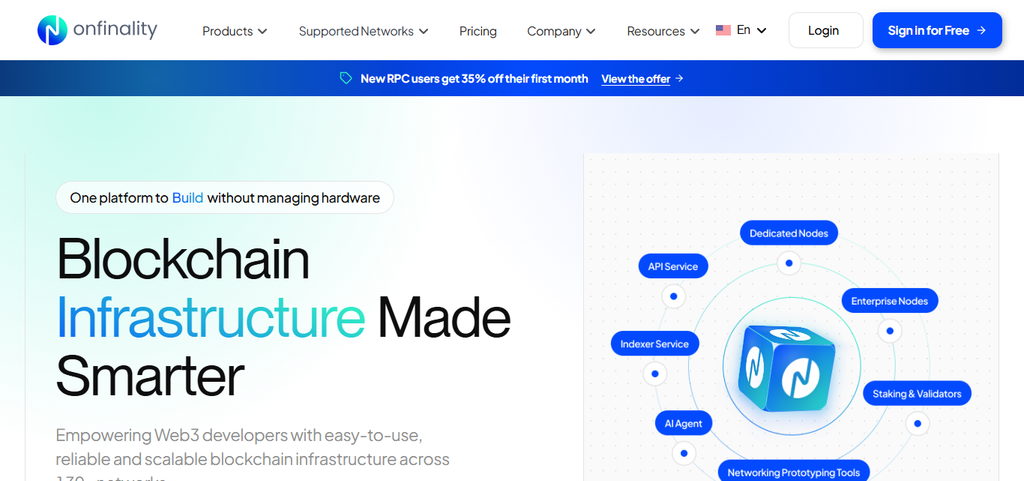
OnFinality also boasts automated scaling that eliminates operational overhead with high performing application scaling during traffic surges. Additionally, OnFinality offers detailed monitoring dashboards, price packages with predictable pricing, and multi-chain tooling for developers.
All of this combined with deep ecosystem integration makes OnFinality the first choice for teams building in the Polkadot and Substrate ecosystems.
Pros
- Provides managed blockchain infrastructure and RPC access.
- Supports private endpoints for greater control.
- Offers dedicated clusters for demanding workloads.
- Provides upgrade paths as applications scale.
- Useful for enterprise and infrastructure-focused projects.
Cons
- Dedicated infrastructure may cost more.
- Enterprise features can be excessive for small projects.
- Requires technical knowledge for advanced deployments.
- Pricing depends on infrastructure requirements.
- Some users may prefer simpler RPC platforms.
OnFinality — Features
| Feature | Details |
|---|---|
| Subquery integration | Native indexing tools for Polkadot ecosystems. |
| Private endpoints | Secure API access for production workloads. |
| Dedicated clusters | Smooth upgrades to high‑performance infrastructure. |
| Automated scaling | Maintains performance during traffic spikes. |
10. Pocket Network
Pocket Network boasts a decentralized node ecosystem where thousands of node runners provide a public and private blockchain application RPC access that is truly decentralized and censorship resistant. Pocket’s Relay Protocol mid-paragraph improves the reliability of its services while reducing the dependence on single-provider collections by distributing requests across its decentralized network.
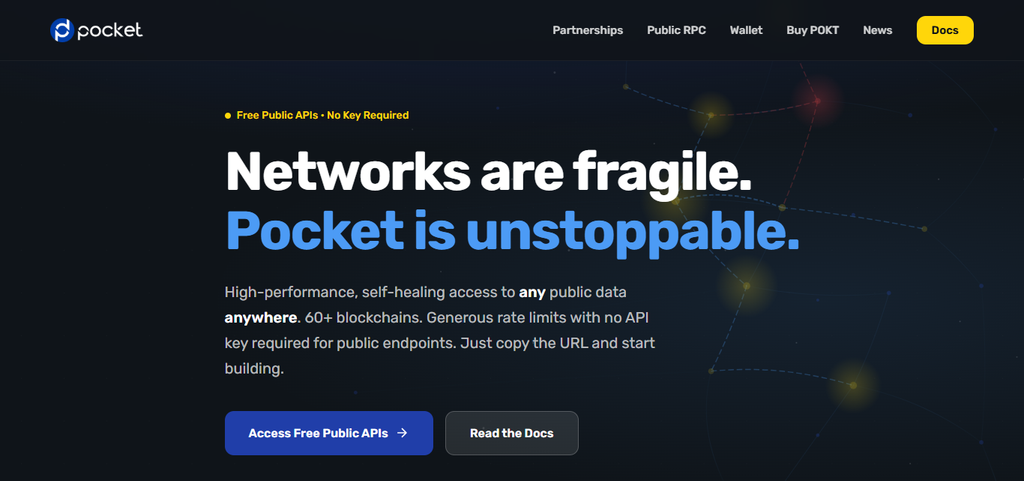
The network also integrates numerous blockchains and offers developers its token-based economics. With its strong principles of decentralization and reliable infrastructure, Pocket Network is among the best options for projects building in Substrate.
Pros
- Has a decentralized relay infrastructure.
- Offers public and private endpoints.
- Supports censorship resistant JSON-RPC.
- Routed by distributed infrastructure.
- Usage: Applications requesting decentralized communication.
Cons
- Decentralized infrastructure increases the level of abstraction and therefore increases management complexity.
- There is a performance tradeoff across the networks and node providers.
- Architecture requires a relay.
- Usage is limited to participating networks.
- Infrastructure tradeoffs increase the effort and expertise required for management and support.
Pocket Network — Features
| Feature | Details |
|---|---|
| Relay protocol | Distributes RPC requests across decentralized node runners. |
| Censorship resistance | Neutral infrastructure free from centralized control. |
| Public/private endpoints | Supports diverse application requirements. |
| Token‑based economics | Transparent incentives for node operators and developers. |
Conclusion
Conclusion – Best Web3 API and RPC Development Companies The best Web3 API and RPC development companies help create fast, secure, and scalable blockchain applications. Their services provide reliable, multi-chain connectivity, and advanced APIs, as well as decentralized infrastructure and performance offered at the enterprise level.
\Developers will have peace of mind knowing long-term stability, scaling and the ability to innovate with Web3, will be easier and seamless courtesy of a partner with high uptime, transparent pricing, and robust tooling.
FAQ
They provide blockchain data, endpoints, and tools for scalable decentralized applications.
They deliver fast, reliable blockchain connectivity powering wallets, dApps, and Web3 infrastructure.
Leading providers support numerous blockchains ensuring broad, flexible development capabilities.
Evaluate uptime, pricing clarity, chain coverage, performance, and developer tooling strength.