


In this article, I will highlight some of the leading enterprise-grade solutions for securing cryptographic keys, digital identities, and sensitive infrastructures, and elaborate on the Best Hardware Security Modules (HSM) for protecting corporate root keys.
You will discover how today’s HSMs provide tamper-resistant security and fully compliant, high-performance encryption, regardless of where they are deployed in the cloud or on-premise.
What is a Hardware Security Module (HSM)?
An HSM (Hardware Security Module) generates and securely stores cryptographic keys in a physical security device. In order to protect sensitive data and digital identities, HSMs encrypt, authenticate, and sign data.
Keys stored in general-purpose systems are more vulnerable to unauthorized access. HSMs isolate cryptography keys, preventing unauthorized access and tampering.
HSMs are useful to enterprises with financial systems and critical infrastructure. HSMs are compliant with security standards and are deployed within cloud environments or on-premises.
Key Poinst & Best Hardware Security Modules (HSM) for Protecting Corporate Root Keys
- Thales Luna HSM provides secure key storage and cryptographic operations.
- AWS CloudHSM offers dedicated hardware keys inside AWS cloud environment.
- IBM Crypto Express enables mainframe-grade encryption and secure key management.
- Utimaco SecurityServer delivers high assurance cryptography for enterprise infrastructures systems.
- Entrust nShield protects cryptographic keys with strong tamper-resistant hardware modules.
- Microsoft Azure Dedicated HSM provides isolated cloud hardware security services.
- Fortanix DSM offers cloud native HSM with scalable key management.
- Futurex HSM systems ensure high performance encryption for critical applications.
- Cavium LiquidSecurity accelerates cryptographic workloads using specialized hardware engines efficiently.
- YubiHSM 2 provides compact low-cost hardware security for developers teams.
10 Best Hardware Security Modules (HSM) for Protecting Corporate Root Keys
1. Thales Luna HSM (Thales Group)
Thales Luna HSM from Thales Group is an enterprise grade hardware security module designed to protect keys and perform cryptographic operations.
It is capable of supporting digital cloud migration and modern PKI and digital signature workloads. The latest iterations of the product line focus on hybrid cloud support and FIPS 140-3 compliance, providing better support for regulation.
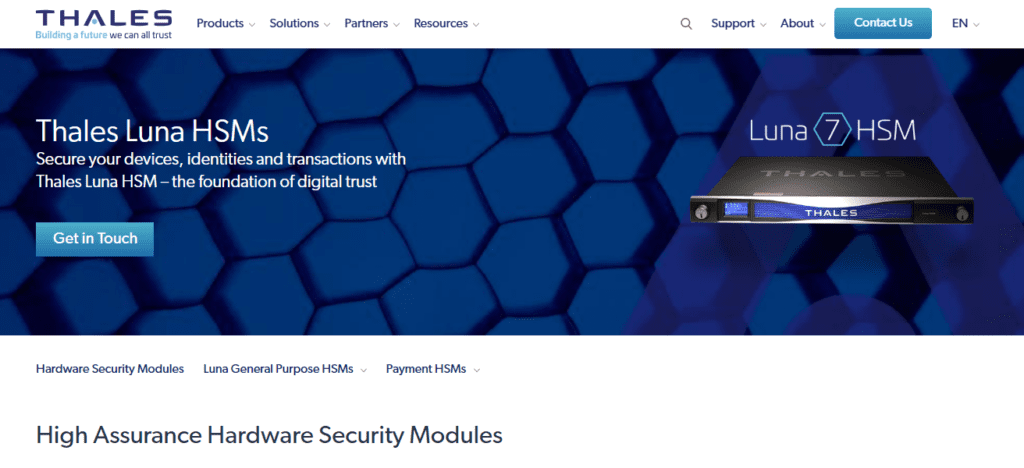
Invest in Luna HSM to protect root-of-trust keys and thwart extraction, all while providing maximum uptime for critical encryption services in the financial, governmental, and telecommunications sectors across the globe.
Thales Luna HSM (Thales Group) Pros & Cons
| Pros | Cons |
|---|---|
| High FIPS 140-3 certified security compliance | Expensive for small organizations |
| Strong hybrid cloud and on-prem support | Complex deployment and configuration |
| Excellent PKI and root key protection | Requires specialized security expertise |
| Highly trusted in the finance and government sectors | Hardware lifecycle management overhead |
2. AWS CloudHSM
Amazon Web Services CloudHSM is a fully managed, single-tenant hardware security module in the AWS cloud, providing customers the ability to generate and control cryptographic keys without the risk of sharing hardware.
More recent updates focus on the ease of use with AWS KMS, IAM policies, and enhancements for multi-region redundancy.
Enterprises rely on CloudHSM for secure application signing, database encryption, and meeting compliance mandates.
CloudHSM enables the latency of cryptographic operations while incorporating stringent isolation, making it the module of choice for organizations requiring cloud-backed security with a hardware commitment.
AWS CloudHSM Pros & Cons
| Pros | Cons |
|---|---|
| Fully managed single-tenant hardware security | Higher cost compared to software KMS |
| Strong AWS ecosystem integration | Locked into the AWS cloud environment |
| Scalable multi-region deployment support | Limited offline or hybrid flexibility |
| Low-latency cryptographic operations | Requires AWS expertise for optimization |
3. IBM Crypto Express
IBM Crypto Express is a hardware security module embedded in the IBM Z mainframes with secure and efficient management of encrypted keys and facilitated cryptographic operations.
IBM pays special attention to the requirements of the payment industry. Crypto Express defense in depth for mainframe latency and high throughput security makes it a popular choice in payment processing systems for embedding banks.
IBM Crypto Express Pros & Cons
| Pros | Cons |
|---|---|
| Extremely secure mainframe-level encryption | Only works with IBM Z systems |
| High performance for financial workloads | Very expensive enterprise solution |
| Quantum-safe cryptography readiness | Limited general-purpose use |
| Deep integration with banking infrastructure | Requires specialized IBM ecosystem skills |
4. Utimaco SecurityServer HSM
The Utimaco SecurityServer HSM provides PKI, blockchain, and IoT key management with the protection of certified cryptography at the FIPS and Common Criteria levels.
The newest iterations of the product have emphasized cloud and container support. Security is not compromised as the level of assurance is retained.
With the modular architecture of the design, it is flexible for customers worldwide with the assurance needed for the most critical applications.
As such, many governments and large organizations have chosen Utimaco HSM for protecting identities, transacting securely with customers, and managing elastic keys for hybrid environments.
Utimaco SecurityServer HSM Pros & Cons
| Pros | Cons |
|---|---|
| Strong certifications (FIPS, Common Criteria) | Setup can be technically complex |
| Supports PKI, IoT, and blockchain security | Higher enterprise pricing |
| Scalable hybrid and cloud-ready design | Limited consumer-level adoption |
| Flexible modular architecture | Requires trained cryptographic administrators |
5. Entrust nShield HSM
The nShield HSM from Entrust provides cryptographic hardware for tamper-resistant, secure key management of enterprise level services.
The nShield HSM is commonly used for certification authorities, payment services, and secure authentication services.
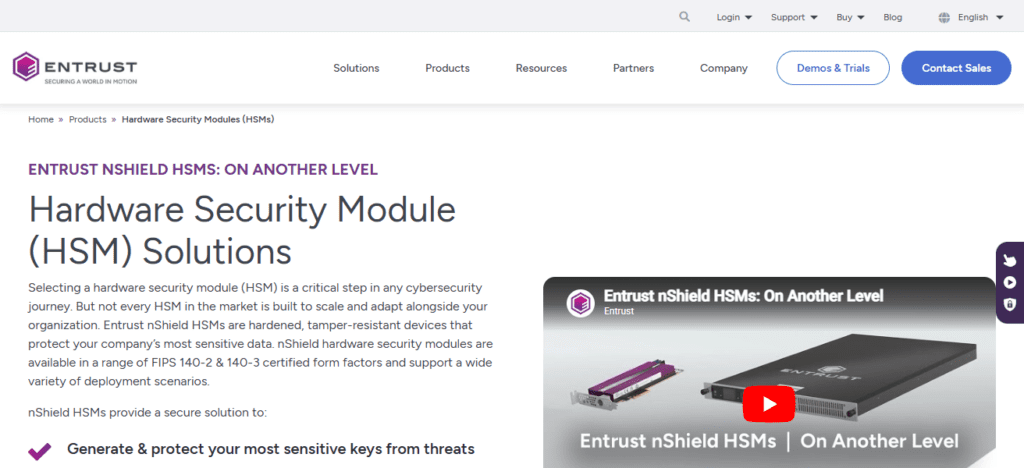
The latest versions offer post-quantum cryptography readiness and cloud integration. The HSM’s hardened security ensures that plaintext keys are never exported.
Entrust nShield HSM is relied on to secure digital identities, TLS infrastructure, and data pipelines, which are of great concern and need to meet compliance for regulated environments.
Entrust nShield HSM Pros & Cons
| Pros | Cons |
|---|---|
| Tamper-resistant hardware security design | High initial investment cost |
| Strong support for certificate authorities | Integration can be complex |
| Post-quantum crypto readiness features | Slower deployment in legacy systems |
| Widely trusted in global enterprises | Requires ongoing hardware maintenance |
6. Microsoft Azure Dedicated HSM
Microsoft’s Azure Dedicated HSMs are security modules of hardware that are single-tenant and fully isolated in a Cloud setting.
These security modules of hardware are designed to support enterprise workloads of finance, healthcare, and governmental systems that require strict compliance.
Enhancements to the service have improved integration with Azure Key Vault and designed the service for more automated provisioning.
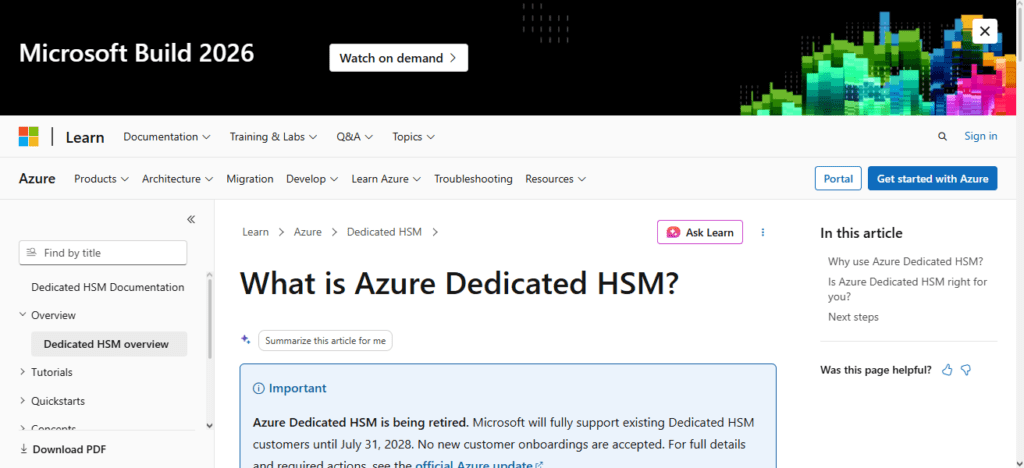
This fully isolated service in the Cloud enables enterprises to maintain their control of secure hardware modules for Cryptographic keys.
This service is especially applicable for enterprise resource planning systems and for securing application encryption and identity management.
Microsoft Azure Dedicated HSM Pros & Cons
| Pros | Cons |
|---|---|
| Fully isolated single-tenant cloud HSM | Only available inside Azure ecosystem |
| Strong Azure Key Vault integration | Limited portability outside Azure |
| High compliance for regulated industries | Requires Azure infrastructure dependency |
| Automated provisioning and scaling | Higher operational cloud costs |
7. Fortanix DSM (Data Security Manager)
Fortanix DSM is a platform with cloud-native HSM technology, providing centralized key management and encryption-as-a-service.
The platform keeps computing confidential, to keep keys safe, even during the processing phase. Fortanix DSM has improved on Kubernetes, as well as multi-cloud orchestration.
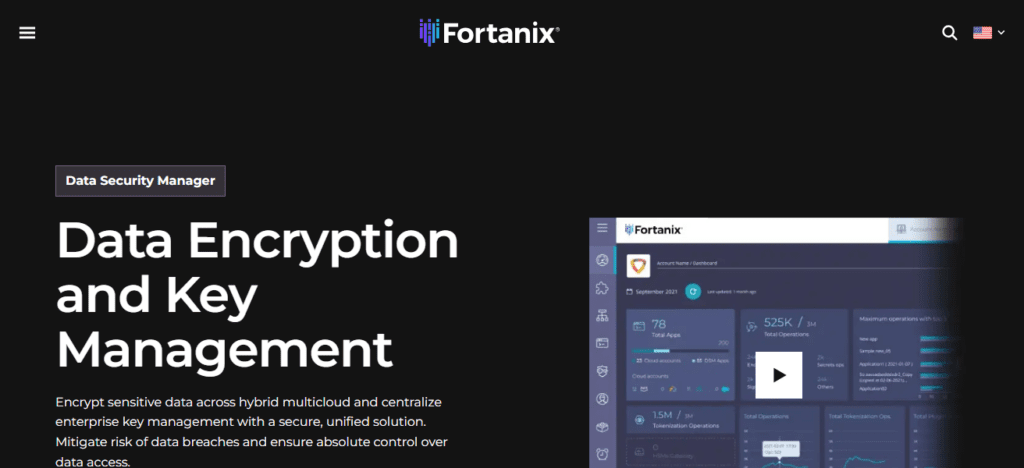
Fortanix DSM is deployed by enterprises to secure APIs, databases, and SaaS applications, especially because there are no hardware HSM constraints. It is a great way to achieve compliance while providing infrastructure cryptography and security.
It is a more modern cryptographic security technology solution, available in comparison to physical HSMs. Fortanix DSM is a great addition to infrastructures that are cloud-focused and hybrid.
Fortanix DSM Pros & Cons
| Pros | Cons |
|---|---|
| Cloud-native and scalable architecture | Less physical hardware assurance |
| Confidential computing security model | Dependent on internet/cloud connectivity |
| Strong Kubernetes and multi-cloud support | Subscription-based pricing can grow |
| Simplifies key management lifecycle | Not ideal for fully offline systems |
8. Futurex HSM Systems
Futurex HSM Systems are a great fit for environments that focus on the security of payments, banking, and enterprise systems. Futurex prioritizes ultra-low latency encryption and advanced tokenization.
Futurex easily integrates into cloud, as well as on-premise systems. Futurex is great for securing financial transactions, PIN management, and digital identity systems.
It is also a great fit for workloads that are mission-critical and demand a high level of encryption, because Futurex has a strong compliance certification and a scalable architecture.
Futurex HSM Systems Pros & Cons
| Pros | Cons |
|---|---|
| Extremely low-latency cryptographic processing | Premium enterprise pricing |
| Excellent payment and banking support | Limited public documentation availability |
| Strong uptime and reliability performance | Requires specialized configuration knowledge |
| Supports advanced tokenization methods | Less flexible for small deployments |
9. Cavium LiquidSecurity HSM
Marvell Technology, Inc. (previously known as Cavium), focuses on high-throughput hardware and cloud-based cryptographic processing. LiquidSecurity provides a great solution for this area.
LiquidSecurity easily integrates into networking security appliances and cloud-based data centers. LiquidSecurity TLS/SSL encryption offload provides a great solution for both performance and CPU.
Modern deployments of LiquidSecurity have a strong focus on security for virtualization and multi-tenancy.
Enterprises focus on LiquidSecurity for cryptographic workloads and seamless web traffic and APIs. LiquidSecurity also provides a strong cryptographic key isolation solution.
Cavium LiquidSecurity (Marvell) Pros & Cons
| Pros | Cons |
|---|---|
| High-speed hardware crypto acceleration | Now legacy-focused after Cavium acquisition |
| Excellent for SSL/TLS offloading | Limited modern enterprise branding support |
| Reduces CPU load in data centers | Integration complexity in modern stacks |
| Strong virtualization capabilities | Less direct vendor ecosystem support |
10. YubiHSM 2 (Yubico)
The YubiHSM 2 from Yubico is a small and budget-friendly option for a hardware security module. It is designed to be used by developers as well as small enterprises.
It offers storage for secure keys, signing actions, and basic cryptographic protections. The most recent upgrades have increased its ease of use with DevOps and Cloud offerings.
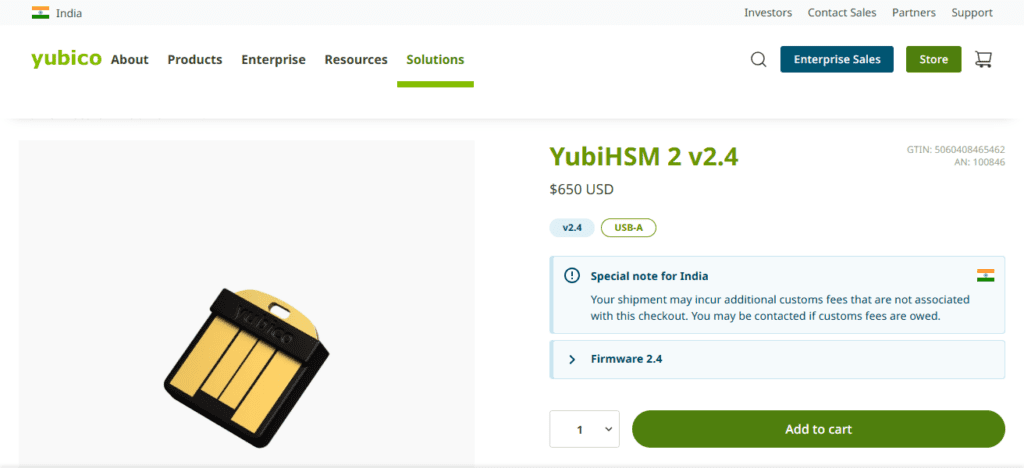
It is popular for securing code signing, SSH keys, and API authentication. Its form factor and cost design make it a great fit for a small enterprise wanting to implement a secure infrastructure without wasting resources.
YubiHSM 2 (Yubico) Pros & Cons
| Pros | Cons |
|---|---|
| Low-cost and compact USB-based HSM | Limited performance for large enterprises |
| Easy integration with DevOps pipelines | Not suitable for heavy cryptographic workloads |
| Strong for developers and startups | Fewer enterprise-grade certifications |
| Simple deployment and portability | Limited advanced hardware redundancy |
How We Select the Top Hardware Security Modules (HSM) for Safeguarding Corporate Root Keys
Security Certification Level HSMs must meet advanced security standards such as FIPS 140-2/140-3 and Common Criteria.
Root Key Protection Strength HSMs providing tamper-resistant protection for corporate root-of-trust keys are preferred.
Cryptographic Performance We measure latency, the number of transactions handled, and the speed of cryptographic operations.
Cloud & Hybrid Configurations HSMs must support on-premise, hybrid cloud, and multi-cloud systems.
Key Management Functions We assess tools for secure key generation, key lifecycle management, and key rotation and backup.
Integration Possibilities HSMs must enable extensive integration through APIs and support PKI, DevOps, and enterprise systems.
Scalability & High Availability HSMs must support clustering, load balancing, and failover.
Conclusion
In summary, HSMs provide a key safeguarding mechanism for corporate root keys. They achieve this by providing a cryptographic environment that is resistant to tampering.
HSMs ensure strong encryption and compliance with regulation, while providing a defense against continuously evolving cyber threats for both cloud and on-premises systems.
HSMs provide a trusted enterprise in addition to advanced key management. Considering that HSMs provide all of this, they are key to protecting digital identities and sensitive information, while also providing long-term enterprise cybersecurity in the constantly evolving modern state of IT.
FAQ
Banks, government agencies, healthcare systems, and cloud service providers widely use HSMs for data protection.
Yes, cloud HSMs provide dedicated hardware security with isolation, encryption, and compliance-grade protection.
On-prem HSM is physical in-office hardware, while cloud HSM is hosted securely in cloud infrastructure.
Yes, most HSMs support FIPS 140-2/140-3, PCI DSS, GDPR, and other global compliance standards.