


This article evaluates the Best Blockchain API Providers supporting developers building strong Web3 applications with dependable blockchain access. These tools’ APIs provide pathways to blockchain data, transaction control, smart contracts, and multi-chain maintenance.
These providers will be analyzed from their features, benefits, and downsides to the factors to consider for choosing a blockchain API provider.
What Are Blockchain API Providers?
Blockchain API Providers provide an interface to communicate with blockchain networks. For example, they are a way to access blockchain without the hassle of running your own nodes. Blockchain API Providers have a huge impact on the speed and ease of maintaining a Web3 application.
Providers simplify Web3 development with RPC calls, analytical APIs, wallets, and are multi-chain. There are several benefits for businesses. Blockchain API Providers help business create DeFi applications, NFT marketplaces, crypto wallets, and DApps.
Why Use Blockchain API Providers?
Access Blockchains Without The Need For Your Own Nodes Easily connect to multiple blockchains without having to run your own private nodes. You don’t have to worry about updating a node, or managing an entire infrastructure.
Less Development And Infrastructure Costs You can use the APIs as is. This can significantly speed up the development of your Web3 apps. You can save a lot of money by not having to set up an expensive blockchain infrastructure.
Enhanced Scalability, Speed, And Reliability You get access to high performance nodes that have great uptime, with a great response time. The infrastructure can support an increased amount of users and transactions.
Access Transactions And Blockchain Data Instantly You can access transactions on the blockchain and data from the network in real time. You can build a wallet, DeFi app, or analytical app that operates in real time.
Key Points & Best Blockchain API Providers
| Platform | Key Point |
|---|---|
| QuickNode | Multi-chain RPC provider with low latency nodes supporting 65+ blockchain networks. |
| Alchemy | Web3 platform offering powerful APIs, debugging tools, EVM and Solana support. |
| Infura (ConsenSys) | Reliable Ethereum infrastructure provider integrated with MetaMask and standard JSON-RPC APIs. |
| Helius | Solana-focused RPC provider offering transaction parsing, data streams, validator access. |
| Chainstack | Enterprise blockchain infrastructure providing scalable nodes and seamless multi-chain deployment. |
| Bitquery | Blockchain analytics platform delivering indexed on-chain data through GraphQL APIs. |
| Tatum | Unified Web3 APIs simplifying wallets, fees, and smart contract deployment. |
| Ankr | Decentralized node platform providing RPCs, staking tools, and gaming SDKs. |
| GetBlock | Offers dedicated and shared RPC connections across 50+ blockchain networks. |
| dRPC | Multi-chain RPC aggregator optimizing requests for uptime and faster dApp responses. |
10 Best Blockchain API Providers
1. QuickNode
QuickNode is an API provider focused on supporting developers creating Web3 applications. They put an emphasis on performance and support over 65 blockchains. Here are a few examples: Ethereum, Solana, Polygon and Bitcoin.
They provide low latency RPC nodes, WebSockets, improved APIs and great developer tools. QuickNode is a great option for DeFi, NFT, trading, gaming, and enterprise Web3 applications as they provide fast and reliable services.
QuickNode Features
- Offers infrastructure for over 65 blockchain networks.
- Provides low latency RPC nodes.
- Offers real time updates via WebSockets.
- Supports Web3 development via APIs and tools.
- Allows advanced blockchain add-ons in the marketplace.
| Pros | Cons |
|---|---|
| Supports 65+ blockchain networks with multi-chain flexibility. | Premium plans can be expensive for small developers. |
| Provides low-latency RPC nodes for high-performance applications. | Advanced features require technical blockchain knowledge. |
| Offers real-time WebSocket connections and developer tools. | Free-tier usage limits may restrict large projects. |
| Includes marketplace add-ons for extended functionality. | Enterprise-level customization may increase costs. |
2. Alchemy
Alchemy is a Web3 development API and infrastructure API with a ton of great developer tools. They support the leading blockchains such as Ethereum, Polygon, Arbitrum, Optimism and Solana. They provide improved APIs, smart contract monitoring with additional features for debugging
As well as NFT tools and account abstraction. They have great scalable infrastructure for creating performant and secure DApps. Because of all the services they provide, Alchemy is popular among startups and enterprises.
Alchemy Features
- Covers a wide selection of tier 1 networks.
- Offers APIs for advanced data and application needs.
- Features smart contract supervision and debugging.
- Provides NFT APIs and account abstraction as a service.
- Supports enterprise grade Web3 development.
| Pros | Cons |
|---|---|
| Provides powerful Web3 APIs and development infrastructure. | Pricing can become costly for growing applications. |
| Supports Ethereum, Solana, Polygon, and Layer 2 networks. | Mainly focuses on popular blockchain ecosystems. |
| Includes debugging, monitoring, and smart contract tools. | Beginners may find advanced features complex. |
| Offers scalable solutions for enterprise applications. | Some premium tools require higher subscription plans. |
3. Infura (ConsenSys)
ConsenSys’ Infura is a pioneer in blockchain APIs and provides highly reliable Ethereum and IPFS services. They provide great Ethereum Layer 2 support and also provide decentralized IPFS infrastructure.
Infura is designed to be secure and maintain a great level of scalability. Because many popular Web3 tools are built with Infura, it is a highly trusted API.
Infura (ConsenSys) Features
- Provides reliable Ethereum and IPFS services.
- Offers secure JSON-RPC APIs for blockchain communication.
- Supports Ethereum Layer 2 networks and dApps.
- Integrates with MetaMask and ConsenSys products.
- Offers fully managed blockchain nodes for developers.
| Pros | Cons |
|---|---|
| Provides highly reliable Ethereum and IPFS infrastructure. | Limited blockchain variety compared with multi-chain providers. |
| Integrates deeply with MetaMask and ConsenSys products. | Heavy Ethereum focus reduces flexibility. |
| Offers secure JSON-RPC API connectivity. | High-volume applications may need paid upgrades. |
| Trusted by millions of Web3 developers globally. | Customization options are limited compared to node providers. |
4. Helius
Helius is a blockchain API focused on Solana with fast Web3 solution support. Their RPC service, along with real-time streams, transaction parsing, and developer APIs, all tailored to Solana, are all enhanced. Most Solana platforms rely on Helios for their thorough node and blockchain data.
Their platform simplifies complex on-chain data for those wishing to develop DeFi apps, NFT marketplaces, wallets, and games.
Helius Features
- Provides high speed RPC infrastructure for Solana.
- Offers enhanced transaction parsing and analytics.
- Provides real time data for Solana.
- Supports advanced DeFi and NFT APIs.
- Offers optimized access to validators.
| Pros | Cons |
|---|---|
| Specialized Solana infrastructure with fast RPC performance. | Mainly limited to the Solana ecosystem. |
| Provides advanced transaction parsing and data tools. | Not ideal for multi-chain applications. |
| Offers real-time Solana blockchain data streams. | Smaller ecosystem compared to larger providers. |
| Supports DeFi, NFT, and gaming developers effectively. | Advanced features may require technical expertise. |
5. Chainstack
Chainstack offers nodes and APIs to build scalable, managed blockchains, all on enterprise-level infrastructure and APIs. They support a multitude of networks, including Ethereum, Polygon, BNB Chain, Avalanche, Solana, and many more.
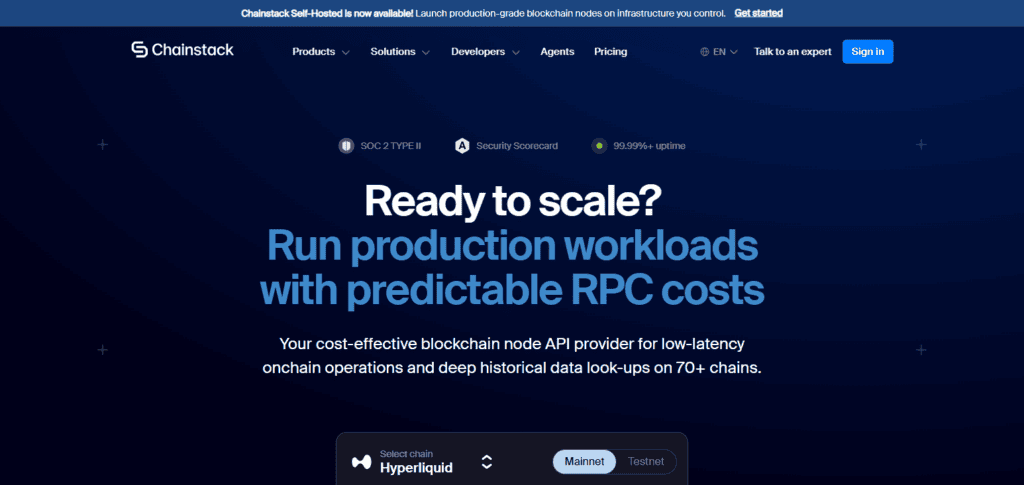
Developers have the ability to launch blockchain nodes and, in addition, have monitoring, automation, and secure API facilities. Chainstack is excellent for the business blockchain infrastructure, especially for financial services, Web3, DEXs, and enterprise blockchains, as it offers a flexible multi-chain infrastructure.
Chainstack Features
- Offers managed blockchain nodes and APIs for enterprises.
- Multi-chain networks with easy deployments.
- Provides secure infrastructure with monitoring and automation.
- Supports Web3 development across multiple ecosystems.
- Provides reliable multi-chain blockchain solutions for enterprises.
| Pros | Cons |
|---|---|
| Offers enterprise-grade blockchain nodes and APIs. | Enterprise pricing may be expensive for startups. |
| Supports multiple blockchain networks and deployments. | Requires technical knowledge for advanced configuration. |
| Provides monitoring, automation, and security features. | Less beginner-friendly than simple API platforms. |
| Enables scalable blockchain infrastructure management. | Some features depend on selected network support. |
6. Bitquery
Bitquery is a blockchain data analytics platform boasting APIs that are among the most comprehensive for indexed, multi-chain analytics. Developers love their GraphQL APIs, as they make analyzing transactions, tokens, wallets, and DEXs much easier.
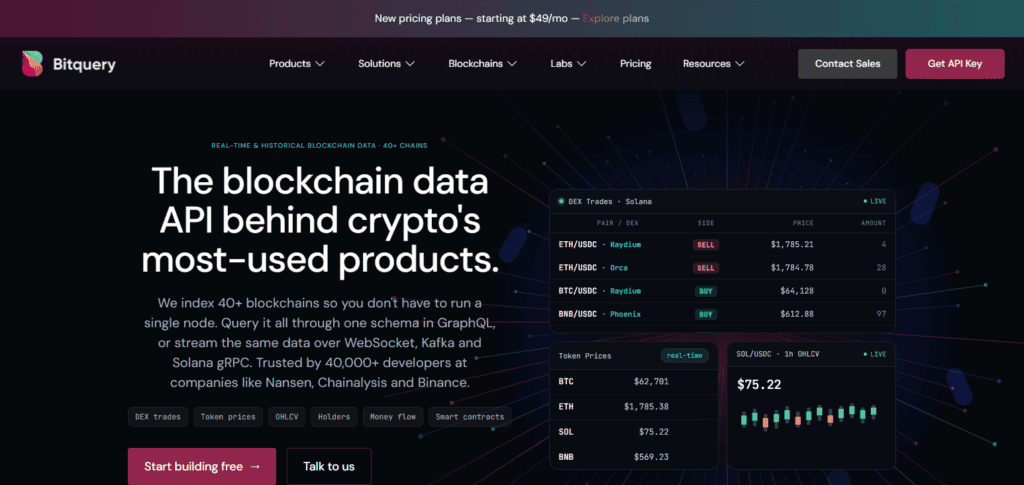
With support of more than 40 chains, Bitquery is a leading choice among analytics, compliance, research, and trading platforms. Their solutions on chained data are unparalleled for those wishing to track blockchain activity and build Web3 analytics.
Bitquery Features
- Advanced blockchain analytics available through GraphQL APIs.
- Allows access to indexed data across 40+ blockchains.
- Analyzes transactions, wallets, and token movements.
- Data easily DEX tracked with crypto flow tools.
- Enables powerful blockchain intelligence apps.
| Pros | Cons |
|---|---|
| Provides advanced blockchain analytics and data insights. | More focused on analytics than RPC services. |
| Supports 40+ blockchain networks with GraphQL APIs. | Complex queries require technical expertise. |
| Helps track transactions, wallets, and token movements. | Pricing depends on data usage requirements. |
| Useful for compliance and trading intelligence solutions. | Not suitable for basic blockchain connections. |
7. Tatum
Using Tatum’s APIs, developers can connect apps to many blockchains without having to deal with the complexities of blockchain development on backend infrastructure. Tatum facilitates wallet creation, transaction management, fee estimation, token creation, and the execution and management of smart contracts.
Tatum integrates the most popular blockchains, including Ethereum, Bitcoin, Polygon, and Solana. Because Tatum provides ready-to-use tools and automation features, startups and businesses of all kinds can speed up the development and deployment of their Web3 apps.
Tatum Features
- Unified APIs across blockchains.
- Wallets and transactions managed easily.
- Token and smart contracts created easily.
- Blockchain ops and fees automated.
- Web3 development simplified for startups and corps.
| Pros | Cons |
|---|---|
| Simplifies blockchain development with unified APIs. | Less control over blockchain infrastructure. |
| Supports wallets, tokens, and smart contract operations. | Advanced customization options are limited. |
| Helps startups launch Web3 applications faster. | Some features require paid subscriptions. |
| Provides beginner-friendly blockchain development tools. | Not ideal for highly specialized enterprise needs. |
8. Ankr
Multi-chain RPC, node, and Web3 infrastructure solutions are a part of Ankr’s decentralized blockchain infrastructure. Ankr’s hosted APIs are very useful for building decentralized apps, gaming, DeFi, and NFT projects.
Ankr solves a major challenge for many blockchain developers by integrating distributed nodes and staking offerings. Developers can easily connect to blockchain networks without relying on traditional centralized service solutions.
Ankr Features
- Multi-chain RPC and blockchain nodes, staking, and tools for Web3.
- Game and Finance APIs for easy access to DeFi and NFTs.
- Development tools increase accessibility for Web3.
- Distributed infrastructure for decentralized apps.
- SDKs empower Web3 devs.
| Pros | Cons |
|---|---|
| Provides decentralized multi-chain RPC infrastructure. | Performance can vary across network providers. |
| Supports many blockchain networks and Web3 applications. | Enterprise adoption is smaller than competitors. |
| Includes staking and developer-focused SDK solutions. | Requires understanding of decentralized infrastructure. |
| Reduces dependence on centralized blockchain providers. | Support resources may be limited for beginners. |
9. GetBlock
GetBlock offers dedicated and shared RPC nodes for APIs of over 50 blockchains. A focus on high availability and fast response times makes integrating for Web3 development easy.
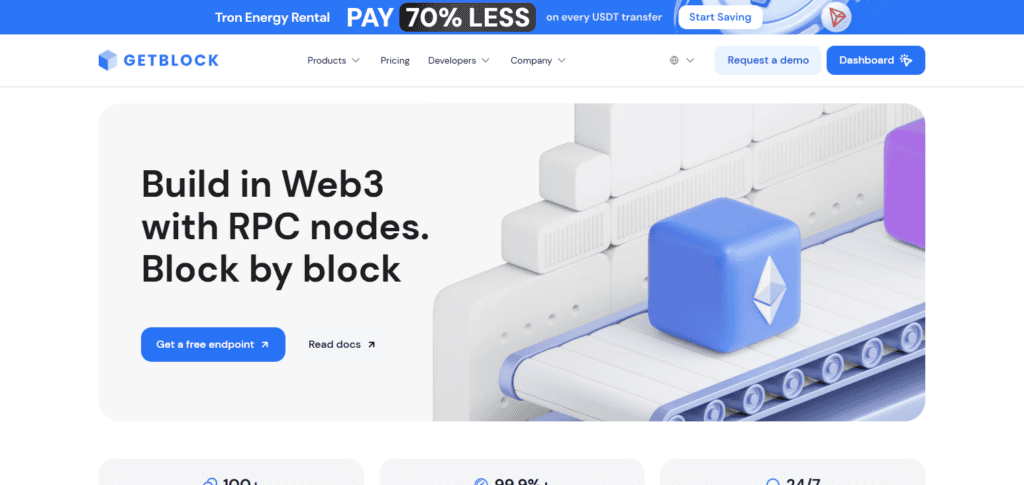
GetBlock provides the tools necessary to create wallets, exchanges, and applications in DeFi, as well as tools to monitor blockchains. GetBlock also supplies dedicated nodes for projects that have higher demands for performance and reliability.
GetBlock Features
- Shared and dedicated RPC nodes across 50+ networks.
- Fast and highly available blockchain APIs.
- Easy integration for Web3 devs and business.
- Custom nodes focused on performance for Ethereum, Bitcoin, Polygon, and BNB Chain.
| Pros | Cons |
|---|---|
| Supports RPC access across 50+ blockchain networks. | Advanced development features are limited. |
| Provides dedicated nodes for better performance. | Dedicated infrastructure can become costly. |
| Offers easy integration with Web3 applications. | Smaller developer community compared to competitors. |
| Focuses on reliable and fast blockchain connectivity. | Fewer enterprise automation features available. |
10. dRPC
dRPC is a multi-chain RPC aggregator. Thanks to their proprietary API request routing system, dRPC is improving connectivity to blockchains. With dRPC, decentralized applications can run with improved uptime, responsiveness, and reliability without the hassle of managing an additional blockchain node.
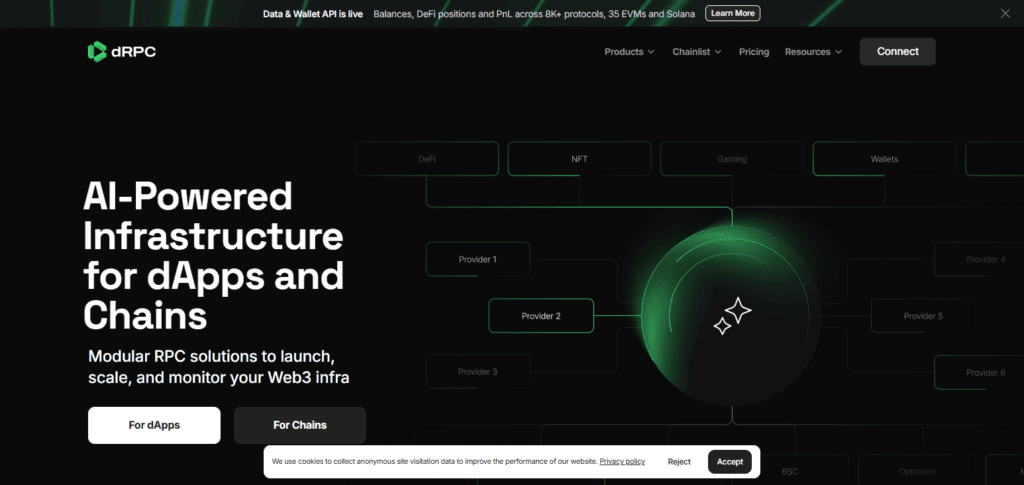
dRPC works with many different networks, automatically choosing the most useful RPC endpoints with the best performance. dRPC is ideal for DeFi, wallet, and Web3 systems that need performant, reliable connections to multiple blockchains.
dRPC Features
- Multi-chain RPC and intelligent routing.
- Cost optimized RPC for uptime and rapid processing for dApps.
- Blockchain reliability for Web3.
| Pros | Cons |
|---|---|
| Provides intelligent RPC routing for improved performance. | Depends on third-party blockchain node providers. |
| Improves uptime and reduces API failures. | Less control over individual node selection. |
| Supports multiple blockchain networks efficiently. | Advanced routing features require technical setup. |
| Helps reduce blockchain infrastructure management costs. | Newer platform compared with established providers. |
Factors to Consider When Choosing a Blockchain API Provider
Available Blockchain Networks Pick providers that allow access to the blockchain networks used in your project. Look for those that are compatible with Ethereum, Solana, Polygon, and others.
API Performance Be sure to look into the performance of the API. Pay attention to things like the speed and latency of the API and the stability of the connections and availability.
Security and Reliability Look into the various security provisions. Also, take into consideration the authentication methods and how data is protected. Look for providers that have a strong history of reliability and cover the various security provisions.
Pricing and Growth Potential Check how pricing works and what the limits of usage and subscriptions are. The provider should have the potential to grow as the application does.
Personalization of Services Select the provider that is most aligned with how you intend to use the application and its goals. Consider what is offered to the developers, the API, support, and how flexible the integration is.
Conclusion
In Conclusion Best Blockchain API Providers The Best Blockchain API Providers enable businesses and developers to build scalable, secure, and efficient Web3 applications. QuickNode, Alchemy, Infura, Helius, and Chainstack supply the infrastructure, dependable APIs, and multi-chain capability that can meet most requirements.
Depending on the specifics of your project, and which blockchains you will be working with, some of the providers will be better than others. Naturally, your available budget will also play a role in your API partner selection. The right blockchain API partner can improve the performance of your application and simplify the development process.
FAQ
Blockchain API Providers offer tools to connect applications with blockchain networks easily.
QuickNode, Alchemy, and Infura are among the top blockchain API providers.
Yes, they provide ready-made tools that simplify Web3 development.
Look for multi-chain support, fast APIs, security, and high uptime.