

In this article, I will discuss the Top Ethena Alternatives for Delta-Neutral Stablecoins and highlight the leading DeFi platforms offering alternative stablecoin solutions and yield-generating opportunities.
We will look into how each protocol works, what makes it different, and how each compares against Ethena in the ever-changing decentralized finance space by analyzing key protocol features, collateral backing, stability mechanisms, blockchain support, and earning potential.
Key Points & Top Ethena Alternatives for Delta-Neutral Stablecoins
| Platform | Explanation |
|---|---|
| MakerDAO | Overcollateralized DAI stablecoin backed by crypto and real-world assets, not perpetual hedges. |
| Solstice USX | Solstice’s USX ecosystem offers eUSX yield through diversified delta-neutral and real-world strategies. |
| Felix | Decentralized Hyperliquid-based protocol offering stablecoin borrowing, lending, and capital-efficient DeFi opportunities. |
| Usual Money | Issues USD0 stablecoins backed by tokenized real-world assets, distributing protocol revenue. |
| Alchemix | Offers self-repaying loans using yield-generating collateral and automated debt repayment mechanisms. |
| Ondo Finance | Provides tokenized Treasury products generating yield through traditional real-world financial assets. |
| Aave | Decentralized lending protocol enabling stablecoin deposits, borrowing, and variable interest earnings. |
| Compound | Decentralized money market enabling users to lend stablecoins and earn interest. |
| Curve Finance | Specialized decentralized exchange optimizing stablecoin swaps with low slippage and liquidity incentives. |
| Yearn Finance | Automated yield aggregator optimizing stablecoin returns through diversified decentralized finance strategies. |
10 Top Ethena Alternatives for Delta-Neutral Stablecoins
1. MakerDAO
MakerDAO, now part of the Sky ecosystem, is a decentralized stablecoin protocol offering DAI, and its successor USDS. These stablecoins are backed by diversified collateral, including ETH, liquid staking tokens, stablecoins and approved real-world assets. Their stability is maintained through overcollateralized vaults, liquidation mechanisms, governance-controlled risk parameters, and Peg Stability Modules that support dollar-peg liquidity.
Unlike Ethena, MakerDAO is not primarily reliant on delta-neutral derivatives or short positions. DAI was built on Ethereum, but the ecosystem allows for integrations and bridging to support other blockchain networks. It offers a collateralized alternative using decentralized issuance and transparent reserves.
Pros
- One of the oldest and most battle-tested DeFi protocols
- Decentralized, overcollateralized stablecoin design
- Large liquidity and wide integration across DeFi
- Savings rate gives holders a native yield
- Strong governance track record
Cons
- Heavy exposure to USDC and real-world assets, which weakens decentralization
- Governance can be slow and complex
- Rebrand to Sky caused confusion over DAI, USDS and MKR/SKY
- Capital inefficient because of high collateral requirements
MakerDAO (now Sky Protocol)
| Feature | Description |
|---|---|
| Overcollateralized stablecoin | Users lock collateral in Vaults to mint DAI (now also USDS). |
| Multi-collateral | Accepts ETH, staked ETH and real-world assets such as T-bills. |
| Dai Savings Rate (DSR) | Holders earn yield by locking DAI/USDS (sDAI/sUSDS). |
| Peg Stability Module | Lets users swap DAI against USDC at near 1:1 to hold the peg. |
| Governance | MKR (now SKY) holders vote on risk parameters. |
| Rebrand | Sky introduced USDS and the SKY token, with the “Stars” sub-protocol model. |
2. Solstice USX
Solstice Finance provides a decentralized stablecoin USX, which is linked to the dollar via overcollateralized issuance and diversified DeFi liquidity mechanisms. It is backed by approved crypto collateral and supported stablecoin assets deposited through the protocol’s minting modules.
USX maintains its dollar peg through vault-based collateralization, lending integrations and liquidity support. Its savings version, sUSX, provides yield opportunities through the protocol’s unified yield mechanism.
USX is live on Ethereum, Arbitrum, BNB Chain, Optimism and Base. Rather than Ethena’s delta-hedging model, Solstice is focused on collateral-backed issuance, cross-chain liquidity and integrated DeFi yield opportunities.
Pros
- Solana-native, so it benefits from low fees and fast transactions
- Backed 1:1 by stable collateral, with Chainlink Proof of Reserves
- YieldVault offers delta-neutral yield without direct crypto price exposure
- Composable with Solana DeFi
Cons
- New protocol with a short track record
- Yield relies on off-chain strategies such as funding-rate arbitrage, which can fail when market conditions change
- Yield figures are mostly historical and not guaranteed
- Counterparty and custody risk from off-chain execution
- Smaller liquidity than established stablecoins
Solstice USX
| Feature | Description |
|---|---|
| Solana-native stablecoin | Synthetic stablecoin built for Solana. |
| 1:1 collateral | Backed by stable collateral such as USDC/USDT. |
| Proof of Reserves | Real-time reserve verification via Chainlink. |
| YieldVault | Lock USX to receive eUSX, which reflects a share of the vault’s net asset value. |
| Delta-neutral yield | Yield comes from funding-rate arbitrage and hedged staking strategies. |
| Composability | Built for use across Solana DeFi apps. |
3. Felix
Felix Protocol is a decentralized lending and stablecoin platform built on the Hyperliquid ecosystem, with feUSD as its dollar-pegged stablecoin. It is backed by overcollateralized crypto assets including HYPE and other supported collateral tokens.
Users must deposit collateral into Collateralized Debt Positions (CDPs) to mint feUSD. It is stabilized by a combination of collateral, liquidations, direct redemptions and variable interest rates on borrowing. These mechanisms help to keep the dollar peg as market conditions change.

Felix is built on top of HyperEVM, using the Hyperliquid ecosystem. Instead of relying primarily on delta-neutral short positions, like Ethena does, Felix uses collateral-backed stablecoin issuance.
Pros
- Focused on the Hyperliquid ecosystem, which is growing quickly
- User-set interest rates in the CDP model give borrowers flexibility
- Isolated markets limit risk spread
- Offers both a stablecoin (feUSD) and lending markets
Cons
- Depends on the success of Hyperliquid and HyperEVM
- Young protocol with limited history and audits relative to older peers
- Smaller liquidity and user base
- Smart contract and oracle risk is higher for new deployments
Felix (Felix Protocol)
| Feature | Description |
|---|---|
| Lending on Hyperliquid | Runs on HyperEVM, the EVM layer of Hyperliquid. |
| feUSD stablecoin | CDP-based stablecoin minted against collateral. |
| Liquity V2-style design | User-set interest rates and no governance over rates. |
| Vanilla markets | Isolated lending and borrowing markets for chosen assets. |
| Yield vaults | Curated vaults that earn lending yield. |
| Hyperliquid ecosystem focus | Aims at liquidity and leverage use cases inside that ecosystem. |
4. Usual Money
Usual Money is a decentralized stablecoin issuer that issues a dollar-pegged cryptocurrency, USD0, which is backed by tokenized real-world assets. It is mostly backed by short-term United States Treasury Bills and other sovereign instruments through providers such as Hashnote, M0 and Spiko.
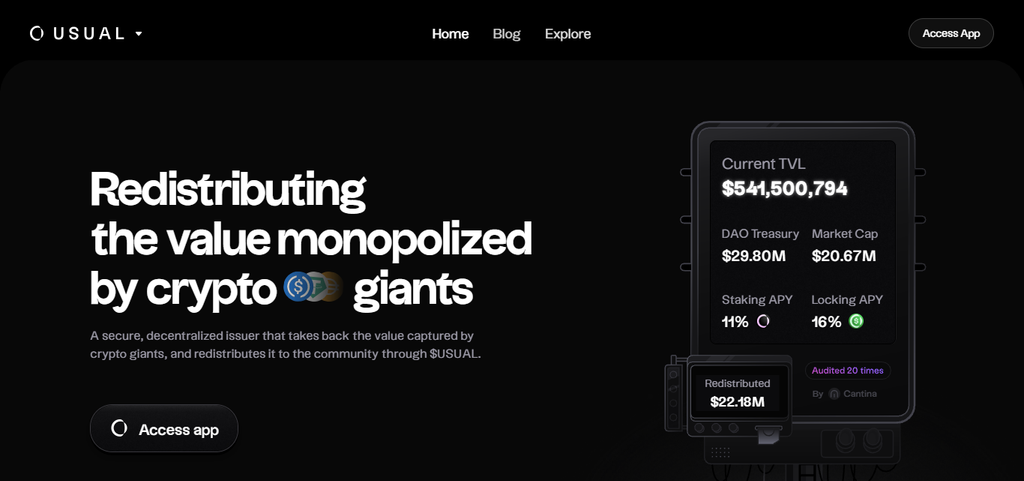
USD0 is fully collateralized, minted and redeemed on a one-for-one basis, has arbitrage incentives, and reserve management mechanisms to maintain its dollar peg. It’s underlying assets provide exposure to traditional finance, rather than crypto derivatives or delta-neutral trading.
USD0 is live on Ethereum, Arbitrum, Base and BNB Chain. Its model focuses on transparent reserves, real world asset backing and community participation in protocol revenue.
Pros
- USD0 is backed by real-world assets (T-bills)
- Shares value with users through the USUAL token
- USD0++ offers boosted rewards
- Reduces reliance on a single issuer
Cons
- The USD0++ redemption change in early 2025 caused a depeg and damaged trust
- Complex tokenomics (locking, floors, penalties)
- Dependence on centralized custodians and RWA issuers
- Token incentives can create sell pressure
Usual Money
| Feature | Description |
|---|---|
| USD0 stablecoin | Backed by tokenized real-world assets, mainly short-term T-bills. |
| USD0++ | Staked, time-locked version of USD0 that earns extra rewards. |
| USUAL token | Governance and value-sharing token distributed to users. |
| Ownership model | Aims to share protocol value with users rather than only the issuer. |
| Redemption mechanics | Floor and exit rules for USD0++ caused a temporary depeg in early 2025. |
| Multi-chain | Available on Ethereum and other networks. |
5. Alchemix
Alchemix is a synthetic asset protocol that mints alUSD, a dollar-pegged token produced by the process of collateralized borrowing. Mostly it is backed by stablecoin deposits that are deposited into yield-generating vaults, with other alAssets using the corresponding crypto collateral.
The protocol uses automated yield strategies to gradually pay back the outstanding debt of borrowers, creating its self-repaying loan model. It is backed by collateral, borrower incentives and the Transmuter redemption mechanism to maintain the alUSD peg.
However, market prices can deviate from one dollar in the short term. Alchemix supports deployments on Ethereum, Arbitrum, Optimism and Fantom. Whereas Ethena is primarily focused on delta-neutral derivatives, its mechanism is yield-backed debt repayment.
Pros
- Self-repaying loans reduce the need to manually repay debt
- Borrow without the same liquidation pressure as typical lending
- Taps into yield from established protocols
- Unique design, useful for long-term holders
Cons
- Limited borrowing power (about 50% LTV)
- Synthetic tokens (alUSD, alETH) can trade below peg
- Repayment speed depends on variable yields
- Complex mechanics, plus reliance on third-party yield sources
- Lower adoption than major lending protocols
Alchemix
| Feature | Description |
|---|---|
| Self-repaying loans | Deposited collateral earns yield that pays down the debt over time. |
| Synthetic assets | Borrow alUSD, alETH and similar tokens. |
| Up to 50% LTV | Collateral ratios are typically 200% (about 50% borrowing power). |
| No liquidation by price drops | Loans are not liquidated on price swings in the usual sense, though risk exists if yield or the collateral weakens. |
| Yield integrations | Uses Yearn, Aave and other yield sources. |
| ALCX token | Governance and incentives. |
6. Ondo Finance
Ondo Finance creates tokenized real-world financial products such as OUSG and USDY, providing exposure to traditional yield-generating assets on-chain. OUSG is mainly funded by institutional short-term US Treasury funds such as BlackRock’s BUIDL, and USDC and bank deposits for liquidity. “USDY” offers a tokenized exposure to short-term US Treasury securities and bank deposits.
The value of these instruments, and how they can be redeemed, depend on the valuation of the underlying assets, the custodial arrangements and the applicable redemption terms. Ondo supports Ethereum, Polygon, Solana & XRPL for OUSG, USDY has additional networks available. Where Ethena is eyeing derivatives-based delta-neutral strategies, Ondo is focused on old-school financial reserves.
Pros
- Gives on-chain access to US Treasury yields
- Strong institutional partnerships and credibility
- Compliance-focused, which suits regulated investors
- Low-volatility yield option
Cons
- KYC and geographic restrictions limit access
- Centralized issuance and custody of underlying assets
- Yield is tied to interest rates, so it falls when rates fall
- Less open than permissionless DeFi
- Regulatory risk
Ondo Finance
| Feature | Description |
|---|---|
| Tokenized real-world assets | Brings treasuries and securities on-chain. |
| USDY | Yield-bearing note backed by T-bills and bank deposits. |
| OUSG | Tokenized exposure to short-term US government bond funds. |
| Ondo Global Markets | Tokenized stocks and ETFs (restricted availability). |
| Compliance | Access is regulated, with KYC and jurisdiction limits. |
| ONDO token | Governance token. |
7. Aave
Aave is a decentralized lending and borrowing protocol that has its own dollar-pegged stablecoin called GHO. GHO is collateralized with approved crypto collateral available through Aave markets, including ETH and other eligible tokens. Users can mint GHO by depositing enough collateral and borrowing against their positions.
It is stable due to over collateralization , liquidation mechanisms , governance controlled minting limits and market arbitrage opportunities . These features maintain the value of GHO near a US dollar. GHO is an Ethereum native asset, and is deployed cross-chain on Arbitrum, Base, Avalanche, Gnosis, Mantle and Monad. Aave opts for collateralized issuance of stablecoins, not Ethena’s delta-neutral strategy.
Pros
- Largest and most trusted lending protocol
- Deep liquidity and multi-chain presence
- Strong security record and many audits
- Flash loans and wide asset support
- Has its own stablecoin (GHO)
Cons
- Smart contract risk, as with any protocol
- Borrowers face liquidation in volatile markets
- Interest rates can spike when utilization is high
- Governance relies heavily on large token holders
- Cross-chain deployments add fragmentation
Aave
| Feature | Description |
|---|---|
| Lending and borrowing | Pooled, non-custodial money market. |
| Variable and stable rates | Interest rates adjust algorithmically based on utilization. |
| aTokens | Interest-bearing receipt tokens. |
| Flash loans | Uncollateralized loans repaid within one transaction. |
| GHO stablecoin | Aave’s native overcollateralized stablecoin. |
| Multi-chain | Deployed on Ethereum, Arbitrum, Polygon, Base and others. |
| Safety Module / Umbrella | Staking mechanism that backstops protocol shortfalls. |
8. Compound
Compound is a decentralized lending protocol that enables users to supply stablecoins and other cryptocurrencies to earn interest or borrow supported assets. Unlike Ethena, Compound does not mint its own proprietary dollar-pegged stablecoin. Instead, it creates markets for existing stablecoins like USDC, USDS and USDT.
Its lending markets are underpinned by supplied liquidity and approved crypto collateral, such as ETH and wrapped bitcoin. The compound itself does not affect the price stability of stablecoins, which is determined by the issuer’s reserves and redemption mechanisms.
The compound is available on Ethereum, Arbitrum, Base, Optimism, Polygon, Unichain and other supported networks. It offers an infrastructure complementary to stablecoin lending.
Pros
- Pioneer of DeFi lending with a long track record
- Simple, easy-to-understand design
- Compound III isolates risk between markets
- Transparent, algorithmic rates
Cons
- Fewer assets and features than Aave
- Has lost market share to competitors
- Lower innovation pace
- Governance has faced controversy (for example, a 2021 bug and governance disputes)
- Liquidation risk for borrowers
Compound
| Feature | Description |
|---|---|
| Algorithmic money market | Rates set by supply and demand. |
| cTokens | Interest-bearing tokens representing deposits. |
| Compound III (Comet) | Single borrowable base asset per market, with collateral assets. |
| Governance | COMP holders propose and vote on changes. |
| Liquidation system | Under-collateralized positions are liquidated by third parties. |
| Simpler, isolated risk | Compound III limits contagion between markets. |
9. Curve Finance
Curve Finance is a decentralized exchange focused on stable coin trading, providing liquidity and enabling efficient cryptocurrency swaps. Its native stablecoin crvUSD is backed by approved crypto collateral deposited through collateralized borrowing markets. Users mint crvUSD against supported assets and the protocol utilizes its novel LLAMMA liquidation mechanism to manage collateral volatility and mitigate risks of sudden liquidation.
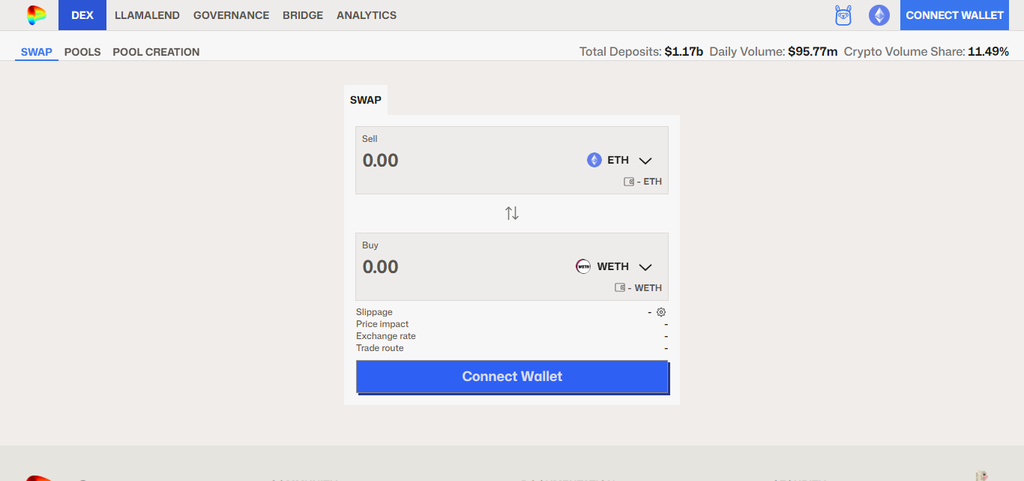
Its dollar peg is supported by collateral, market liquidity, and redemption-related incentives. Curve is live on Ethereum and several EVM-compatible networks, but crvUSD availability varies by deployment. Ethena is not about delta neutral hedging like Ethena, but about collateral-backed stablecoin issuance and the infrastructure for stablecoin liquidity.
Pros
- Best-in-class low-slippage stablecoin swaps
- Very deep liquidity, central to DeFi
- Rewards for liquidity providers (fees plus CRV)
- veCRV model gives governance influence
- crvUSD adds a soft-liquidation mechanism
Cons
- Interface and mechanics are complex for beginners
- veCRV locks reduce flexibility
- Exposure to depegs in pooled assets
- The 2023 Vyper compiler exploit damaged confidence
- Founder’s large CRV-backed loans raised concentration concerns
Curve Finance
| Feature | Description |
|---|---|
| Stable-asset AMM | Optimized for low-slippage swaps between similarly priced assets. |
| Stableswap and Cryptoswap pools | Pools for pegged assets and for volatile pairs. |
| crvUSD | Native stablecoin using the LLAMMA soft-liquidation mechanism. |
| veCRV model | Locking CRV gives voting power and boosted rewards. |
| Gauge system | Votes direct CRV emissions to pools. |
| Curve Lend | Lending markets built around crvUSD. |
10. Yearn Finance
Yearn Finance is a decentralized yield optimization protocol that helps users earn returns through automated crypto vault strategies. Yearn does not have a dedicated delta neutral stablecoin as its main product like Ethena. Rather, its vaults take in already existing stablecoins like USDC, DAI, USDS and USDT, subject to availability.
These deposits are deployed to selected DeFi lending markets, liquidity pools and other yield generating strategies . The backing of stablecoins and the stability of the dollar peg is a function of the underlying tokens, not the Yearn vaults.
Yearn V3 is available on Ethereum, Arbitrum, Polygon, Base and Katana. The main advantage is that it automatically optimizes stablecoin yield across diversified decentralized finance strategies.
Pros
- Automates yield farming and compounding
- Saves users time and gas fees
- Fixed-supply YFI with community governance
- Strategies are developed and reviewed by experienced contributors
- ERC-4626 support improves composability
Cons
- Past exploits (notably 2021 and 2023 incidents)
- Returns depend on strategy performance and market conditions
- Layered contracts increase smart contract risk
- Lower TVL and attention than in its peak
- Less transparent for users who don’t follow strategy details
Yearn Finance
| Feature | Description |
|---|---|
| Yield aggregator | Automatically moves deposits to the best yield strategies. |
| Vaults (V2/V3) | Pooled strategies with auto-compounding. |
| Strategies | Code-based strategies managed by developers. |
| ERC-4626 support | Standard vault interface for composability. |
| yETH and related products | Liquid staking and other pooled assets. |
| YFI governance | Fixed-supply token with community governance. |
Conclusion
To summarize, the Top Ethena Alternatives for Delta-Neutral Stablecoins provide varying approaches to stablecoin issuance, asset backing, and yield generation. Solstice, MakerDAO, Felix and Usual Money all have their own ways of keeping things steady and making profits.
Meanwhile Aave, Compound, Curve and Yearn are expanding DeFi opportunities. Users need to compare collateral, security, liquidity and risks before choosing a protocol.
FAQ
Popular alternatives include Solstice USX, MakerDAO, Felix, Usual Money, Alchemix, Ondo Finance, Aave, Compound, Curve Finance, and Yearn Finance.
Solstice USX is a notable alternative, using diversified reserves and delta-neutral hedging strategies to support its stablecoin ecosystem.
Ethena primarily uses crypto collateral and short derivatives positions, while MakerDAO relies on overcollateralized assets and liquidation mechanisms to maintain stablecoin backing.
Usual Money and Ondo Finance provide stablecoin and tokenized asset products backed by real-world financial instruments, including short-term US Treasury securities.