

This article will cover the Top Drift Protocol Competitors for Solana Margin Trading, highlighting top platforms for decentralized trading, leveraged positions, perpetual futures, lending, and liquidity management.
In this article, I will explore their key features, trading capabilities, and benefits to give the reader an understanding of how these platforms compare with Drift Protocol in the growing Solana DeFi ecosystem.
Key Points & Top Drift Protocol Competitors for Solana Margin Trading
| Competitor | Explanation |
|---|---|
| Jupiter | Offers Solana trading, perpetuals, token swaps, and liquidity aggregation across markets. |
| Phoenix | Provides high-performance decentralized orderbook trading with fast execution and low fees. |
| Flash.Trade | Enables leveraged Solana trading through perpetual markets with advanced risk management. |
| Kamino Finance | Combines lending, liquidity provision, and leveraged strategies across Solana DeFi markets. |
| Marginfi | Offers decentralized lending and borrowing services supporting leveraged Solana trading strategies. |
| Lavarage | Provides leveraged trading opportunities through decentralized finance tools built for Solana users. |
| Pacifica | Delivers decentralized perpetual futures trading with efficient execution and competitive trading features. |
| Adrena Protocol | Supports leveraged perpetual trading with liquidity pools and advanced Solana trading features. |
| GMTrade | Offers decentralized derivatives trading with leveraged positions and streamlined market access. |
| Project 0 | Provides decentralized trading infrastructure supporting leveraged positions and Solana ecosystem participation. |
10 Top Drift Protocol Competitors for Solana Margin Trading
1. Jupiter
Jupiter is one of the leading decentralized finance platforms in the Solana ecosystem, providing token swaps, liquidity aggregation, and perpetual futures trading. Its Jupiter Perps product allows traders to take leveraged long and short positions on supported assets such as SOL, BTC and ETH. The platform operates on a trading model based on liquidity pools .
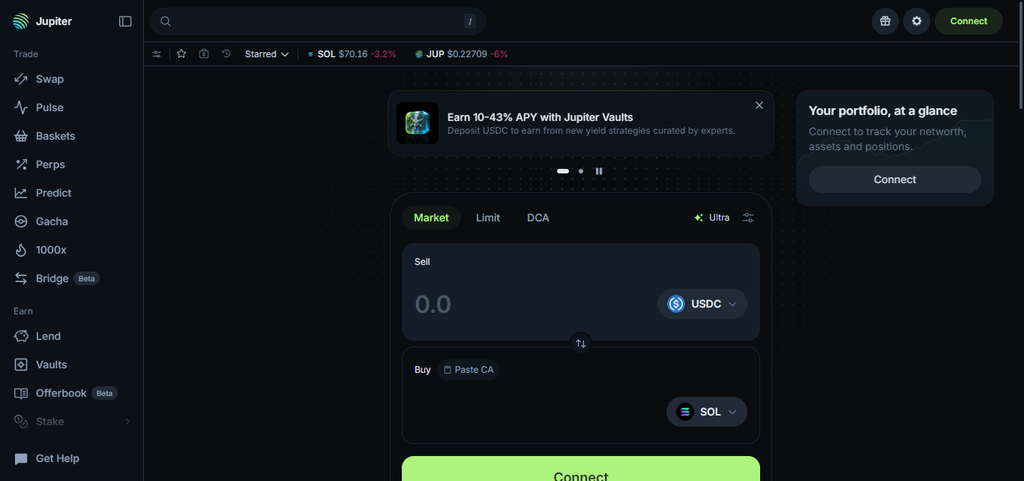
The Jupiter Liquidity Provider ( JLP ) pools provide market liquidity and counterparty to traders . Users receive a unified trading interface, access to multiple markets and established Solana infrastructure. Jupiter is taking Drift head on with its leveraged derivatives, liquidity management and trading accessibility (although its pool-based architecture is different from Drift’s hybrid exchange model).
Jupiter Best for
- Best for liquidity aggregation and token swaps on Solana.
- Best for decentralized perpetuals trading.
- Best for access to multiple cryptocurrency markets.- Best for integrated trading and leveraged exposure.
2. Phoenix
Phoenix is a decentralized exchange built by Ellipsis Labs and designed for high-performance orderbook trading on Solana. Its architecture supports limit orders, market execution and on-chain settlement without using traditional centralized exchange infrastructure. Phoenix is now offering perpetual futures, giving traders access to leveraged positions in crypto and other supported markets.
The crankless orderbook architecture provides efficient order execution, matching and settlements via Solana transactions. The platform also emphasizes transparency, execution quality and capital efficiency for traders and market makers. Phoenix challenges Drift with decentralized derivatives infrastructure, providing an alternative orderbook-based approach to leveraged trading and liquidity management.
Phoenix Best for
- Best for high-performance on-chain order book trading.
- Transparent decentralized trade execution. Best at it.
- Best suited for limit orders and market making strategies.
- Best for efficient trading infrastructure on the Solana network.
3. Flash.Trade
Flare.Trade is a decentralized trading protocol on Solana that in the past offered spot and perpetual futures markets with the ability to trade on margin. It used a pool-to-peer liquidity model in its trading architecture that enabled traders to open leveraged positions while liquidity providers supplied assets through the Flash Liquidity Pool.
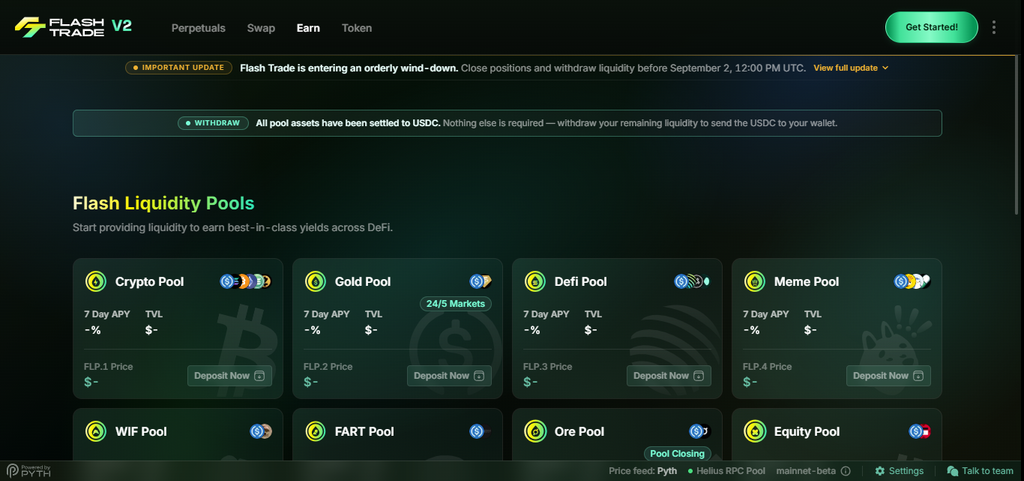
The platform featured oracle-based pricing with Pyth integration for market pricing and trading execution. Liquidity providers would be rewarded based on trading activity and would offer an alternative liquidity model to traditional orderbooks.
Flash!Trade competed on Drift via leveraged derivatives and liquidity provision. It announced a shutdown in August 2026, so it should be treated as a historical competitor, not as an active alternative.
Flash.Trade Best for
- Best for pool based trading of historical perpetuals.
Best for crypto trading strategies with leverage. - Best for liquidity provider engagement.
- Best for exploring decentralized derivatives infrastructure.
4. Kamino Finance
Kamino Finance is one of the top DeFi protocols on Solana. It specializes in lending, borrowing, liquidity management and automated financial strategies. Its lending markets allow consumers to deposit supported assets and earn interest, while borrowers access liquidity against the collateral they supply.
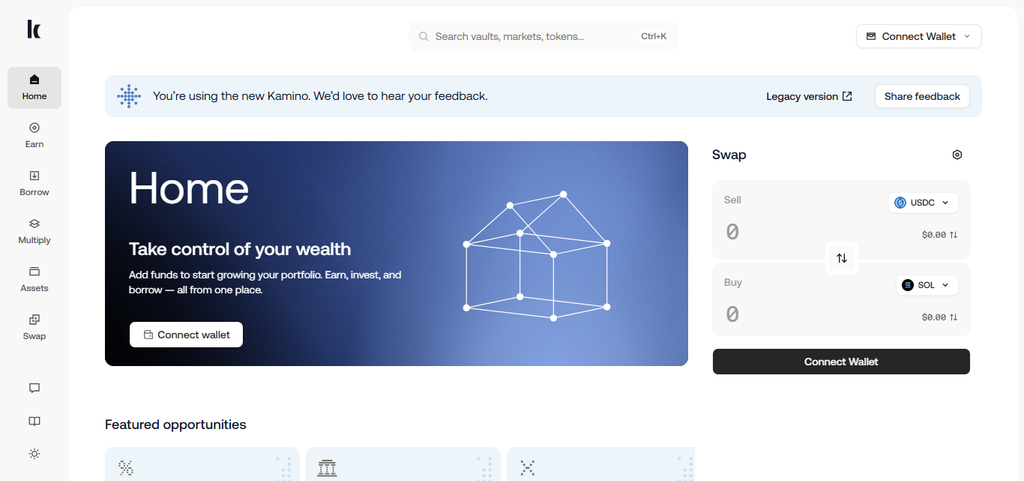
There are also leveraged strategies and automated liquidity management products on Kamino that help users improve capital efficiency across decentralized markets. It can be integrated with Solana apps allowing for the possibility of collateral use, borrowing and composable DeFi.
Unlike Drift which focuses mainly on perpetual futures and derivatives trading, Kamino provides financial infrastructure that supports leveraged DeFi strategies. Indirectly, it competes by meeting the needs of the traders who seek borrowing facilities, collateral management and capital efficient exposure.
Kamino Finance Best for
- Ideal for automated liquidity management.
- Best for leveraged DeFi strategies.
- Best to improve capital efficiency over Solana markets
- Perfect for decentralized lending and borrowing.
5. Marginfi
Lavarage is identified within the Solana leveraged-trading competitor landscape as a project associated with decentralized margin-trading opportunities. Its relevance to Drift stems from the general demand for leveraged crypto exposure, capital efficiency, and decentralized trading infrastructure.
Key comparison points for Lavarage include supported trading markets, collateral requirements, borrowing mechanisms, liquidation procedures, liquidity availability, and execution costs. These attributes define how well a protocol caters to traders seeking leveraged positions without dependence on centralized exchanges.
However, publicly verifiable information about Lavarage’s current product architecture, supported markets, and operational status is limited. Its competitor classification should therefore remain provisional until its official documentation and active product availability are independently confirmed.
Marginfi Best for
- Best for getting a loan backed by cryptocurrency.
- Best for sites with decentralized lending.
- It is best to earn interest on the assets provided.
- Good for accessing additional liquidity with collateral.
6. Lavarage
Pacifica is a decentralized perpetual futures trading platform related to the Solana trading ecosystem. It provides an orderbook based trading experience to traders with leveraged cryptocurrency markets. The platform focuses on execution efficiency, market liquidity and trading transparency as well as advanced tools for the management of leveraged positions.

It has multiple trading markets and maker and taker order execution and risk-management mechanisms built for active derivatives traders. The competition between Pacifica and Drift is on attracting users who want to trade decentralized perpetual futures and want professional trading features.
Its orderbook design is an alternative to pool based platforms and is therefore relevant when comparing liquidity depth, execution quality, trading fees and overall derivatives infrastructure.
Lavarage Best for
- Best for exploring decentralized leveraged trading.
- Best for margin exposure to cryptocurrency.
- Best for assessing capital-efficient trading opportunities.
- Best for exploring alternative Solana margin-trading infrastructure.
7. Pacifica
Adrena Protocol was a decentralized perpetual futures trading platform built on Solana, providing leveraged crypto trading via its Adrena Liquidity Pool (ALP). Traders would be able to open long and short positions and liquidity providers would supply capital to back trading activity.
The protocol was built with an emphasis on capital efficiency, access to liquidity, leveraged exposure and decentralized derivatives functionality. Its peer-to-pool model offered an alternative to traditional orderbook exchanges like Drift.
Adrena previously worked in leveraged markets and liquidity based execution. However, the protocol announced that its supporter’s withdrawal means users should close positions in August 2026. So it is to be placed as a historical competitor, not a live alternative.
Pacifica Best for
- Best for decentralized trading of perpetual futures
- Best execution for orderbook trades.
- Best for leveraged positions in crypto.
- Best for advanced derivatives trading features.
8. Adrena Protocol
GMTrade is a decentralized perpetual futures trading platform on Solana. It gives you leveraged exposure to the cryptocurrency and other financial markets. Its architecture uses liquidity pools and oracle-based pricing to allow trading without relying entirely on traditional centralized orderbooks.
Traders can take long or short positions and liquidity providers provide capital to facilitate the market. GMTrade also focuses on competitive trading fees, market accessibility and diversified asset exposure, such as select commodities, currencies and equities.
Its pool-based design is an alternative to Drift’s hybrid trading infrastructure. GMTrade is directly competing for derivatives traders looking for decentralized execution, leveraged positions, and more opportunities to interact with financial markets on the Solana ecosystem.
Adrena Protocol Best for
- Best for trading perpetual futures on historical pools.
- Best for leveraged crypto positions.- Best for offering decentralized liquidity
- It’s perfect for experimenting with alternative derivatives trading models.
9. GMTrade
GMTrade is a decentralized perpetual futures trading platform on Solana. It gives you leveraged exposure to the cryptocurrency and other financial markets. Its architecture uses liquidity pools and oracle-based pricing to allow trading without relying entirely on traditional centralized orderbooks.
Traders can take long or short positions and liquidity providers provide capital to facilitate the market. GMTrade also focuses on competitive trading fees, market accessibility and diversified asset exposure, such as select commodities, currencies and equities.
Its pool-based design is an alternative to Drift’s hybrid trading infrastructure. GMTrade is directly competing for derivatives traders looking for decentralized execution, leveraged positions, and more opportunities to interact with financial markets on the Solana ecosystem.
GMTrade Best for
- Ideal for derivatives trading on liquidity pools.
- Best for leveraged crypto positions.
- A wide exposure to the financial markets.
- Best for decentralized perpetual.
10. Project 0
This competitor landscape also includes project 0, a project that needs further verification for its specific Solana margin-trading functionality. To be able to compare it to Drift Protocol in a meaningful manner, one would need to evaluate if it provides perpetual futures, leveraged positions, decentralized order execution, collateral management and liquidity provision.
Such capabilities are essential to its competitive positioning in the Solana derivatives ecosystem. Other factors to consider are supported pairs, leverage limits, liquidation mechanisms, oracle integrations, transaction fees, and security audits.
However, there is little reliable public documentation to confirm the current trading products and operational status of Project 0. As such, it should only be tentatively considered a direct Drift competitor until official product information is available.
Project 0 Best for
- Ideal for exploring new DeFi infrastructure.- Best for finding opportunities to trade in decentralized markets.
- Perfect for brainstorming potential Solana ecosystem innovations.
- Best to watch for alternative margin-trading developments.
Conclusion
In the end, the Top Drift Protocol Competitors for Solana Margin Trading provide an extensive array of opportunities for decentralized trading, perpetual futures, lending, borrowing, and liquidity management. There are different platforms for Solana users such as Jupiter, Phoenix, Pacifica, Kamino and Marginfi.
Traders should weigh up supported markets, trading fees, liquidity, security, leverage options and overall platform functionality when picking an alternative.
FAQ
Jupiter offers decentralized perpetual futures trading, liquidity access, and leveraged positions.
Phoenix supports efficient on-chain orderbook trading and transparent transaction execution.
Kamino provides lending, borrowing, liquidity management, and automated leveraged strategies.
Marginfi enables collateral-backed borrowing, lending opportunities, and improved capital efficiency.