
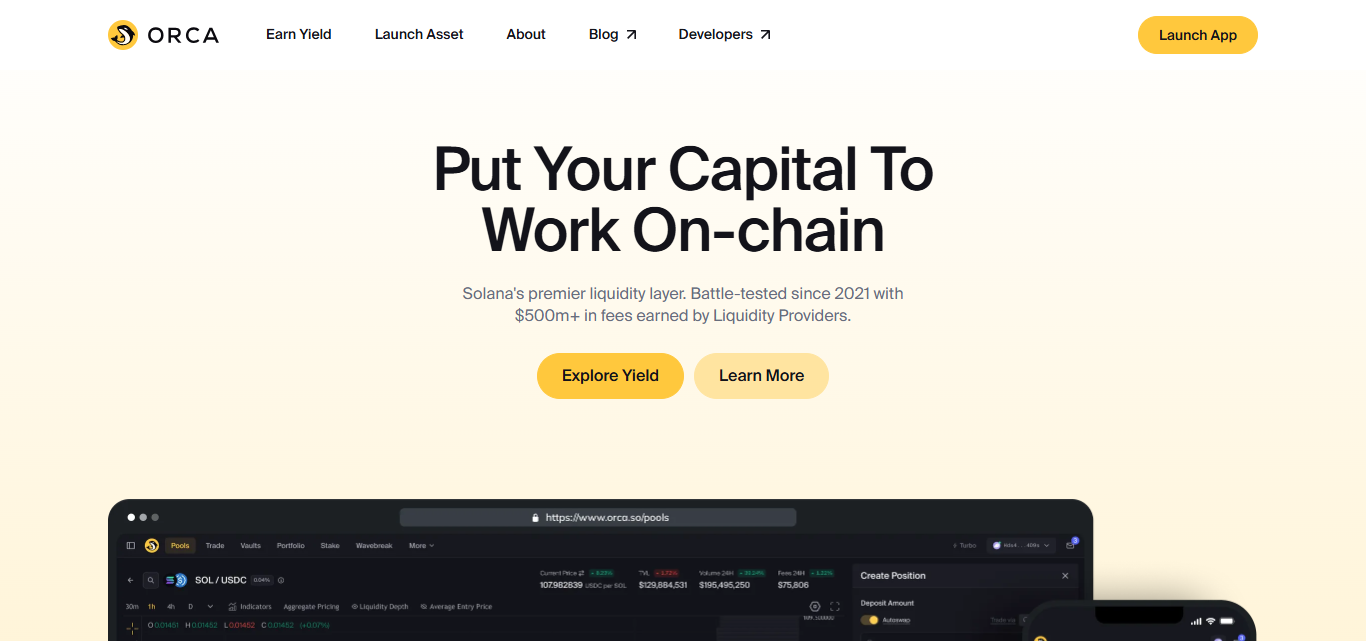

In this article, I’ll be discussing the Best Orca Alternatives for Solana Concentrated Liquidity, including platforms that provide efficient liquidity management, competitive trading fees, and reliable swap execution.
You will learn their main features, supported trading pairs, liquidity pool options, transaction fees, and unique advantages, so you’ll know which platforms provide good alternatives to Orca for decentralized trading on Solana.
Key Points & Best Orca Alternatives for Solana Concentrated Liquidity
| Platform | Explanation |
|---|---|
| Meteora | Offers dynamic liquidity pools, concentrated positions, and customizable fee strategies for Solana liquidity providers. |
| Raydium | Provides concentrated liquidity pools, automated market making, and efficient token swaps across Solana. |
| Jupiter | Aggregates Solana liquidity sources, optimizing token swaps and routing across decentralized exchanges. |
| Lifinity | Uses proactive market making to reduce impermanent loss and improve liquidity efficiency. |
| Phoenix | Delivers on-chain central limit order book trading with transparent execution and efficient settlement. |
| Saber | Specializes in stablecoin swaps, offering low-slippage trading and liquidity opportunities across Solana. |
| Mango | Combines decentralized trading, margin markets, and liquidity tools within the Solana ecosystem. |
| 1inch | Aggregates decentralized exchanges across supported networks to find competitive swap rates and execution. |
| OpenOcean | Connects multiple decentralized exchanges, optimizing swap routes and pricing across supported blockchain networks. |
| PancakeSwap | Provides automated market making, liquidity pools, and concentrated liquidity features across supported networks. |
10 Best Orca Alternatives for Solana Concentrated Liquidity
1. Meteora
Meteora is one of the most powerful options for Solana liquidity providers seeking flexible liquidity management as an alternative to Orca. Its Dynamic Liquidity Market Maker (DLMM) enables providers to allocate capital into particular price bins rather than spreading liquidity across a price curve. This approach delivers capital efficiency, customizable liquidity positions, and dynamic fee mechanisms.
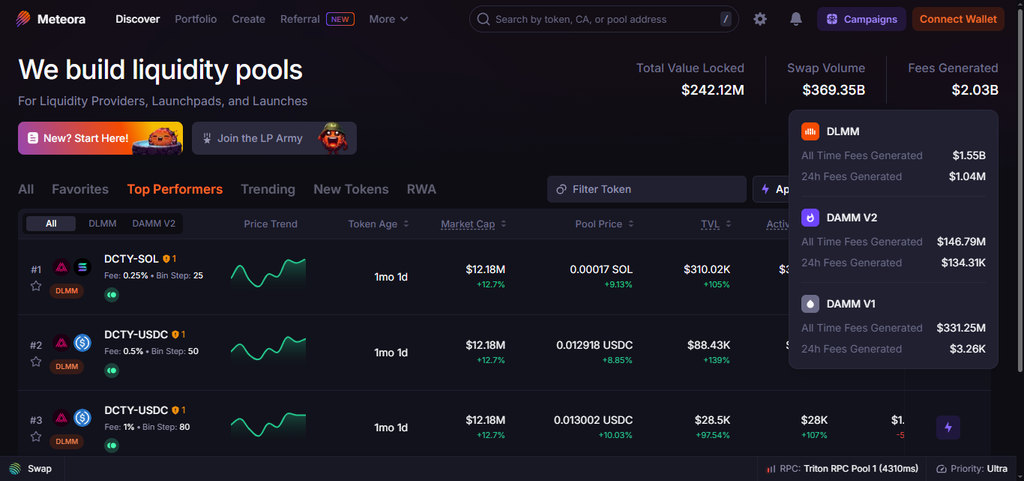
Meteora swaps across different Solana token pairs, and levies fees and transaction fees for supported trading. The fees are pool-specific, and are subject to change depending on market volatility. Traders can earn trading fees by providing liquidity, but profits rely on trading volume, price movements and position management.
Meteora – Key Features
| Features | Explanation |
|---|---|
| Dynamic Liquidity Market Maker (DLMM) | Concentrates liquidity into specific price bins for improved capital efficiency. |
| Dynamic Trading Fees | Adjusts trading fees according to market volatility and liquidity conditions. |
| Flexible Liquidity Positions | Allows providers to choose different liquidity distribution strategies across price ranges. |
| Automated Liquidity Vaults | Offers automated strategies to manage liquidity positions and optimize potential returns. |
2. Raydium
Raydium is a leading Solana DEX that provides automated market-making and concentrated liquidity features. Its Concentrated Liquidity Market Maker (CLMM) enables liquidity providers to select specific price ranges, thus facilitating more efficient capital distribution around active trading prices. The platform also offers traditional liquidity pools and token swaps for a range of Solana assets.
Raydium has different pool fee structures for trading, fees and transaction costs supported based on the selected pool type and configuration. Traders should take liquidity depth, price impact and network fees into consideration before executing transactions. Due to its combination of liquidity pools, token access, and trading tools, it’s a solid Orca alternative.
Raydium – Key Features
| Features | Explanation |
|---|---|
| Concentrated Liquidity (CLMM) | Enables liquidity providers to allocate capital within selected price ranges. |
| Automated Market Maker | Supports decentralized token swaps through automated liquidity pools. |
| Liquidity Pool Creation | Allows projects and users to establish token trading pools. |
| Yield Farming | Provides eligible liquidity providers with additional token reward opportunities. |
3. Jupiter
Jupiter is a leading Solana trading aggregator that pools liquidity from multiple decentralized exchanges. Rather than being a concentrated liquidity pool, it looks across the available trading paths to find good swap prices and execution opportunities. Its routing infrastructure can access liquidity from platforms like Raydium, Orca, Meteora, and other supported venues.
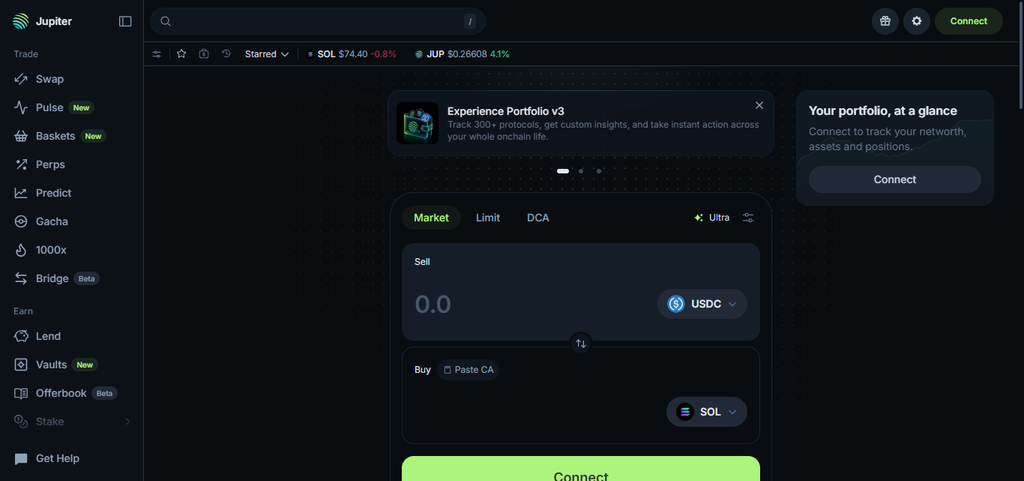
Jupiter allows swapping between a wide variety of Solana tokens for supported trades, fees and transaction costs. Costs are dependent on the chosen route, underlying pool fees and platform fees where applicable. Traders can also compare quoted outputs and potential price impact prior to confirming trades. This is especially helpful for better swap execution instead of managing concentrated liquidity positions directly.
Jupiter – Key Features
| Features | Explanation |
|---|---|
| DEX Aggregation | Connects multiple Solana exchanges to discover competitive token swap routes. |
| Smart Swap Routing | Splits trades across liquidity sources to improve execution efficiency. |
| Price Comparison | Compares available trading routes to identify competitive swap prices. |
| Limit Orders | Allows users to set preferred prices for executing token trades. |
4. Lifinity
Lifinity is a decentralized exchange on Solana, which employs a proactive market-making model to achieve better liquidity efficiency and trading execution. Unlike traditional automated market makers, it also includes oracle-based pricing to help manage price movements and reduce exposure to certain forms of impermanent loss.

The approach is built around keeping prices competitive and allowing efficient token trades. Lifinity supports swaps for supported trading pairs on Solana. Trading fees and transaction costs are determined by the market and pool configuration in effect.
Before providing liquidity, providers should take into consideration the depth of the pool, trading activity, and price risks. The market making mechanism is unique to be compared with orca.
Lifinity – Key Features
| Features | Explanation |
|---|---|
| Proactive Market Making | Uses proactive pricing strategies to improve decentralized trading efficiency. |
| Oracle-Based Pricing | Uses external price information to support accurate market pricing. |
| Impermanent Loss Management | Uses its market-making model to help reduce certain liquidity risks. |
| Capital Efficiency | Focuses liquidity around market prices to improve capital utilization. |
5. Phoenix
Phoenix is a decentralized exchange on Solana built on an on-chain central limit order book (CLOB). This enables traders to place limit orders, trade on transparent market prices and execute trades on a blockchain-enabled trading infrastructure.

Phoenix has an order-book model, where buyers and sellers place orders at certain prices, instead of Orca’s concentrated liquidity pools. Phoenix supports trading markets with maker and taker execution for supported trading,
fees and transaction costs, with applicable trading fees depending on the market and product. Traders should also pay attention to Solana network fees and the order book depth. Phoenix is a good alternative for users who care more about order-based execution than managing concentrated liquidity.
Phoenix – Key Features
| Features | Explanation |
|---|---|
| Central Limit Order Book | Provides on-chain order-book trading with transparent market pricing. |
| Limit Order Execution | Allows traders to submit orders at specific buying prices. |
| On-Chain Settlement | Processes trading operations directly through Solana blockchain infrastructure. |
| Market Transparency | Displays available bids and asks for better trading visibility. |
6. Saber
Saber was an automated market maker on Solana that focused on stablecoin swaps and other similarly priced assets. Its StableSwap mechanism is designed to reduce slippage when trading assets with similar value, such as stablecoins and wrapped or bridged tokens.
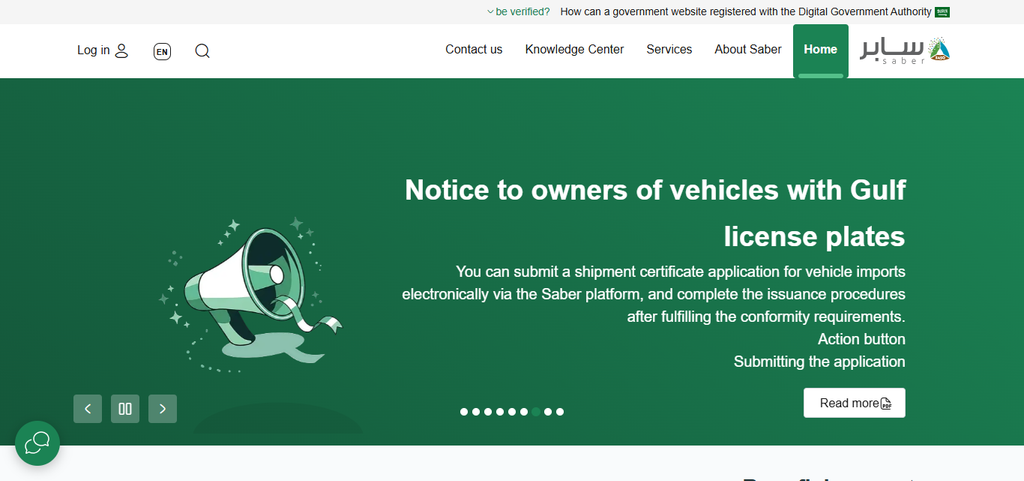
Historically this was helpful for liquidity providers wanting exposure to stable asset trading, rather than volatile token pairs. Originally, its pools were used to support stablecoin and pegged asset markets for the supported trading, fees and transaction costs.
Trading fees are determined by the individual pool configurations. Saber is winding down its DEX operations, but has already told liquidity providers to withdraw funds. So this should be taken as a historical reference and not a live alternative to Orca.
Saber – Key Features
| Features | Explanation |
|---|---|
| StableSwap Mechanism | Historically enabled efficient swaps between similarly priced stable assets. |
| Stablecoin Liquidity Pools | Supported liquidity pools designed for stablecoin trading pairs. |
| Low-Slippage Trading | Its pricing model targeted reduced slippage for pegged assets. |
| Cross-Chain Asset Support | Supported wrapped and bridged assets across connected blockchain ecosystems. |
7. Mango
Mango Markets is a decentralized trading protocol on Solana, historically known for its combination of spot markets, margin trading, lending and perpetual futures. Its infrastructure offers a different trading experience compared to Orca, as it concentrates on order-based markets and leveraged financial products instead of concentrated liquidity pools.

Depending on the protocol services available, traders can explore market access, trading functionality and capital management features. Mango has a history of supporting multi-crypto markets with maker and taker fees
borrowing fees, and other product-specific fees for supported trading, fees, and transaction costs. But check its working condition and services offered before using it. It’s more of a broad DeFi trading comparison, not a direct concentrated liquidity alternative.
Mango Markets – Key Features
| Features | Explanation |
|---|---|
| Margin Trading | Historically supported leveraged trading across eligible cryptocurrency markets. |
| Spot Trading | Provided decentralized spot markets for supported digital assets. |
| Lending and Borrowing | Connected lending and borrowing functionality with its trading ecosystem. |
| Perpetual Futures | Offered perpetual trading products with leverage and collateral management. |
8. 1inch
1inch is a decentralized exchange aggregator that connects traders with a variety of liquidity sources to find competitive swap prices and efficient execution routes. It has several blockchain networks in its ecosystem, including Solana, and it’s useful for people searching for cross-chain DeFi trading opportunities.
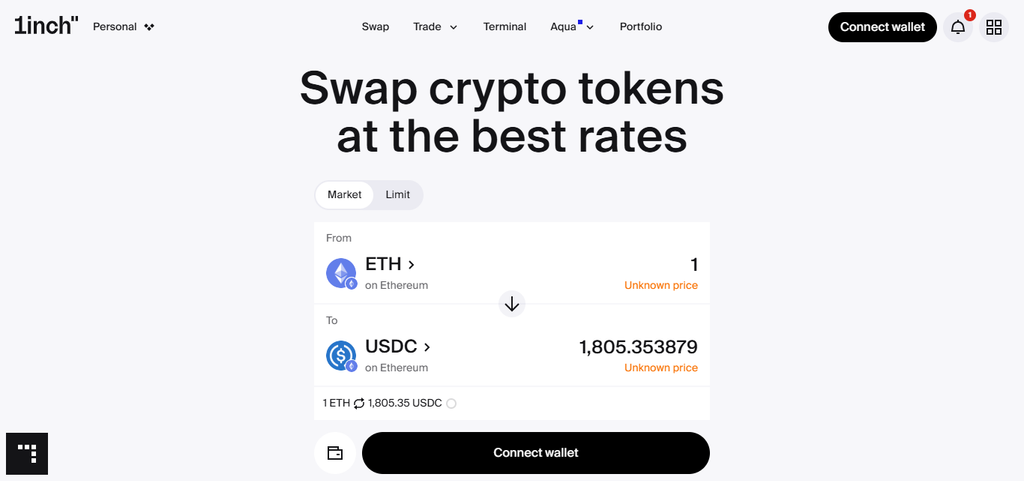
1inch is not a typical concentrated liquidity exchange on Solana, but an aggregation and swap execution protocol.” It has an available integration through which users can access supported Solana token swaps.
Fees and transaction costs for supported trading are applicable based on execution mode, liquidity sources, and network charges. With its routing capabilities, multichain access and non-custodial trading approach it is another option to compare decentralized swap services with.
1inch – Key Features
| Features | Explanation |
|---|---|
| DEX Aggregation | Connects decentralized exchanges to discover competitive token swap opportunities. |
| Pathfinder Routing | Identifies efficient trading paths across supported liquidity sources. |
| Multi-Chain Support | Provides decentralized trading access across multiple blockchain networks. |
| Non-Custodial Swaps | Allows users to execute swaps while maintaining wallet control. |
9. OpenOcean
OpenOcean is a multichain DEX aggregator that aggregates liquidity sources to find the best token swap opportunities. Its Solana integration works as a meta-aggregation service that compares available routes through supported aggregators and liquidity providers.
This allows traders to explore different execution opportunities without manually visiting multiple decentralized exchanges. OpenOcean supports Solana’s token swaps through its aggregation infrastructure for supported trading, fees, and transaction costs without a default
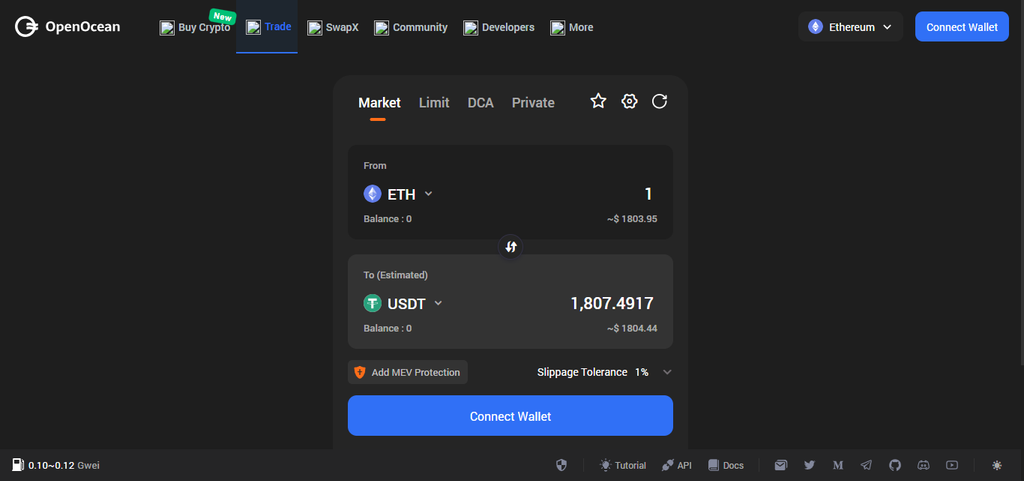
API fee charged on its Solana Swap API. However, underlying execution costs, network charges and any fees payable to integrators may apply. It’s not directly offering concentrated liquidity, but it’s helpful to compare swap execution given its smart routing, cross-chain functionality, and developer APIs.
OpenOcean – Key Features
| Features | Explanation |
|---|---|
| DEX Aggregation | Combines liquidity sources to identify competitive decentralized trading routes. |
| Smart Routing | Searches available trading paths to improve swap execution. |
| Cross-Chain Swaps | Supports token exchange opportunities across supported blockchain networks. |
| Developer APIs | Provides integration tools for decentralized applications and trading platforms. |
10. PancakeSwap
PancakeSwap is a multi-chain decentralized exchange offering automated market-making, token swaps and concentrated liquidity features through its V3 infrastructure. Its launch on Solana gives liquidity providers the chance to take positions in particular price ranges, thereby increasing capital efficiency and the use of liquidity.
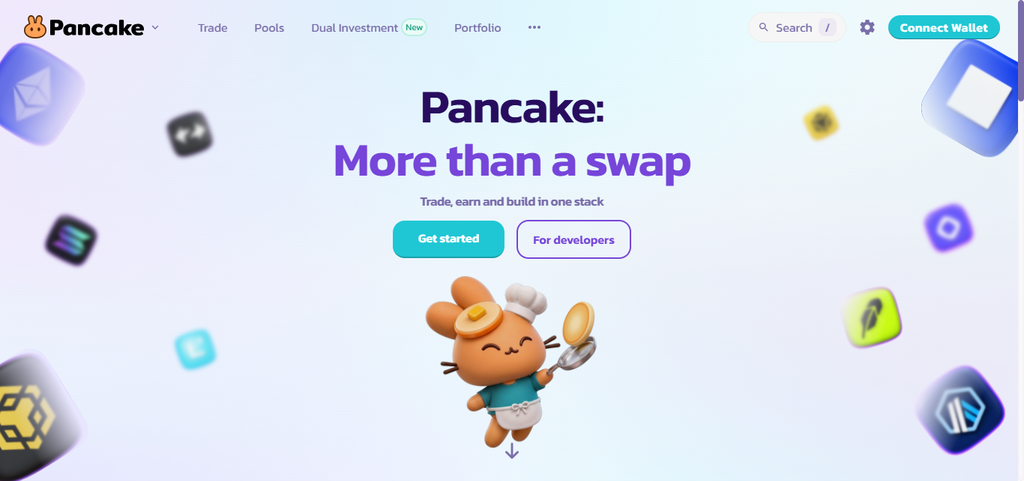
Users can choose from the supported token pairs and determine the liquidity range they would like to trade based on their trading strategy. For supported trading, fees and transaction costs, PancakeSwap Solana V3 has multiple fee tiers ranging from 0.01% to 4% depending on pool configuration.
84% of trading fees are given to liquidity providers, and 16% of trading fees are used for protocol allocations. It’s a direct Orca alternative with its native Solana liquidity pools.
PancakeSwap – Key Features
| Features | Explanation |
|---|---|
| Concentrated Liquidity | Allows providers to allocate capital within selected trading price ranges. |
| Automated Market Maker | Facilitates decentralized token swaps through automated liquidity pools. |
| Multiple Fee Tiers | Offers different trading fee options depending on pool configuration. |
| Liquidity Farming | Provides eligible liquidity providers with additional farming reward opportunities. |
Conclusion
Conclusion Picking the Best Orca Alternatives for Solana Concentrated Liquidity depends on your trading requirements, liquidity management strategies, and transaction costs.
Meteora and Raydium have powerful concentrated liquidity features and Jupiter has efficient swap routing. Evaluate the trading pairs and fees supported, liquidity depth, and platform features to choose the best alternative for your Solana DeFi activities.
FAQ
Meteora offers dynamic liquidity bins, customizable fees, and flexible liquidity strategies.
Yes, Raydium CLMM allows providers to select specific liquidity price ranges.
No, Jupiter aggregates liquidity sources to optimize decentralized token swap execution.
Fees vary across platforms, trading pairs, liquidity pools, and network conditions.